Before you pack them: storing, inspecting, and retiring eclipse viewers
Finding last eclipse’s viewers in a drawer can feel like a small planning victory. But age alone does not tell you whether they are ready for another day in the Sun. Their origin, labeling, storage history, and present physical condition all matter.
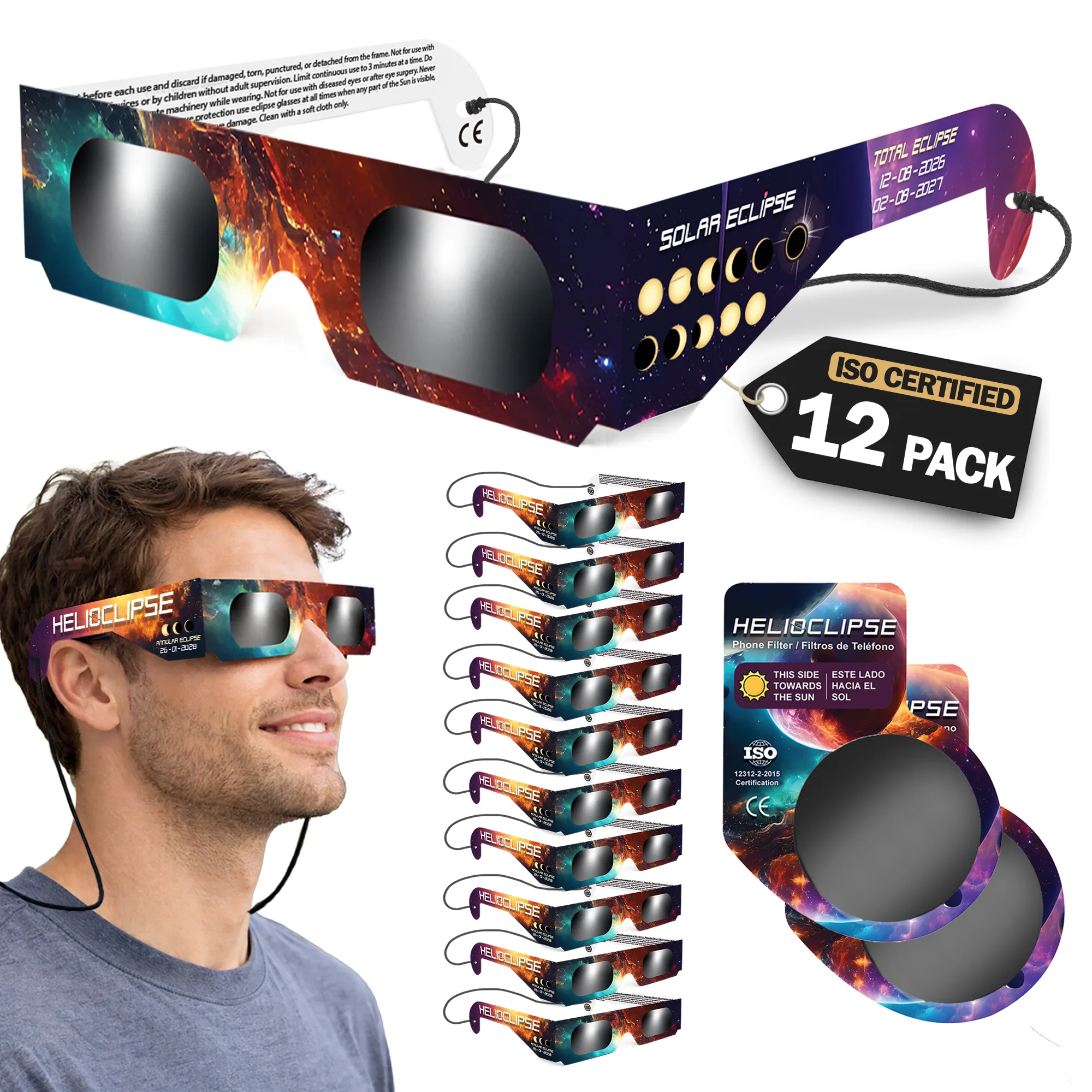
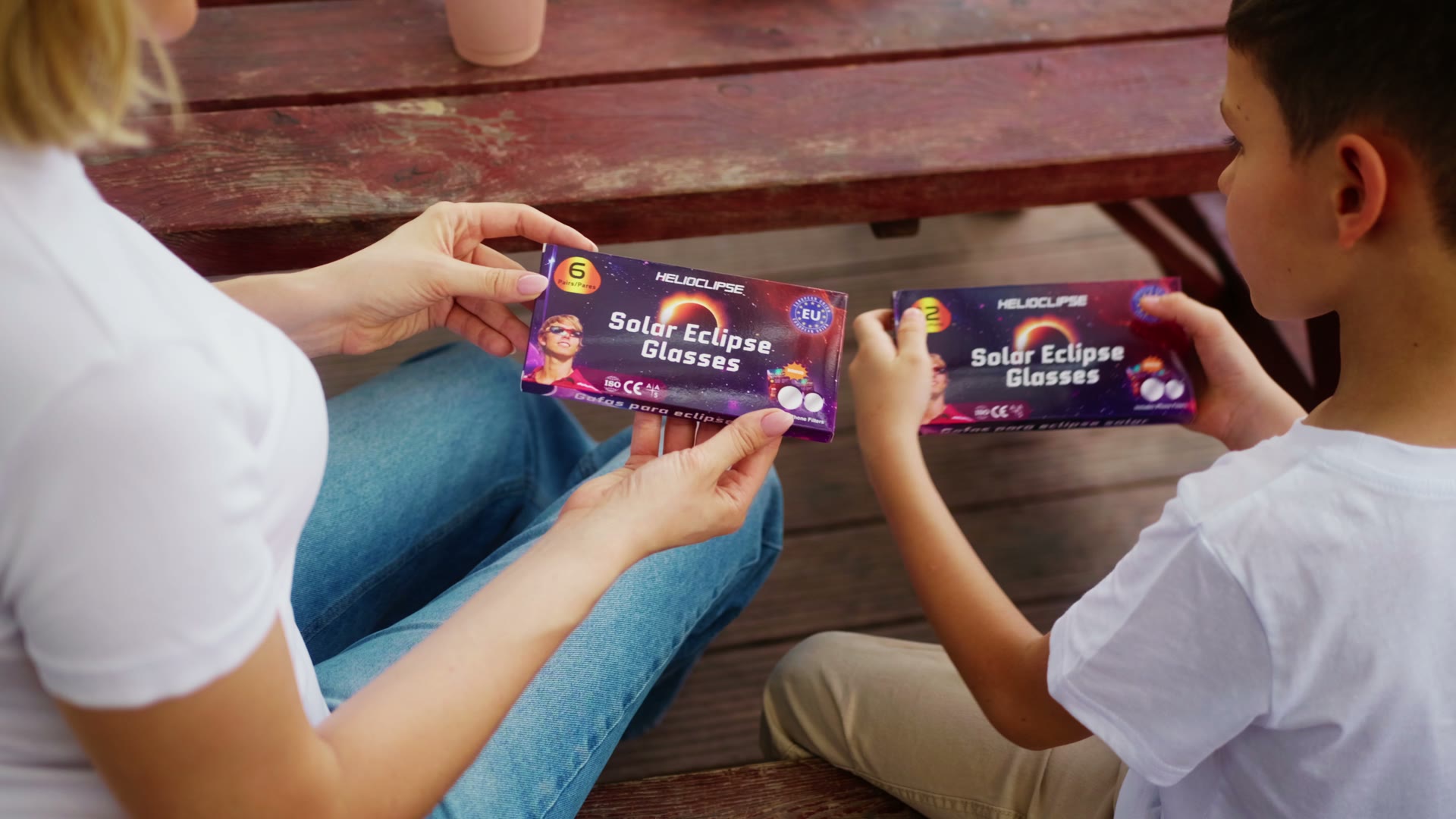
A practical eclipse glasses storage scratches damage routine takes only a few minutes: establish where the viewers came from, examine every filter and frame, retire anything questionable, and protect the approved set until eclipse day. If you need additional pairs for your family, class, or event, arrange ISO 12312-2 certified eclipse viewers from Helioclipse early enough to inspect and organize them before distribution.
Our approach follows manufacturer and institutional guidance on physical damage, eclipse planning, and safe solar observation. The central rule from NASA and the American Astronomical Society (AAS) is refreshingly clear: inspect every viewer before use, and discard it if it is scratched, punctured, torn, or otherwise damaged. Do not improvise a repair and hope for the best.
Why a tiny defect can retire the whole viewer
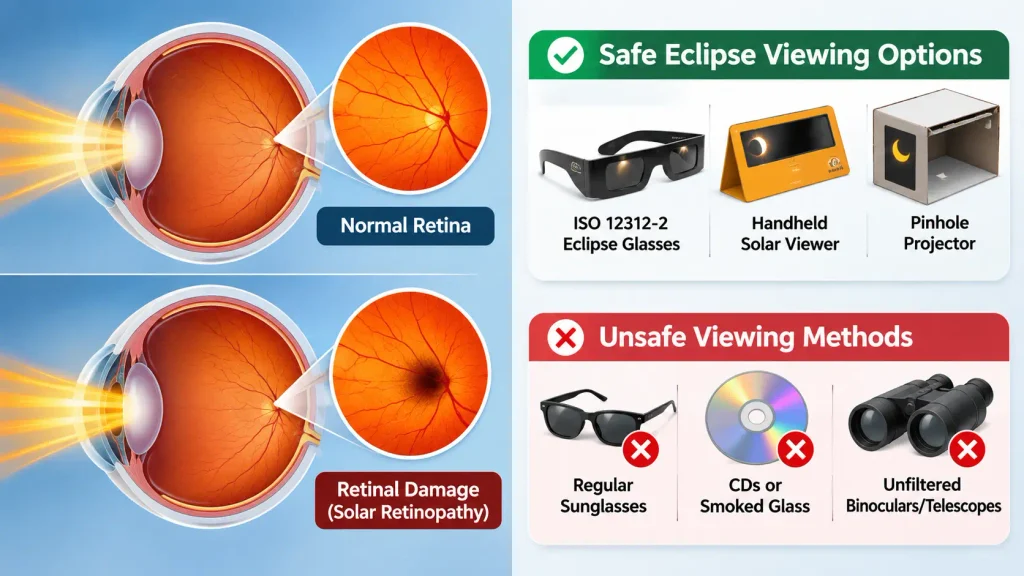
Eclipse glasses are not dark sunglasses. Their specialized filter reduces visible sunlight to a safe viewing level while also controlling ultraviolet and infrared radiation. ISO 12312-2 addresses properties including transmission, filter uniformity, material and surface quality, mounting, and labeling. Our guide to ISO 12312-2 explains what that standard does—and why an ISO mark by itself is not a substitute for trustworthy provenance.
The filter has to remain intact and securely mounted. A puncture creates a direct route for intense sunlight. A deep scratch, torn edge, separated seam, or filter coming loose from its frame means the viewer is no longer in the condition in which it was manufactured and tested. You cannot judge the safety of such a defect merely by deciding that it looks small.
That is why retirement is binary. Do not cover a hole with marker, paint, adhesive, or ordinary tape. Do not glue a loose filter back into a cardboard frame. A patch may hide a defect from casual view, but it does not restore a tested, uniformly protective filter assembly. Place the damaged viewer in a discard container immediately so it cannot drift back into the usable pile.
How long can you keep solar eclipse glasses?
The useful answer to how long can you keep solar eclipse glasses? is not simply “three years” or “forever.” Current AAS guidance says viewers may be reused if they are less than 10 years old, came from a manufacturer whose product was tested by a properly accredited laboratory and found to conform to ISO 12312-2, and remain in excellent condition. The filters must not be scratched, punctured, torn, loose, or otherwise damaged.
Some older viewers carry warnings telling users to discard them after three years or limit each viewing session to three minutes. The AAS describes those warnings as outdated for recently manufactured, compliant viewers in excellent condition. Even so, always follow the instructions supplied with the particular product. If a manufacturer gives a stricter lifespan or use limitation, do not override it with general advice from the internet.
Storage history is equally important. A five-year-old viewer kept flat, dry, and protected in its original envelope may be a better candidate for reuse than one purchased last month and then crushed under camping equipment. If you cannot establish where an old viewer came from, whether it was a genuine tested product, or what happened to it in storage, replacement is the sensible choice. Our guide to spotting fake and low-quality eclipse glasses covers the provenance check in more detail.
Treat an eclipse glasses storage scratches damage 2026 guide as a condition-based process, not permission to keep every old pair until a printed date arrives. Certification and trustworthy origin get a viewer into the inspection queue; they do not excuse damage found later.
Store viewers as protective equipment, not souvenirs
The AAS recommends keeping solar viewers at room temperature in their original case or package, or in another clean, dry container that protects them against scratches and punctures. A rigid document box is useful for a family set. Schools and public events can use shallow, labeled bins with dividers so the viewers lie flat rather than bearing the weight of an entire equipment kit.
Choose a dry indoor cupboard away from direct sunlight, heaters, wet outdoor equipment, food, and craft supplies. Do not leave viewers loose in a car for months, where heat, moisture, grit, and repeated handling can take their toll. Avoid tightly folding cardboard arms across the filter area, fastening rubber bands over the lenses, or packing viewers next to keys, pens, scissors, tripod fittings, or metal tent pegs.
Cardboard viewers need particular protection from moisture. Wet cardboard can swell and allow the filter to detach from its mounting. If a viewer has been soaked, badly warped, or left in conditions that make its integrity uncertain, retire it rather than trying to flatten and reuse it.
For a coordinator, the best places and timing for eclipse glasses storage scratches damage checks are straightforward: use a clean indoor table when the shipment arrives, repeat the inspection before packing, check again as viewers are handed out, and ask users to report any pair dropped, bent, or damaged during the event. The sky may be the destination, but quality control belongs somewhere calm and well lit.
A pre-packing inspection that actually works
Set aside enough time to examine viewers individually. Inspecting the top few pairs in a stack tells you nothing about those underneath, especially if the bundle has been compressed or handled by several groups.
Use this sequence:
- Confirm identity and provenance. Check the manufacturer information, instructions, and ISO 12312-2 labeling. Confirm that the viewers came through a source you trust. A printed standards number is useful information, but counterfeit products can copy printed claims.
- Inspect both sides of the filter. Under good indoor illumination, look for scratches, scuffs, punctures, tears, creases crossing the viewing area, dull patches, peeling layers, or other visible irregularities. Do not stare at the Sun to perform this test.
- Check the mounting. Make sure the filter is securely attached around its perimeter. Retire a viewer if the filter is lifting, sliding, separating from the frame, or exposing a gap.
- Check the frame. Look for water damage, severe warping, crushed bridges, torn arms, staples or sharp edges, and any distortion that prevents the viewer from covering both eyes securely.
- Read the instructions. Keep any age, fit, handling, and use restrictions with the viewers rather than separating packaging from the product.
- Quarantine failures immediately. Mark or destroy discarded viewers so nobody mistakes them for usable spares. Never return a failed pair to the main box.
- Store the accepted set flat and dry. Count it, record the inspection date, and close the container until the next planned check.
Do not aggressively flex, scrape, or rub a filter in an attempt to prove its strength. Inspection should reveal damage, not create it. If you cannot confidently classify a suspicious mark, replace the viewer; a solar eclipse is not the occasion for experimentation with eye protection.
Cleaning without creating new damage
Dust or a fingerprint is not automatically a reason to discard a viewer, but cleaning must be gentle. The AAS says hard-plastic eclipse glasses may come with a microfiber pouch suitable for wiping the lenses. The same kind of soft pouch, a soft nonabrasive tissue, or a suitable nonabrasive cloth may also be used carefully on cardboard viewers.
Keep liquids away from cardboard. Do not use water, glass cleaner, solvents, baby wipes, or other wet wipes on cardboard eclipse glasses or handheld viewers. Moisture can swell the frame and weaken the connection between the cardboard and filter. If contamination cannot be removed with the cleaning method allowed by the manufacturer, replacement is safer than escalating to harsher chemicals or vigorous rubbing.
After cleaning, perform the complete inspection again. Cleaning can expose an existing scratch—or create one if grit was dragged across the surface. A viewer does not pass merely because it now looks less dusty.
Schools, libraries, clubs, and bulk kits need a chain of care
When dozens or hundreds of viewers are involved, damage is often a logistics problem rather than an astronomical one. A box may be opened for a classroom demonstration, moved to another building, compressed beneath books, or distributed by volunteers who have not seen the safety instructions.
Build a simple chain of care:
- Name one person responsible for receiving, counting, and inspecting the shipment.
- Keep the product instructions and purchase records with the master carton.
- Divide viewers into manageable packets without bending their filter areas.
- Add a few inspected spares to each distribution point.
- Give teachers and volunteers a discard container and a one-minute damage briefing.
- Inspect viewers before they reach children, then have an adult check fit and condition again at use time.
- Supervise children throughout direct solar viewing.
- Collect loaned viewers face up rather than cramming them into pockets or a mixed equipment bag.
- Reinspect returned viewers before putting them into long-term storage.
Marketplace terms such as solar eclipse glasses bulk, eclipse viewing glasses, or solar eclipse glasses iso 12312-2 certified describe what buyers hope to find, not proof of testing or present condition. Confirm the product’s provenance and instructions, then inspect every unit. NASA does not approve particular brands of solar viewers, so claims such as “NASA approved” should not be treated as a certification category.
Bulk planning also needs enough redundancy to retire damaged pairs without pressure. If a class has exactly one viewer per child and no spares, a torn filter creates a temptation to share it, patch it, or ignore the defect. A modest reserve turns the correct decision—discard and replace—into the easy decision.
Human behavior is part of the safety plan
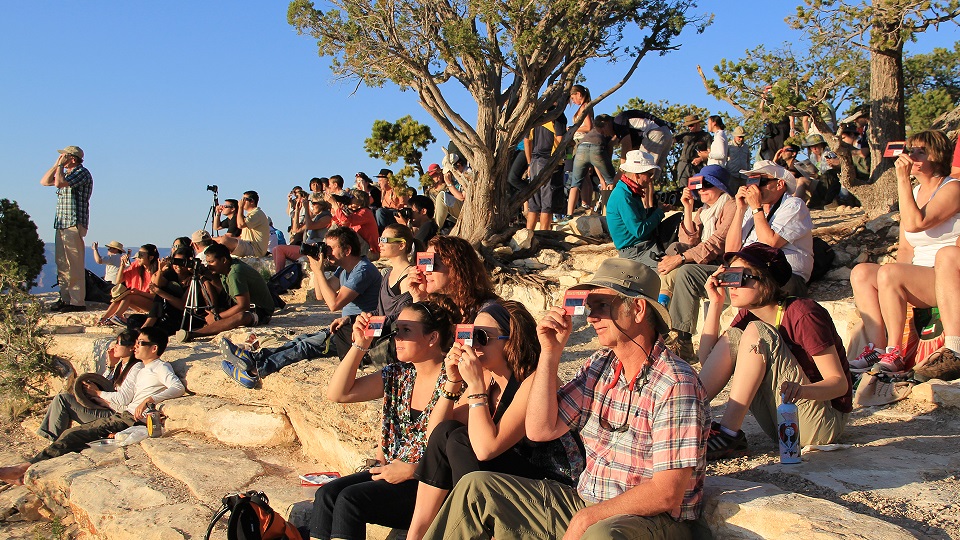
How will an eclipse affect human behavior? People become excited, look upward together, call friends over, pass viewers from hand to hand, and may rush as a dramatic phase approaches. NASA’s eclipse guide notes that crowds often cheer or shout around totality. That shared reaction is part of what makes an eclipse memorable, but it can also disrupt a careful distribution plan.
Prepare before attention shifts to the sky. Tell the group how to put viewers on while looking down, then look up; after viewing, look away before removing them. Explain where damaged viewers should go and where replacements are kept. During a total solar eclipse, viewers stay on throughout the partial phases and come off only when the bright solar face is completely covered for observers inside the path of totality. They go back on as soon as any bright sunlight reappears. During a partial or annular eclipse, there is no glasses-off phase.
Our guide to when eclipse glasses come on and off is worth sharing with teachers, volunteers, and first-time viewers before the event. Rehearsing that sequence once is more effective than shouting instructions over an excited crowd.
Clip-ons, welding filters, and improvised substitutes
What are the disadvantages of clip-on glasses? Ordinary sunglass clip-ons are not solar viewers, regardless of how dark they appear. A purpose-made solar clip-on also needs careful handling: it must be intended for direct solar viewing, conform to the relevant requirements, remain securely positioned, and fully prevent direct sunlight from reaching the eyes. A clip that shifts, fits poorly, or leaves an uncovered line of sight is not acceptable. For people who wear prescription glasses, the AAS advises keeping them on and placing eclipse glasses over them, or holding a compliant handheld viewer in front.
Can i wear welding glasses to see the solar eclipse? Not just any welding glasses. According to the AAS, only a fixed welding filter of shade 12 or higher transmits a sufficiently small fraction of sunlight; shade 13 or 14 generally gives a more comfortable view. Adjustable or auto-darkening welding helmets should not be used because they may not reach a safe shade, could be set incorrectly, or may not darken quickly enough. Purpose-made, traceable eclipse viewers are generally the clearer choice for families and group distribution.
Ordinary sunglasses, exposed film, smoked glass, camera filters, food wrappers, and homemade dark materials are not substitutes. If you do not have a trustworthy direct-viewing filter, use an indirect method such as pinhole projection with your back to the Sun. Look at the projected image, never through the pinhole.
Eclipse glasses must also never be combined with unfiltered binoculars, cameras, or telescopes. Magnifying optics concentrate sunlight and can damage the filter as well as the eye. Optical instruments require correctly fitted solar filters secured over the front aperture and expert guidance.
Unrelated terminology—and the myth of a safe quick glance
An eclipse treatment planning system is medical radiotherapy software and has nothing to do with solar eclipses or protective viewers. Similar wording can appear in technical material, but it provides no guidance about storing, inspecting, or selecting filters for direct observation of the Sun.
There is also no useful “one-second rule.” The question “what if you look at a solar eclipse for 1 second?” starts from a dangerous premise: there is no dependable, universally safe interval for staring at the bright uneclipsed or partially eclipsed Sun. Retinal injury may occur without immediate pain, so a glance feeling comfortable does not prove that it was harmless. Use a compliant, undamaged viewer every time direct protection is required.
If someone notices visual distortion, blind spots, unusual light sensitivity, altered color perception, or other vision changes after looking at the Sun, they should stop observing and seek prompt advice from a qualified eye-care professional. Do not use the affected person’s lack of pain—or another observer’s lack of symptoms—as reassurance.
The retire-or-reuse decision
Reuse is reasonable only when all the evidence lines up: trustworthy origin, appropriate ISO 12312-2 conformity, readable instructions, acceptable age under current manufacturer and AAS guidance, good storage history, an intact frame, a secure mounting, and a filter free from disqualifying damage.
Retire the viewer if any one of those foundations fails. That includes unknown provenance, counterfeit or misleading labeling, punctures, tears, meaningful scratches, moisture damage, severe warping, loose filters, damaged mounting, or uncertainty that cannot be resolved. “Probably fine” is not a safety category.
After the eclipse, do not throw good viewers loose into a souvenir drawer. Inspect them once more, place the accepted set in a clean and dry protective envelope or container, label it with the purchase source and inspection date, and store it flat at room temperature. That small act gives your future self much better information when the next eclipse approaches.
Frequently asked questions
Can I reuse eclipse viewers I saved from a previous event?
Yes, if they are less than 10 years old, came from a source whose product was properly tested for conformity with ISO 12312-2, and remain in excellent condition. Inspect each viewer before use and discard it if the filter is scratched, punctured, torn, loose, or otherwise damaged.
Does the article explain how an eclipse may change people's behavior?
No. The excerpt focuses on inspecting, storing, and retiring solar viewers rather than on human behavior during an eclipse.
What drawbacks should I check for with clip-on solar viewers?
The excerpt does not specifically discuss clip-on viewers. For any solar viewer, the filter must be intact and securely mounted; scratches, punctures, tears, loose filters, separated seams, or other damage require retirement.
What should I do before using an eclipse viewer to look at the Sun?
Inspect every filter and frame before use, and use only viewers with trustworthy origin and appropriate ISO 12312-2 conformity. Do not repair damage with tape, glue, paint, or other materials; place questionable viewers in a discard container so they are not reused.
Is there a safe substitute for a damaged eclipse viewer?
No replacement method for a damaged viewer is described in the excerpt. A patched, glued, or otherwise repaired filter does not restore a tested, uniformly protective assembly, so the damaged viewer should be discarded.
On-site next steps
- Replace damaged or uncertain viewers through the Helioclipse eclipse-glasses shop before group supplies become time-critical.
- Keep new viewers sealed and protected until you can perform a documented inspection and distribution check.
- Use the Helioclipse Eclipse Explorer to confirm whether your location will experience a partial eclipse or totality; that determines whether there is ever a safe glasses-off phase.
- Send the inspection checklist to teachers, relatives, and event volunteers now—not when everyone is already looking up.
Sources & further reading
- American Astronomical Society: Eyewear & Handheld Viewers
- NASA Science: Eclipse Viewing Safety
- NASA educator resource: Eclipse Essentials: Safe and Stylish Solar Viewing Glasses
- Space.com: Is It Safe to Reuse Your Solar Eclipse Glasses?
- Astronomy Magazine: How to observe the Sun safely during a solar eclipse
- American Astronomical Society: How to View a Solar Eclipse Safely
- American Astronomical Society: About the ISO 12312-2 Standard for Solar Viewers
- B. Ralph Chou, via the AAS: Solar Eclipse Eye Safety
- NASA Science: Solar Eclipse Guide
- American Astronomical Society: Eclipse Basics