When glasses on, when glasses off: 2027 eclipse phases for first-time viewers
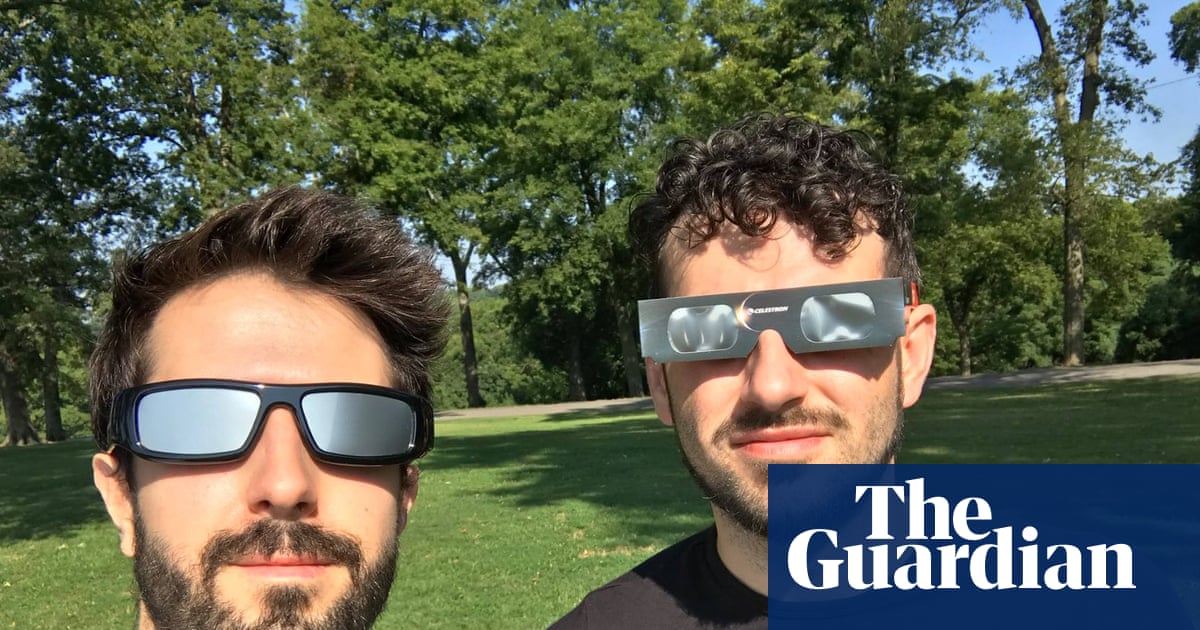
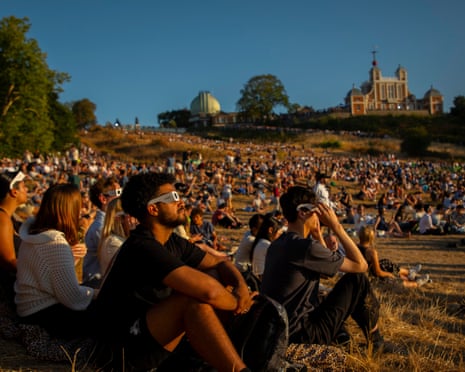
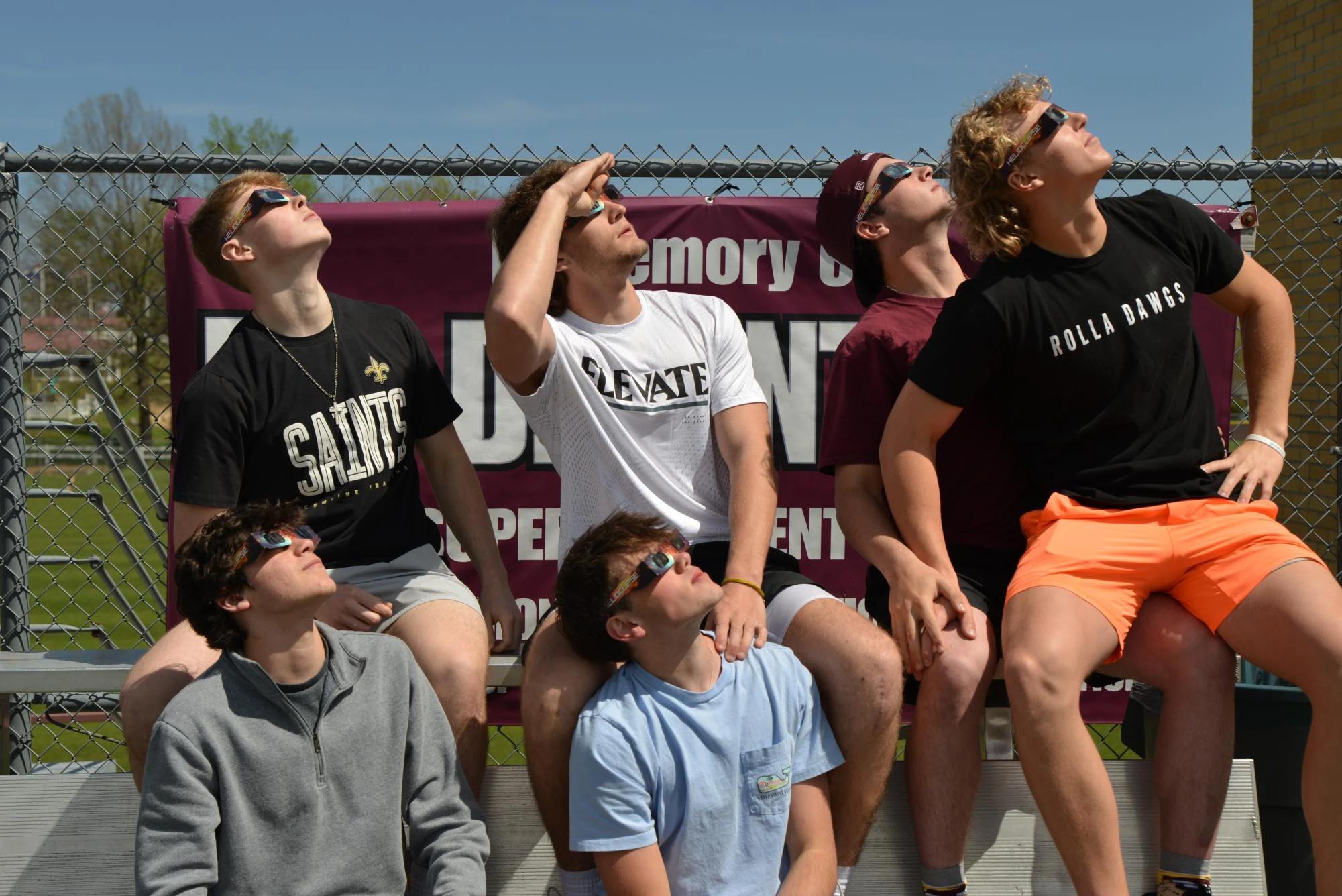
The rule for 2 August 2027 is simple enough to remember in a noisy crowd: glasses on whenever any bright part of the Sun is visible; glasses off only during totality, only inside the path of totality, and only after the last direct sunlight disappears.
That one sentence is the backbone of solar eclipse eye safety phases 2027 planning. It applies whether the Sun looks normal, half covered, reduced to a hair-thin crescent, or almost completely hidden. “Almost” is still a partial eclipse—and a 99.9% partial eclipse is not a safe substitute for totality.
For first-time viewers, the challenge is less about memorizing astronomy than recognizing the transition at the right moment. This solar eclipse eye safety phases 2027 2027 guide walks through that transition, from first contact to the final partial phase. Before choosing an observing site, check its exact position with our Eclipse Explorer and 3D map. Your location determines whether a glasses-off interval exists at all.
The rule to remember before anything else
Safe solar eye safety practice depends on what part of the Sun is exposed—not on how dark the landscape feels or how impressive the eclipse looks.
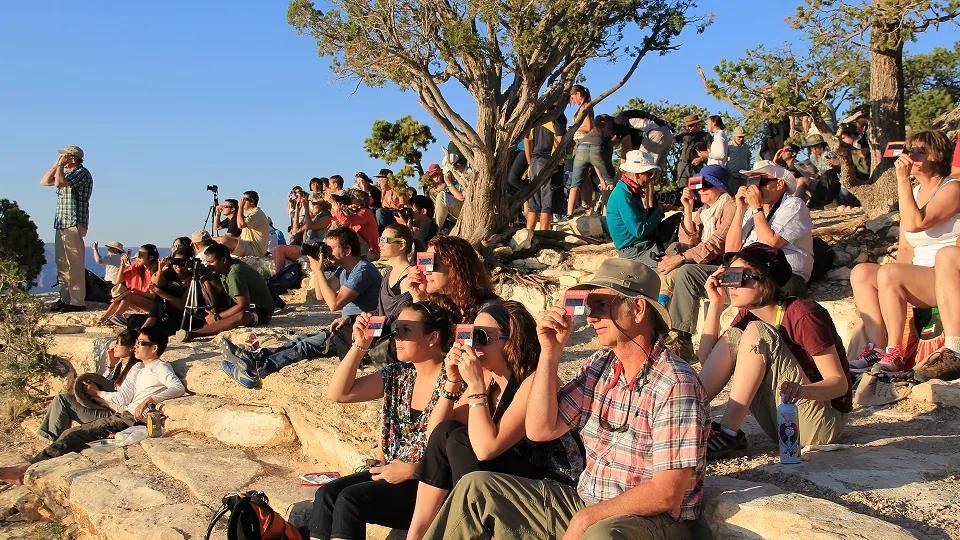
Wear special-purpose solar viewers whenever you look directly at:
- the ordinary uneclipsed Sun;
- any partial phase of a solar eclipse;
- the bright ring of an annular eclipse;
- the Sun before totality begins and immediately after totality ends.
You may look at a total solar eclipse without a solar viewer only when the Moon completely covers the Sun’s bright face. This brief interval occurs exclusively inside the path of totality. If your location is outside that path, keep your viewers on for every direct look, even if 99% or more of the Sun is covered.
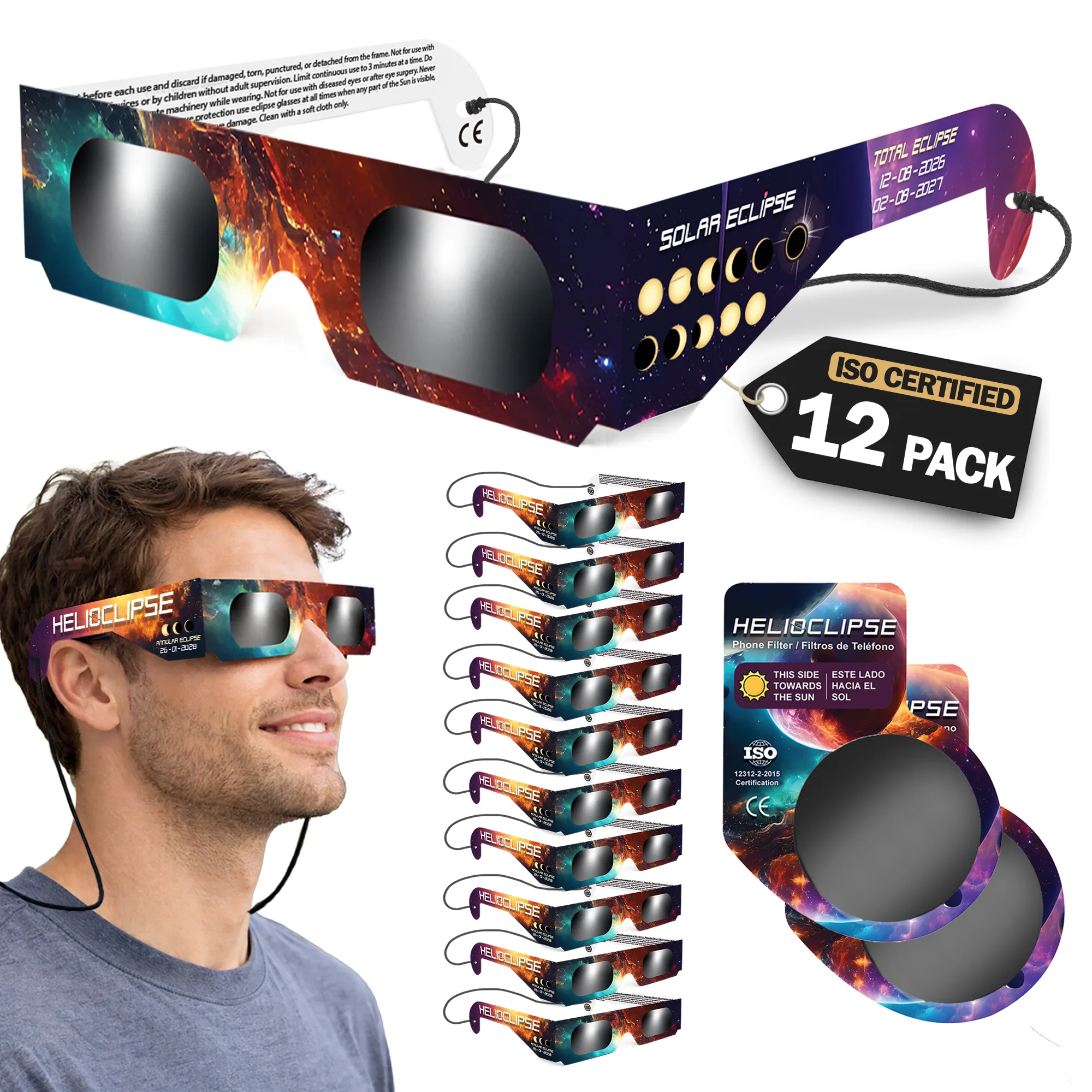
Ordinary sunglasses do not make direct solar viewing safe, no matter how dark they appear. Purpose-made viewers should conform to ISO 12312-2, the international standard applying to filters for direct, unmagnified observation of the Sun. Our guide to ISO 12312-2 and eclipse viewers explains what the standard covers—and why a printed claim should be considered alongside the identity of the supplier, instructions and condition of the product.
Why your location changes the glasses-off answer
The 2 August 2027 eclipse is total only along a relatively narrow corridor crossing southern Spain, Gibraltar, North Africa, the Middle East and portions of the Indian Ocean region. Space.com reports a maximum totality of about 6 minutes 23 seconds and a path roughly 258 kilometres (160 miles) wide at its broadest. Outside that moving lunar shadow, observers see a partial eclipse and never reach a safe glasses-off phase.
The contrast is dramatic. Approximate published circumstances include about 1 minute 52 seconds of totality in Málaga, 2 minutes 51 seconds in Cádiz, 4 minutes 39 seconds in Tarifa and 4 minutes 25 seconds in Gibraltar. Farther east, Luxor receives about 6 minutes 19 seconds near 1:02 p.m. EEST, with the Sun around 82 degrees above the horizon. Our broader 2 August 2027 planning guide covers the event’s geography and practical preparation in more detail.
Meanwhile, Madrid is expected to see roughly 86% of the Sun covered, London about 42%, Paris about 52% and Cairo about 95%. Those are substantial partial eclipses, but there is no totality in those cities. Viewers stay on for every direct look.
Use the Helioclipse Eclipse Explorer as your solar eclipse 2027 path of totality map, zooming to the actual observing site rather than relying on a country-level graphic. The august 2, 2027 solar eclipse path has sharp boundaries: being close to the path is not the same as being inside it, and a small change in location near an edge can substantially alter totality’s duration.
The eclipse phase by phase
Astronomers describe a total solar eclipse using four contacts. You do not need to call them out during the event, but they provide a clean framework for deciding when protection stays on and when it can briefly come off.
Before first contact: glasses on for any direct look
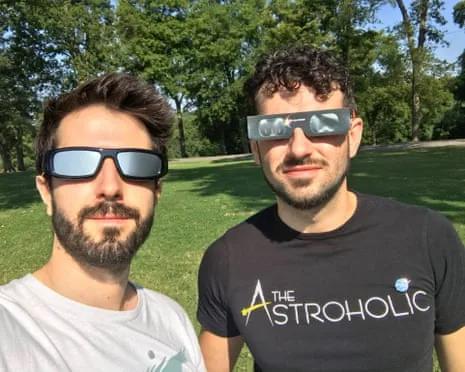
Before the Moon begins crossing the Sun, the Sun is fully exposed. Put your eclipse glasses on before looking up. If you wear prescription glasses, keep them on and place the eclipse viewers over them, or hold a certified handheld viewer in front.
A useful habit is: stand still, look down, place the viewer securely over your eyes, and only then look toward the Sun. When finished, turn away before removing it. Practise this with children in advance so nobody tries to reposition a loose viewer while staring upward.
First contact and the opening partial phase: glasses stay on
First contact, or C1, is the instant the Moon first appears to touch the Sun’s edge. Over the following partial phase, the Moon seems to take an increasingly large bite from the solar disk.
The change starts slowly. Depending on location, the partial phase leading to totality can last well over an hour. Take short looks every few minutes rather than staring continuously. The Moon’s progress will be easier to notice, and a family or classroom can share handheld viewers without rushing.
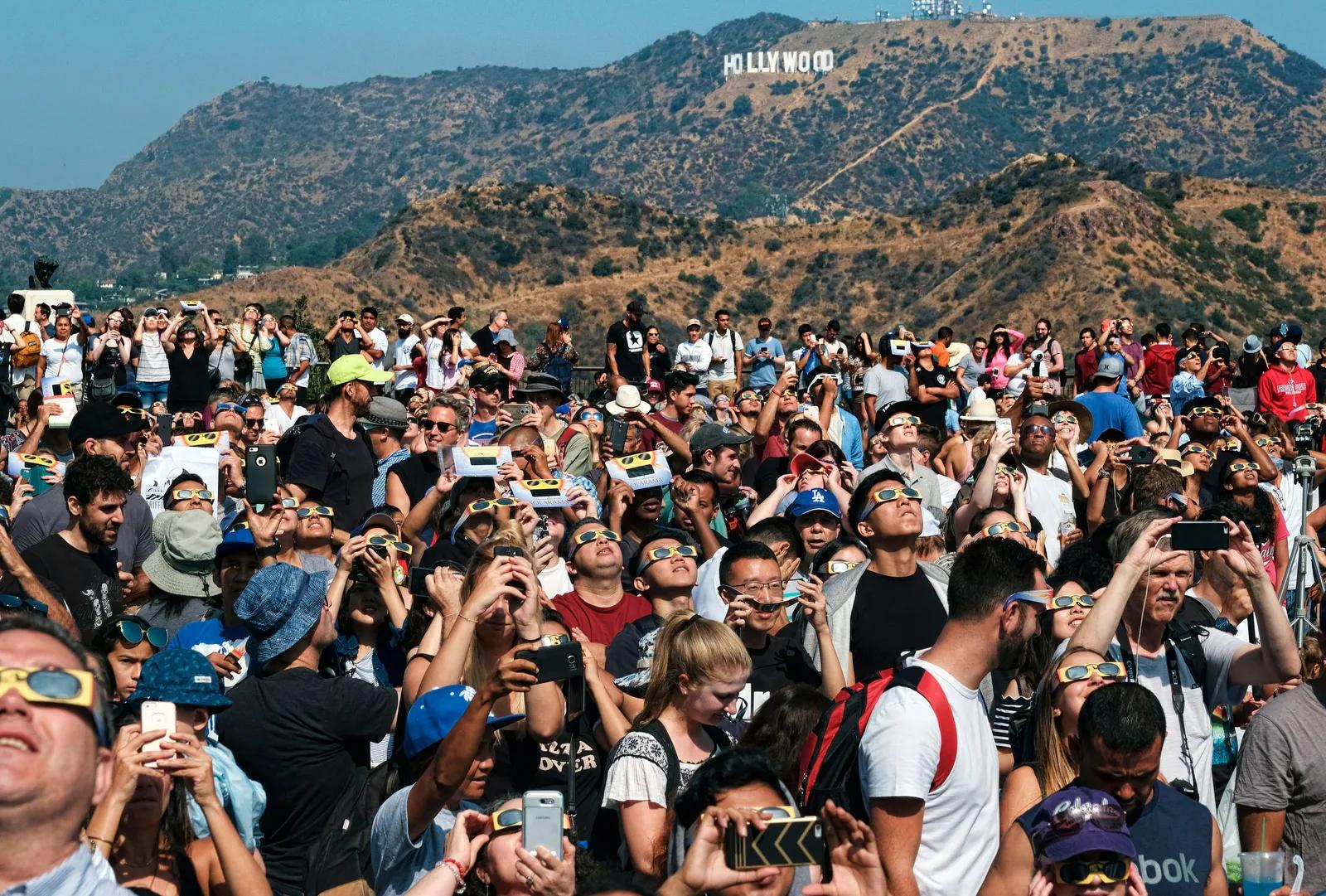
Filters remain on throughout this phase. That is true at 10% coverage, 90% coverage and 99.9% coverage.
The thin crescent, Baily’s beads and diamond ring: keep glasses on
As totality approaches, the daylight may become strangely sharp and muted. Temperatures can fall, shadows sharpen, and tiny solar crescents may appear beneath leafy trees. Near the path’s centre, the approaching lunar shadow can transform the scene rapidly in the final minutes.
None of those environmental cues authorizes you to remove your viewer. Nor does the appearance of Baily’s beads—points of direct sunlight shining through valleys along the Moon’s edge. The brilliant diamond-ring effect is also direct sunlight. Keep your eclipse glasses on while either is visible.
NASA’s operational cue is clearer than trying to judge a percentage: wait until the last bright point disappears and the view through your solar viewer goes dark. That marks second contact, or C2, and the start of totality at your location.
Totality: glasses may come off inside the path
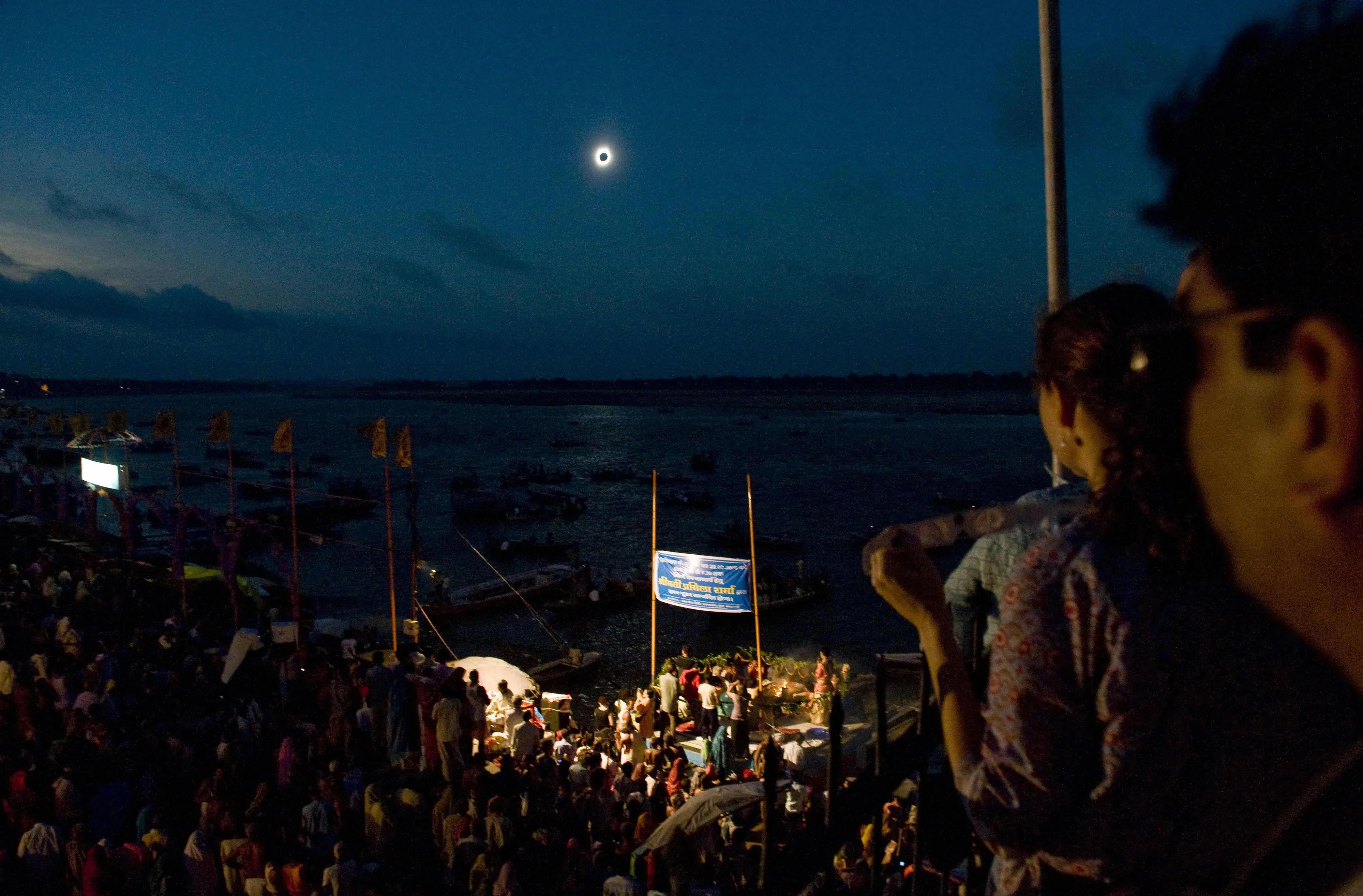
Only after the Moon completely covers the Sun’s bright face may you remove your eclipse glasses and look directly at the totally eclipsed Sun. The black lunar silhouette will be surrounded by the pale corona, the Sun’s outer atmosphere. You may also notice pink chromosphere or prominences around parts of the Moon’s edge, bright planets, and a sunset-like glow around the horizon.
This is the sole glasses-off interval in a solar eclipse. It exists only for observers who are genuinely inside the path of totality. If clouds hide the transition or you are uncertain whether totality has begun, leave your viewers on and follow a trusted event leader or an accurate location-specific contact-time countdown.
Totality’s length varies enormously across the path. A viewer in Málaga has less than two minutes, while someone near Luxor can have more than six. Set a timer or appoint one adult as the group’s safety caller, using verified local contact times rather than the event’s global maximum. Read our focused guide to why totality lasts more than six minutes near Luxor for the geometry behind that exceptional duration.
Third contact: glasses back on before sunlight returns
Third contact, or C3, is the end of totality. A point of direct sunlight is about to reappear from behind the Moon.
Do not wait to test whether that point looks uncomfortable. Put your eclipse glasses back on before the first bright photospheric light returns. An announced countdown is valuable here: “Thirty seconds—viewers ready. Ten seconds—viewers on.” Families and school groups should agree on that procedure before the eclipse starts.
Once the glasses are securely in place, you can watch the diamond ring and Baily’s beads appear in reverse. The landscape brightens quickly, but the eclipse is not over.
The closing partial phase and fourth contact: glasses remain on
After totality, the Moon spends another extended period uncovering the Sun. This is a partial phase, so viewers remain necessary for every direct look.
Fourth contact, or C4, occurs when the Moon’s edge leaves the solar disk and the eclipse ends. There is no special glasses-off reward at that moment: the normal Sun is fully visible again and remains unsafe to stare at directly.
Partial, annular and total eclipses are not interchangeable
The glasses-off exception belongs only to the total phase of a total solar eclipse. It never applies to an ordinary partial eclipse, and it does not apply during the bright “ring of fire” phase of an annular eclipse.
That distinction matters twice in 2027. NASA lists an annular solar eclipse on 6 February 2027, visible as annular from portions of South America and Africa. Even at maximum annularity, a ring of the Sun’s bright surface remains exposed, so filters stay on throughout. On 2 August 2027, a total phase occurs—but only inside its path of totality.
A lunar eclipse is different because you are looking at the Moon, not directly at the Sun. Lunar eclipses require no solar viewers. Solar eclipses occur at new Moon, when the Moon passes between Earth and the Sun; lunar eclipses occur at full Moon, when Earth’s shadow falls on the Moon.
The same safety logic will apply when people study the 2028 eclipse path for the total solar eclipse of 22 July 2028: location and eclipse type determine whether totality occurs, while every partial phase still requires protection.
A first-timer’s glasses-on, glasses-off script
The most useful aas eclipse safety guidance can be turned into a short spoken script. Save it to your phone, print it for a school group or assign it to one person in your party:
- Before looking up: “Viewers on.”
- Throughout both partial phases: “Any bright Sun means viewers stay on.”
- During Baily’s beads and the diamond ring before totality: “Still on.”
- After the final direct sunlight disappears: “Totality confirmed—viewers off.”
- Before totality ends: “Viewers ready, then viewers on.”
- For the entire closing partial phase: “Keep them on.”
The phrase aas eye-safety: filters on for all partial eclipse planning is awkward as prose, but it captures the non-negotiable operational rule: every partial phase requires a proper filter. The related aas eclipse glasses safety guidance adds an equally important action—inspect viewers before use and supervise children.
Online shorthand such as eclipse aas eye safety viewers filters can blur three separate topics. Eye-worn viewers protect direct, unmagnified vision; front-mounted instrument filters protect cameras or magnifying optics; and the timing rule determines when each is needed. Do not treat these products or procedures as interchangeable.
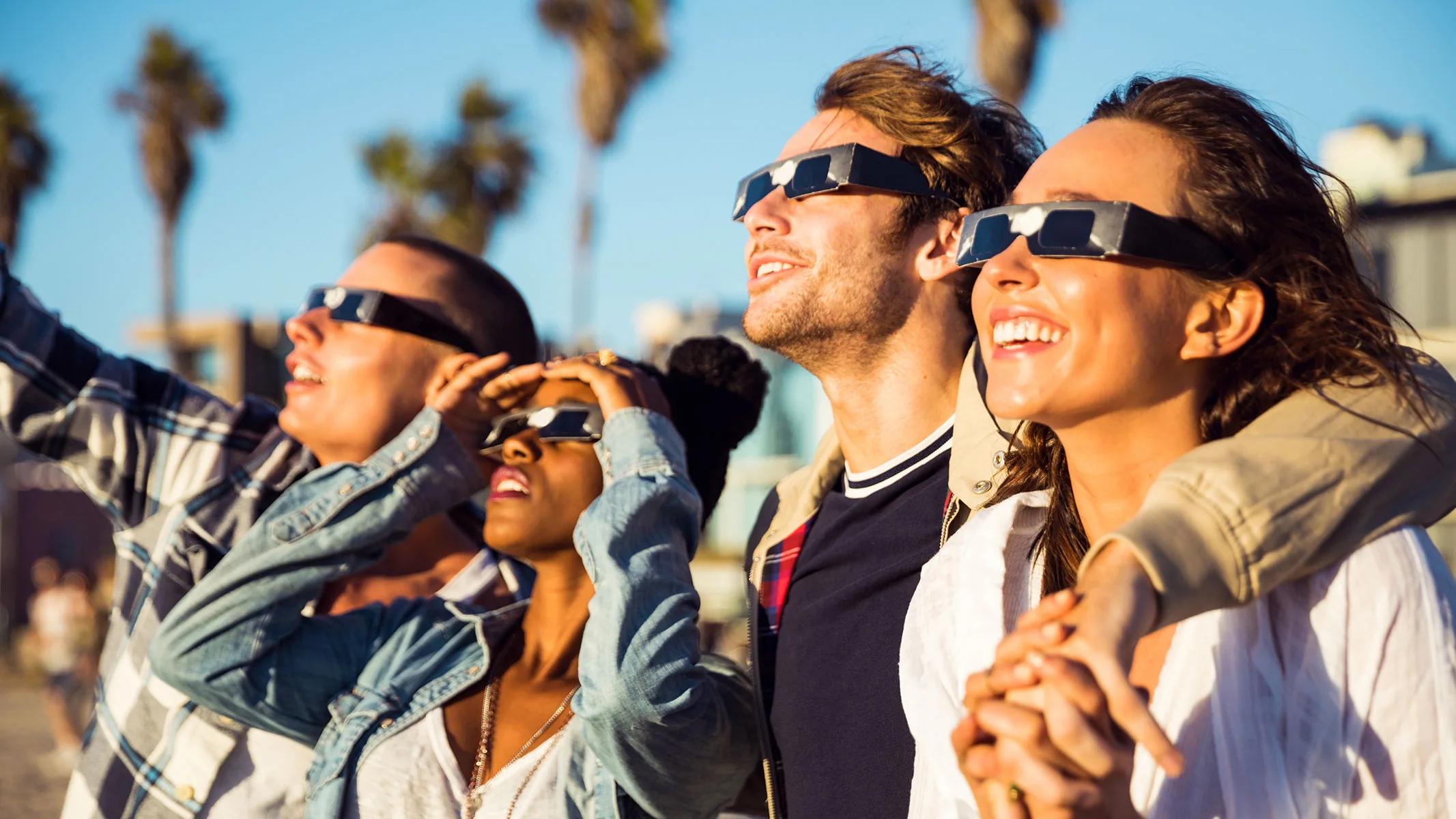
Check the viewers before eclipse morning
Choose special-purpose viewers that conform to ISO 12312-2 and come from a supplier whose identity and product information you can verify. A standard number printed on cardboard is not, by itself, laboratory evidence, so avoid anonymous products with unclear origins or missing instructions.
Marketplace wording can be misleading. “approved solar eclipse glasses” does not identify who performed testing, while “eclipse glasses nasa approved” is especially problematic because NASA states that it does not approve particular brands of solar viewers. More useful product language includes eclipse glasses iso 12312-2 alongside traceable supplier information and clear use instructions.
Inspect every filter before the event. Do not use a viewer if the filter is scratched, punctured, torn, separating from its frame or otherwise damaged. Keep cardboard viewers dry and store them flat in a clean envelope or protective package where keys, grit and luggage cannot scrape them.
The AAS says modern viewers may be reusable when they are less than 10 years old, were shown by an appropriately accredited laboratory to conform to ISO 12312-2, and remain undamaged. Follow the manufacturer’s current instructions as well. When the history or condition of an old viewer is uncertain, replace it rather than improvising a test by looking at the Sun.
To prepare a family, class or viewing party early, visit our shop for ISO 12312-2 certified solar eclipse glasses. Order with enough time to inspect the viewers, read the instructions and practise the look-down/viewer-on/look-up routine before 2 August.
Cameras, binoculars and telescopes need their own filters
Eclipse glasses are designed for direct viewing at normal, unmagnified vision. They are not a substitute for a solar filter on a camera, binoculars or telescope.
During partial phases, any optical instrument aimed at the Sun needs a correctly designed solar filter secured over the front aperture, before sunlight enters the optics. Looking through unfiltered binoculars or a telescope while wearing eclipse glasses is extremely dangerous: concentrated sunlight can damage the viewer and your eyes. Small finder scopes must also be capped, removed or properly filtered.
Instrument setup becomes more complicated inside totality because filters may need to come off at C2 and return securely before C3. Do not improvise that sequence for the first time during the eclipse. Get advice from an experienced solar observer, rehearse without pointing at the Sun, and make unaided enjoyment of totality the priority if operating equipment would distract you from safe transitions.
Phones and cameras can also pull attention away at the exact moment viewers need to go back on. If you want photographs, assign one person to imaging and another to call the safety countdown. A six-minute totality near Luxor offers time, but a sub-two-minute interval in Málaga will vanish quickly.
Safe ways to watch without looking directly at the Sun
Indirect projection is excellent during the partial phases, particularly for young children or anyone who finds wearable viewers uncomfortable. With your back to the Sun, let sunlight pass through small holes in a colander, perforated spoon or card and fall onto the ground or another surface. Each opening projects a tiny image of the crescent Sun.
You can also cross the slightly spread fingers of one hand over the other to make a grid of openings. Trees create the same effect naturally: gaps between leaves project dozens of solar crescents onto the ground.
Do not look through a pinhole at the Sun. The safe image is the projection on a surface. A supervised projection activity also gives a group something to observe between brief direct looks through viewers.
These are among the most practical solar eclipse eye safety tips because they turn safety into part of the experience rather than a restriction. Children can trace the changing crescents, compare their orientation before and after totality, and watch how rapidly the shapes change near the middle of the event.
What authoritative guidance actually says
AAS eye safety guidance and NASA guidance agree on the central distinction: direct viewing without a special-purpose solar filter is safe only during the brief total phase of a total solar eclipse, when the Moon fully blocks the Sun’s bright face.
The solar eclipse eye safety NASA materials also stress that the diamond ring before totality is a viewers-on phenomenon. Once the final glimmer disappears and the solar viewer goes dark, totality has begun. Before bright sunlight reappears at the opposite edge, eye protection must be back in place.
Likewise, solar eclipse eye safety does not change because the remaining crescent looks tiny or the surroundings have become dark. The exposed photosphere remains intensely bright. That is why a city with a 95% partial eclipse follows the same direct-viewing rule as a city with a much smaller partial eclipse.
Your eclipse-day safety checklist
Pack and agree on the procedure before leaving home:
- Verify that your observing point is inside or outside totality using a location-specific map.
- Save the local times for C1, C2, C3 and C4, with the time zone clearly labeled.
- Inspect every solar viewer for damage.
- Bring spare viewers for lost or bent pairs.
- Practise putting viewers on before looking up.
- Assign an adult to supervise children.
- Appoint one person to call the start and end of totality.
- Keep viewers on during all partial phases, Baily’s beads and the pre-totality diamond ring.
- Remove them only after direct sunlight has completely disappeared.
- Replace them before the first bright sunlight returns.
- Use separate, securely mounted front-aperture filters for cameras or magnifying optics.
- If there is uncertainty at any point, keep the viewer on or use indirect projection.
Tell your group this rule now rather than explaining it for the first time amid the excitement. The moment totality arrives, people may cheer, move around or forget a careful plan. A short rehearsal makes the safe action automatic—and leaves everyone free to absorb the corona when it appears.
How to safely watch a solar eclipse
European Space Agency, ESA
Frequently asked questions
How long will the 2026 solar eclipse last?
The provided guidance covers the 2 August 2027 eclipse, not an eclipse in 2026. For 2027, maximum totality is reported as about 6 minutes 23 seconds, but the glasses-off interval exists only within the path of totality and varies by location.
What Moon phase produces a solar eclipse?
The excerpt does not identify the Moon phase associated with a solar eclipse. It explains that totality occurs only when the Moon completely covers the Sun’s bright face for observers inside the path of totality.
Is a solar eclipse visible live today?
The excerpt does not provide information about whether an eclipse is occurring today. It addresses viewing guidance for the 2 August 2027 eclipse, so check the date and your exact location before planning to observe.
Can I make my own solar eclipse viewers?
No homemade viewer instructions are provided in the excerpt. For direct solar viewing, use special-purpose solar viewers that conform to ISO 12312-2, and consider the supplier’s identity, instructions, and the product’s condition.
What solar filter should I use on a camera during an eclipse?
The excerpt does not specify a filter for cameras. Its ISO 12312-2 guidance applies to filters for direct, unmagnified observation of the Sun, so it should not be treated as camera-filter guidance.
On-site next steps
- Choose Helioclipse solar eclipse glasses early enough to inspect them and practise with your group.
- Confirm whether your exact site reaches totality with the Helioclipse Eclipse Explorer; note the local C2 and C3 times rather than relying on a regional estimate.
- Continue planning with the Helioclipse blog and eclipse guides, especially if you are coordinating a family, school or large viewing event.
The memorable version is still the best: any bright Sun, viewers on; complete totality, viewers off; bright Sun returning, viewers on again.
Sources & further reading
- American Astronomical Society: How to View a Solar Eclipse Safely
- American Astronomical Society: Eyewear & Handheld Viewers
- American Astronomical Society: Solar Filters for Optics: Telescopes, Binoculars & Cameras
- American Astronomical Society: About the ISO 12312-2 Standard for Solar Viewers
- American Astronomical Society: Eclipse Basics
- NASA Science: Future Eclipses
- NASA Science: What to Expect
- NASA Science: What to Expect: A Solar Eclipse Guide
- Astronomy Magazine: How to observe the Sun safely during a solar eclipse
- Space.com: Total solar eclipse 2027 — Everything you need to know about the “eclipse of the century”