Luxor, Egypt Solar Eclipse 2027: One City, One Eclipse — 6 Minutes Under an Almost-Overhead Sun
For the Luxor, Egypt solar eclipse 2027, the headline number is extraordinary: roughly 6 minutes 22 seconds of totality on Monday, 2 August. At maximum eclipse, the Sun will stand about 82° above the horizon—only around 8° from the point directly overhead. The temples and tombs of ancient Thebes will be inside the Moon’s umbra, midday will briefly resemble deep twilight, and the solar corona will replace the Sun’s familiar bright face.
Yet Luxor will not be an effortless viewing site. The eclipse arrives close to the hottest part of the day, when August temperatures can reach approximately 42–43°C. Shade is scarce at many archaeological sites, dust may soften the sky even when there is no cloud, and access to famous monuments cannot be assumed. The most important Luxor 2027 eclipse decision is therefore not which ancient backdrop looks best in a photograph. It is where your group can remain safe, shaded and stationary for several hours.
Start by placing your accommodation and candidate viewing area on our Eclipse Explorer and 3D map. A map can show the 2 August 2027 solar eclipse path, your position inside totality and the expected circumstances for a specific point; it cannot guarantee that a roof, temple courtyard or roadside pull-off will be accessible.

Luxor, Egypt solar eclipse 2027: the essential numbers
Location-specific predictions for Luxor put the partial eclipse beginning at about 11:40 a.m. local civil time, maximum eclipse near 1:05 p.m. and the partial eclipse ending around 2:26 p.m. Totality itself lasts about 6 minutes 22 seconds in the city-area calculation published by Timeanddate. Other Luxor-site estimates give approximately 6 minutes 19 seconds, with totality beginning around 1:02 p.m.
Those figures are not necessarily contradictory. A prediction may refer to a different coordinate within the Luxor area, and published clock labels can follow different timezone conventions. The longest duration associated with the wider region—about 6 minutes 23 seconds—occurs near the point of greatest eclipse southeast of the city, not automatically at every hotel, temple or west-bank viewing site.
For practical planning, remember this sequence:
- Partial eclipse begins: approximately 11:40 a.m. local civil time.
- Totality: approximately 1:02–1:08 p.m., depending on the exact site and prediction.
- Maximum eclipse: around 1:05 p.m. locally.
- Totality duration in Luxor: approximately 6 minutes 19 seconds to 6 minutes 22 seconds.
- Partial eclipse ends: approximately 2:26 p.m.
- Solar altitude near totality: about 82°.
Treat these as planning figures, not a second-by-second operating schedule. Confirm your exact coordinate in the Helioclipse map as the event approaches, then compare it with an authoritative local timetable. Also recheck Egypt’s 2027 civil-time rules: a timezone policy change could alter the displayed clock time without changing the astronomical instant.
The distinction between total and partial eclipse matters more than a few seconds of duration. Luxor is inside the umbra, where the Moon completely covers the bright solar photosphere. Cairo, by comparison, is outside totality and is expected to see roughly a 95% partial eclipse. Even 95% is not a dimmer version of totality: a bright portion of the Sun remains visible, the corona does not emerge in the same way, and certified viewers stay on throughout.
Why six minutes changes the experience
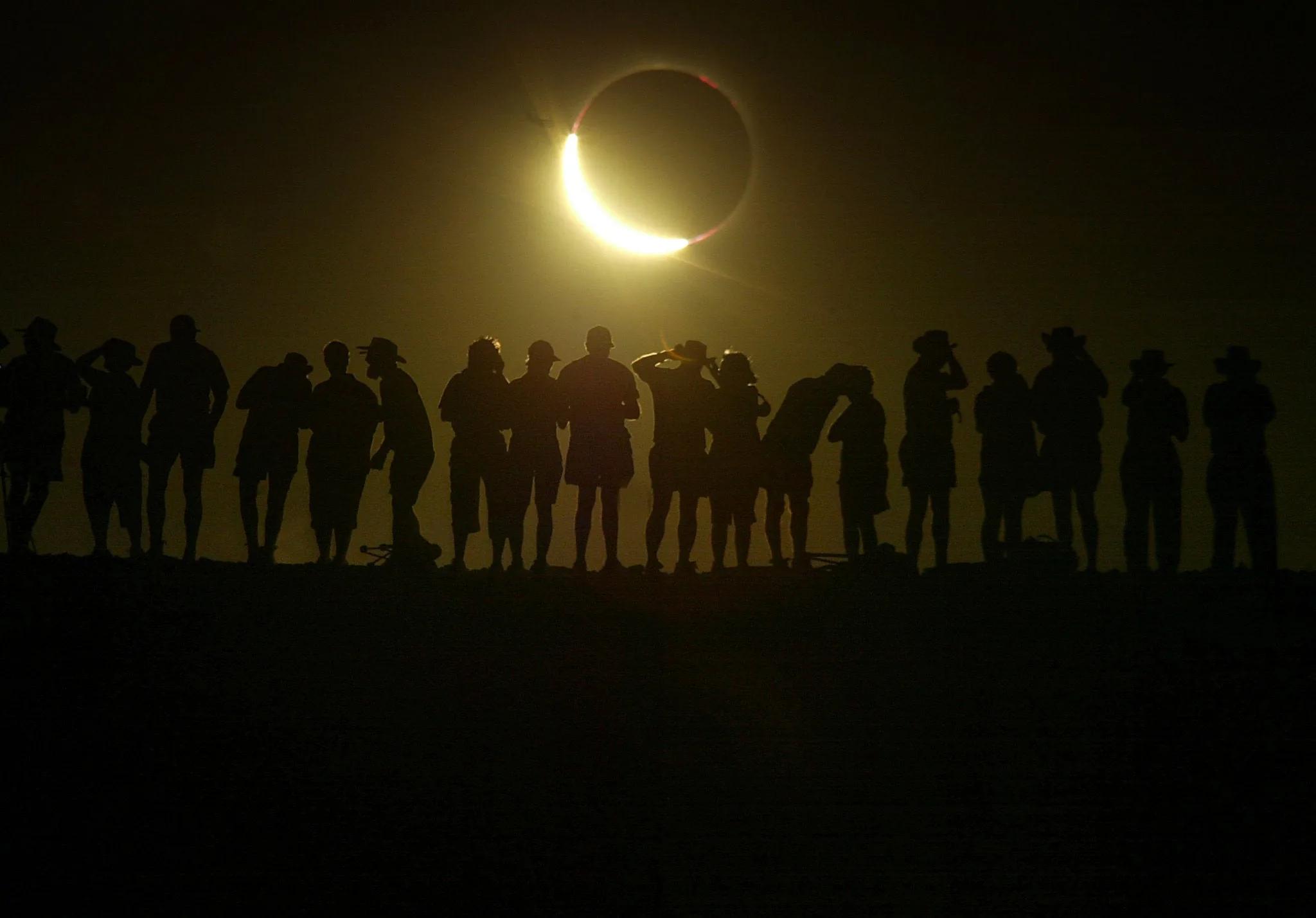
Most total solar eclipses give a fixed observer only a few minutes—or less—inside the umbra. Luxor’s six-plus minutes provide time for the experience to unfold instead of feeling like a single breathless reveal. After the last bright edge of the photosphere disappears, your eyes begin adapting to the darker sky. The corona can show delicate streamers around the black lunar disk, the horizon may glow in warm colors around you, and bright planets or stars may become visible.
The duration comes from unusually favorable geometry. On 2 August 2027, the Moon appears large enough to cover the Sun while its umbral shadow crosses Earth near a region where the eclipse geometry produces a broad, long-lived total phase. The path reaches roughly 258–259 kilometres in width near its broadest portion, and the maximum duration on land is about 6 minutes 23 seconds—the longest land-based totality since 1991 and the longest until 2114.
Luxor is close to that maximum, but chasing one or two extra seconds is usually a poor trade if it costs shade, reliable transport or controlled access. A well-managed site in the city with 6 minutes 19 seconds is better than an uncertain desert location promising 6 minutes 22 seconds. The meaningful contrast is between totality and no totality, not between two safe sites separated by three seconds.
For a wider explanation of the event’s exceptional duration, read our guide to the 2027 “eclipse of the century” near Luxor. Our broader 2 August 2027 planning guide covers the international path and the decisions that should be settled before eclipse week.
An almost-overhead eclipse above ancient Thebes
At roughly 82° altitude, the eclipsed Sun will not sit photogenically beside a temple pylon or low over the Nile. It will be almost overhead. That changes both the physical experience and the way you should assess a site.
A low eastern or western obstruction is unlikely to block the Sun, but walls, awnings, trees and roofs can still matter when the target is only about 8° from the zenith. Stand in the exact place you expect to observe and look nearly straight up. A narrow courtyard that seems open at eye level may have a roof edge, palm canopy or shade cloth directly in the eclipse line.
Luxor occupies the landscape of ancient Thebes on both banks of the Nile. Karnak and Luxor Temple lie on the east bank; the Valley of the Kings, the Temple of Hatshepsut, the Ramesseum, Medinet Habu and the Colossi of Memnon lie to the west. Published site estimates commonly place these landmarks at about 6 minutes 19 seconds of totality, but that astronomical suitability does not establish public access.
The temptation to watch from a world-famous monument will be enormous. Resist building a plan around it until Egyptian authorities or the site operator publish explicit eclipse-day arrangements. Ticket rules, opening hours, crowd limits, security zones and photography restrictions can all change. Some tomb visits also take you underground—the one place you do not want to be when totality begins.
A temple visit before or after eclipse day can still make the event feel rooted in Luxor without turning an archaeological site into a logistical gamble. For totality itself, a managed hotel property, designated gathering area or other authorized open space may offer more useful advantages: controlled entry, drinking water, toilets, emergency support, shade and a short retreat to air conditioning.
Heat is the main planning problem
Luxor’s low summer cloud frequency is one reason the city has become such a compelling eclipse destination. Historical climate analysis suggests that August cloud is uncommon; one cited estimate puts Luxor’s cloud frequency near 0.7%. That is encouraging, not a forecast. Thin cirrus remains possible, and airborne dust or haze can reduce contrast even beneath an otherwise clear sky.
Heat is much more predictable. Daytime temperatures regularly exceed 41°C and may approach 42–43°C around eclipse season. Because the partial phase begins before noon and ends in mid-afternoon, anyone following the complete event could spend nearly three hours in intense sunlight. Totality may cause a noticeable cooling, but six minutes of shade from the Moon cannot reverse the heat accumulated before maximum eclipse.
Build the plan around thermal safety:
- Choose a site with substantial shade available before and after totality, not merely a small umbrella for one person.
- Carry more drinking water than you expect to use, while following current local health guidance on hydration and electrolytes.
- Wear light, loose clothing, a broad-brimmed hat and sunscreen.
- Give children, older adults and anyone with relevant medical conditions an easy air-conditioned retreat.
- Avoid a schedule that combines a long archaeological tour with several hours of stationary eclipse viewing at midday.
- Keep cameras, phones and batteries shaded when they are not in use; heat can trigger shutdowns or shorten battery life.
- Arrange transport that does not depend on crossing the Nile or driving through the city immediately before totality.
Do a timed rehearsal on a previous day. At approximately 1:05 p.m., stand at the proposed site, identify where the Sun is, check the actual shade footprint and walk the route to water, toilets and air conditioning. This simple test reveals problems that no brochure or satellite map can show.
Choose one site—and make it boringly reliable
A successful Luxor eclipse plan should become less adventurous as 2 August approaches. You do not want to be changing banks, negotiating an entrance or sitting in traffic at 12:45 p.m. The Moon’s shadow will not wait for a delayed bus.
Book accommodation early and ask precise questions before treating any rooftop or garden as a viewing site. Is the view of the zenith unobstructed? Will access be guaranteed to registered guests? Is there a capacity limit? Can people remain indoors until shortly before totality? Are tripods allowed? What happens if security restrictions change? A promise that “the eclipse can be seen from the hotel” is less useful than a written description of the designated area.
If you join a Luxor 2027 eclipse tour, examine its operational plan rather than paying only for its astronomy branding. Prices vary too widely for a meaningful universal figure, and premium packages may combine flights, hotels, lectures and monument visits. The essential questions are whether the operator has a confirmed site, heat management, medical support, transport redundancy and a policy for schedule changes.
Independent visitors need the same basics. Share the final location, meeting point and fallback arrangements with everyone in your group before eclipse morning. Download maps and contact details for offline use. Mobile networks may be congested, and a large influx of visitors could strain roads and services. Agree that if someone is separated close to totality, the group will remain at its assigned site rather than launching a last-minute search across the city.
What the sky will do
The eclipse begins quietly. Through a proper solar viewer, the Moon first appears to take a small bite from the Sun. Over the following hour, that bite grows into a narrowing crescent. Because the remaining photosphere is intensely bright, the landscape may still look surprisingly normal until late in the partial phase.
In the final minutes before totality, the light becomes sharper and stranger. Shadows may look unusually crisp. Small gaps between leaves—or holes in a colander held for projection—cast repeated crescent images on the ground. The temperature can fall, animals may react to the sudden dimming, and the western sky may darken as the umbra approaches.
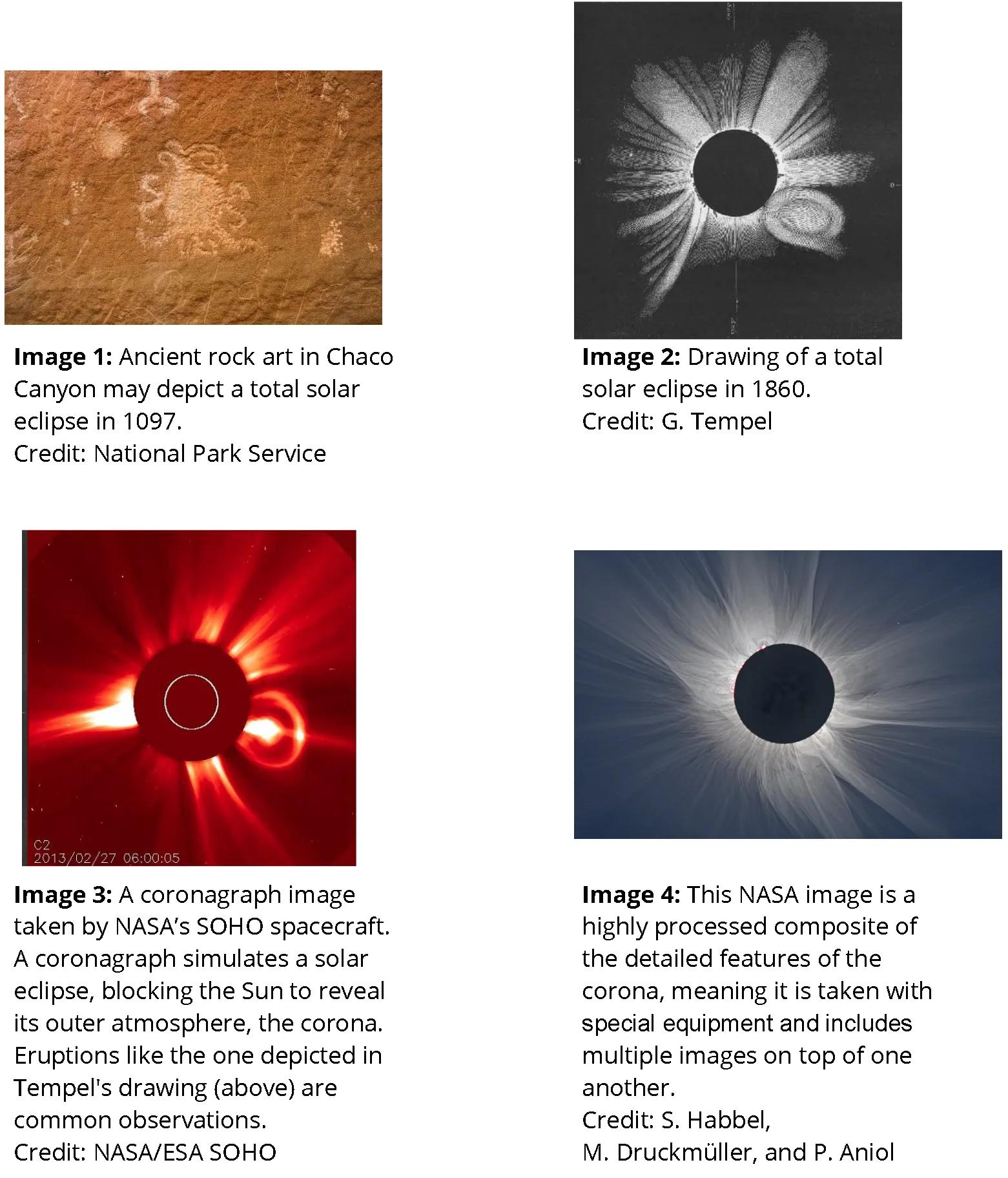
Only when the Moon completely covers the bright face of the Sun does totality begin. The last points of direct sunlight vanish, the corona becomes visible, and the sky turns dark enough for bright celestial objects to emerge. With more than six minutes available, take time to look around as well as up. Notice the horizon, the changing light on the desert and the reactions of the people beside you.
Totality ends when the first brilliant point of photosphere reappears. That moment can be startlingly bright. Solar viewers must go back on immediately, and they remain on for every direct look during the receding partial phase. Our first-timer guide explains when eclipse glasses go on and come off in more detail.
Eye safety without confusion
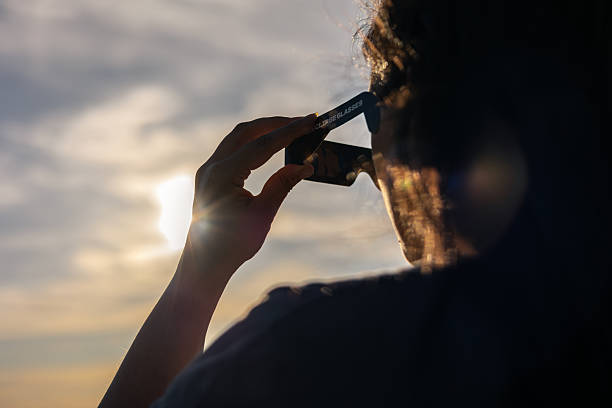
During every partial phase, look at the Sun only through special-purpose solar viewers that conform to ISO 12312-2. Ordinary sunglasses are not suitable, regardless of how dark they appear. Inspect every viewer before use and discard it if the filter is scratched, punctured, torn or separating from its frame. Adults should supervise children and practise the viewing motion with them in advance: cover the eyes, look up, look away, then remove the viewer.
Inside Luxor’s path of totality, unaided viewing is appropriate only after the bright solar photosphere is completely covered. If any bright portion remains, keep the viewers on. As soon as sunlight reappears at the end of totality, replace them immediately. If cloud makes the contact moment difficult to judge, follow trained event staff or keep your viewers on until you are certain totality has begun.
Cameras, binoculars and telescopes require purpose-made solar filters secured over the front aperture of the instrument. Eclipse glasses worn over your eyes do not make it safe to look through unfiltered magnifying optics; concentrated sunlight can damage the viewer and your eyes. Seek expert guidance before attempting telescopic or telephoto solar imaging.
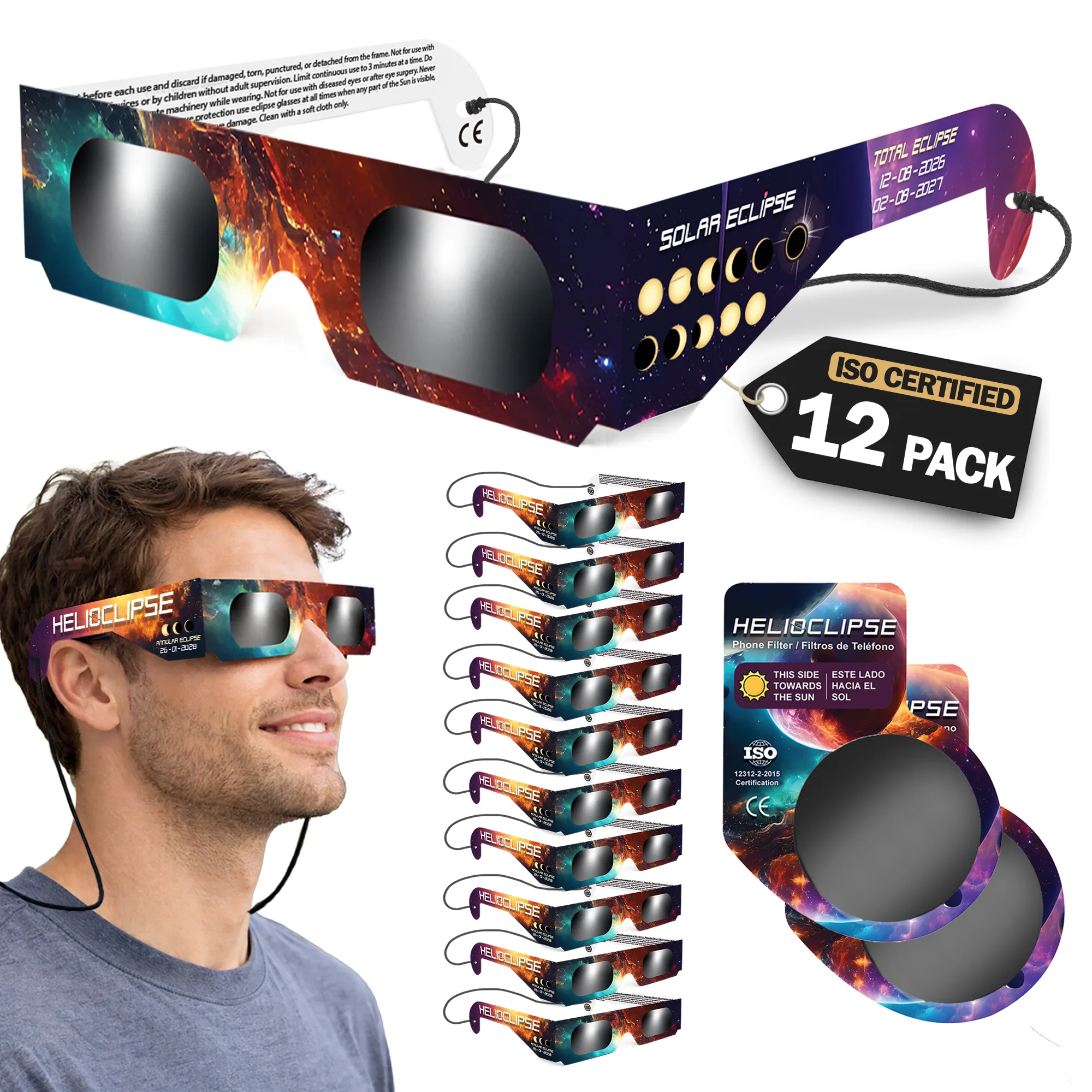
Shopping language can be confusing. Phrases such as solar eclipse glasses iso 12312-2 certified, eclipse viewing glasses and bulk solar eclipse glasses should lead you to check the named manufacturer, usage instructions, filter condition and credible conformity information—not simply trust a marketplace title. NASA does not approve or certify individual viewer brands, so claims of “NASA approved” glasses are a warning sign rather than an official endorsement.
If you are organizing a family, school or tour group, obtain suitable viewers early enough to inspect and distribute them before travel. Our ISO 12312-2 explainer covers what the standard applies to and what a printed claim does—and does not—prove.
A practical Luxor eclipse-day checklist
Before leaving your room
Confirm the site and transport plan with your host or organizer. Check authoritative weather information for dust, wind and exceptional heat warnings, even if the forecast shows no cloud. Charge devices, download offline details and write the maximum-eclipse time somewhere that does not depend on a phone battery.
Pack certified viewers for every person who needs them, plus protected spares. Add water, sun protection, any necessary medication, a light-coloured ground covering and a simple time reference. If you bring camera equipment, pack only filters and mounting systems you have already tested under expert guidance.
At the site
Arrive several hours early if the event organizer recommends it, but spend as much of the partial phase in shade or air conditioning as the site permits. Confirm the nearly overhead sightline, establish a fixed meeting point and tell children exactly who will supervise their viewers.
Set alarms as prompts, not as astronomical authority. Your group should respond to the visible phase of the eclipse and to competent on-site guidance. Do not remove viewers merely because a phone countdown reaches zero.
During totality
Once the Sun’s bright face is completely covered, put down unnecessary tasks. Six minutes sounds long, but camera adjustments, messages and equipment troubleshooting can consume it. Look at the corona, scan the horizon and share the moment with the people who travelled with you.
When the first direct sunlight returns, viewers go back on immediately. Remain mindful of heat after maximum eclipse; the Sun will brighten again while the afternoon temperature remains severe.
The 2027 Solar Eclipse: 6 Minutes 23 Seconds of Darkness ...
Steppe to Stars
Frequently asked questions
Are organized trips available for the 2027 solar eclipse in Egypt?
The excerpt does not confirm whether organized trips will be available. It advises choosing a viewing area where a group can remain safe, shaded, and stationary for several hours, since access to archaeological sites cannot be assumed.
What should I expect to pay for an Egypt eclipse package in 2027?
The excerpt provides no pricing information for travel or viewing packages. Costs would need to be confirmed separately with travel providers and venue operators.
Where is a practical place to watch the 2027 eclipse near Luxor?
Luxor will be inside the path of totality, with totality lasting roughly 6 minutes 19 seconds to 6 minutes 22 seconds depending on the exact location. Prioritize a safe, shaded, accessible place where you can stay for several hours rather than selecting a site solely for its historic backdrop.
How long will totality last in Luxor during the 2027 solar eclipse?
In the Luxor city area, totality is expected to last approximately 6 minutes 19 seconds to 6 minutes 22 seconds. The longest regional duration, about 6 minutes 23 seconds, occurs near the point of greatest eclipse southeast of the city.
What time will the solar eclipse be visible on August 12, 2026?
The excerpt does not provide timing for an eclipse on August 12, 2026. It covers the eclipse on Monday, August 2, 2027, when the partial phase in Luxor is expected to run from about 11:40 a.m. to 2:26 p.m. local civil time.
On-site next steps
- Put your exact Luxor accommodation and proposed observing point into the Helioclipse Eclipse Explorer. Check totality status, duration, solar altitude and the site-specific timing rather than relying on a city label alone.
- Once your group size is settled, order Helioclipse solar eclipse glasses early enough to inspect them, practise with children and pack protected spares.
- Continue planning with our eclipse guides and safety articles, then recheck local access rules, civil-time conventions and official Egyptian announcements close to departure.
Sources & further reading
- August 2, 2027 Total Solar Eclipse in Luxor, Egypt — Timeanddate
- The 2027 total solar eclipse will plunge these 10 ancient Egyptian temples and monuments into darkness — Space.com
- Total solar eclipse 2027 — Everything you need to know about the “eclipse of the century” — Space.com
- Luxor 2027: A Total Solar Eclipse for the Ages — Sky & Telescope
- Six-minute “eclipse of the century” is coming to the Valley of the Kings — CNN
- Future Eclipses — NASA Science
- Eclipse Viewing Safety — NASA Science
- How to View a Solar Eclipse Safely — American Astronomical Society
- About the ISO 12312-2 Standard for Solar Viewers — American Astronomical Society
- Eclipses and the Moon — NASA Science