Your first total solar eclipse: a calm, plain-language primer for 2026
A total solar eclipse asks you to keep two ideas in your head at once. The first is wonderfully simple: for a few minutes, the Moon covers the Sun and reveals the pearly solar corona. The second is practical: that transformation happens only inside a narrow moving shadow, and reaching it safely takes more planning than looking up a solar eclipse time.
The total eclipse of August 12, 2026 has now passed. Its path crossed northern Russia, Greenland, western Iceland, the North Atlantic, northern Spain and a small corner of northwestern Portugal. Much of Europe, northern North America and northwestern Africa instead saw a partial eclipse. This primer preserves what first-time viewers needed to understand and, just as importantly, the lessons that apply to the next total eclipse you plan to see.
If you are reconstructing where the 2026 shadow went—or testing a location for a future event—start with our Eclipse Explorer and 3D map. A country name is not precise enough: your pin must be inside the path of totality, with the Sun visible above the local horizon.
The one distinction that changes everything
A total solar eclipse occurs when the Moon completely covers the Sun’s bright surface. The Moon’s dark inner shadow, the umbra, touches only a narrow corridor on Earth. If you stand within that corridor at the correct time, daylight collapses into an extraordinary twilight and the Sun’s faint outer atmosphere—the corona—appears around the black lunar silhouette.
Outside the umbra, the Moon covers only part of the Sun. That is a partial solar eclipse, even where 99% or more of the solar disk is obscured. Madrid and Barcelona both experienced approximately 99% coverage in 2026, yet neither had totality. The remaining sliver of photosphere was still bright enough to hide the corona and require proper solar viewers throughout.
An annular solar eclipse is different again. The Moon passes centrally across the Sun but appears too small to cover it, leaving a brilliant ring. There is no safe glasses-off interval during annularity. A lunar eclipse is a separate geometry altogether: Earth’s shadow falls on the Moon, and ordinary naked-eye viewing is safe.
This answers the crucial planning question: where must you be in order to see a total solar eclipse? You must be inside the calculated path of totality, not merely in a country or region advertised as an eclipse destination. The 2026 path was about 293 kilometres wide at its broadest, but boundaries and duration varied along the route. Moving a modest distance could change a short totality into a longer one—or turn it into no totality at all.
What happened on August 12, 2026
The 2026 total solar eclipse time and date depended on location, but the calendar date was August 12 everywhere along the total-eclipse route. The Moon’s shadow first crossed remote Arctic territory, swept over eastern Greenland and western Iceland, traversed the North Atlantic, and reached Spain in the evening. Maximum totality anywhere on Earth was about 2 minutes 18 seconds.
In western Iceland, totality occurred with the Sun roughly 25 degrees above the western sky. Reykjavík experienced about 1 minute 1 second beginning around 5:48 p.m. GMT, while the Snæfellsnes area near Snæfellsjökull reached approximately 2 minutes 10 seconds around 5:45 p.m. The Sun was comfortably higher than it was later in Spain, but Atlantic cloud was the major uncertainty.
Spain offered a different trade-off: generally better historical August cloud prospects in some inland areas, but a much lower Sun. Gijón had about 1 minute 46 seconds of totality near 8:26 p.m. CEST, with the Sun approximately 10 degrees above the west-northwestern horizon. Burgos had roughly 1 minute 44 seconds near 8:28 p.m., with an altitude of about 8 degrees. León’s total phase ran approximately from 8:28 to 8:30 p.m. local time.
Farther east, the geometry became increasingly unforgiving. Mallorca had about 1 minute 36 seconds near 8:31 p.m., but the eclipsed Sun was only around 2.7 degrees above the horizon. A ridge, building, tree line or haze bank could therefore decide the entire experience. Valencia’s totality lasted roughly a minute, after which the remaining partial phase continued toward sunset.
The 2026 total solar eclipse locations were therefore not interchangeable. Iceland offered a higher Sun and longer duration in selected western areas but substantial cloud risk. Inland northern Spain often offered better climatological odds, yet required a clean western horizon. Islands and Mediterranean coasts could frame the eclipsed Sun dramatically, but low altitude made small obstructions consequential.
Archived resources may still be labeled next total solar eclipse 2026 map, even though the event is now historical. Such a map remains useful for understanding path geometry, but it should not be mistaken for live planning information about a future event.
Why 99% is not “almost the same” as totality
The difference between 99% partial coverage and totality is not one percentage point of spectacle. It is a change of state.
At 99%, a thin piece of the Sun’s photosphere remains exposed. That sliver is intensely bright, the corona stays overwhelmed by glare, and you must continue using safe solar viewers. At totality, the final bright bead disappears, the corona becomes visible, the horizon may glow in every direction, and the landscape falls into an unfamiliar twilight. Planets or bright stars can emerge. People who were chatting moments earlier often become very quiet—or very loud.
The contrast was especially instructive in Spain. Madrid reached approximately 99% coverage but remained outside totality. Barcelona was also close to 99%, while cities including León, Burgos and Zaragoza lay inside the total path. “Nearly total” was still a deep partial eclipse, not a shorter version of the total experience.
The same principle applied elsewhere. London saw about 91% of the solar disk covered, Dublin about 94%, Paris roughly 92%, Berlin about 85% and Lisbon about 95%. Those were substantial partial eclipses, but certified viewers remained necessary from beginning to end. In North America, coverage was much lower: NASA listed about 37% for Fairbanks, 24% for Bangor, Maine, 16% for Boston and 9% for New York City.
For a deeper path briefing, see our August 12, 2026 planning guide. Its broader lesson survives the date: always check whether your exact coordinates are inside the umbra.
The eclipse unfolded slowly—until it suddenly did not
A total eclipse is not a two-minute event. The partial phases commonly extend for more than an hour on either side of totality. At first contact, the Moon takes a tiny bite from the solar disk. Through a proper viewer, that notch grows into a deep crescent while ordinary daylight changes almost imperceptibly.
Later, the surroundings begin to feel different. Shadows sharpen because the Sun has become a narrow light source. Gaps between leaves project dozens of crescent Suns onto the ground. The light can look metallic or strangely desaturated, the temperature may fall, and animals may respond as if evening has arrived.
In the final moments before totality, sunlight shines through valleys along the Moon’s edge, creating Baily’s beads. The last bright point forms the diamond-ring effect. Only when the brilliant solar surface is completely hidden does totality begin.
During totality, the black Moon is surrounded by the corona. Red prominences may appear along its edge, and a sunset-like glow can ring the horizon. But the interval is short: most locations in the 2026 path received less than two minutes. The first reappearance of the bright Sun ended the unaided view immediately.
A first-timer should not try to photograph everything. Pick two or three priorities before the event: look at the corona, glance at the horizon, notice the people beside you, and put your viewer back on as soon as sunlight returns. Our phase-by-phase guide explains when glasses stay on and when they may come off.
The calm eye-safety rule
The rule is short enough to rehearse with your whole group:
- Partial phase: viewers on.
- Genuine totality, from inside the path: viewers may come off.
- First returning sunlight: viewers on immediately.
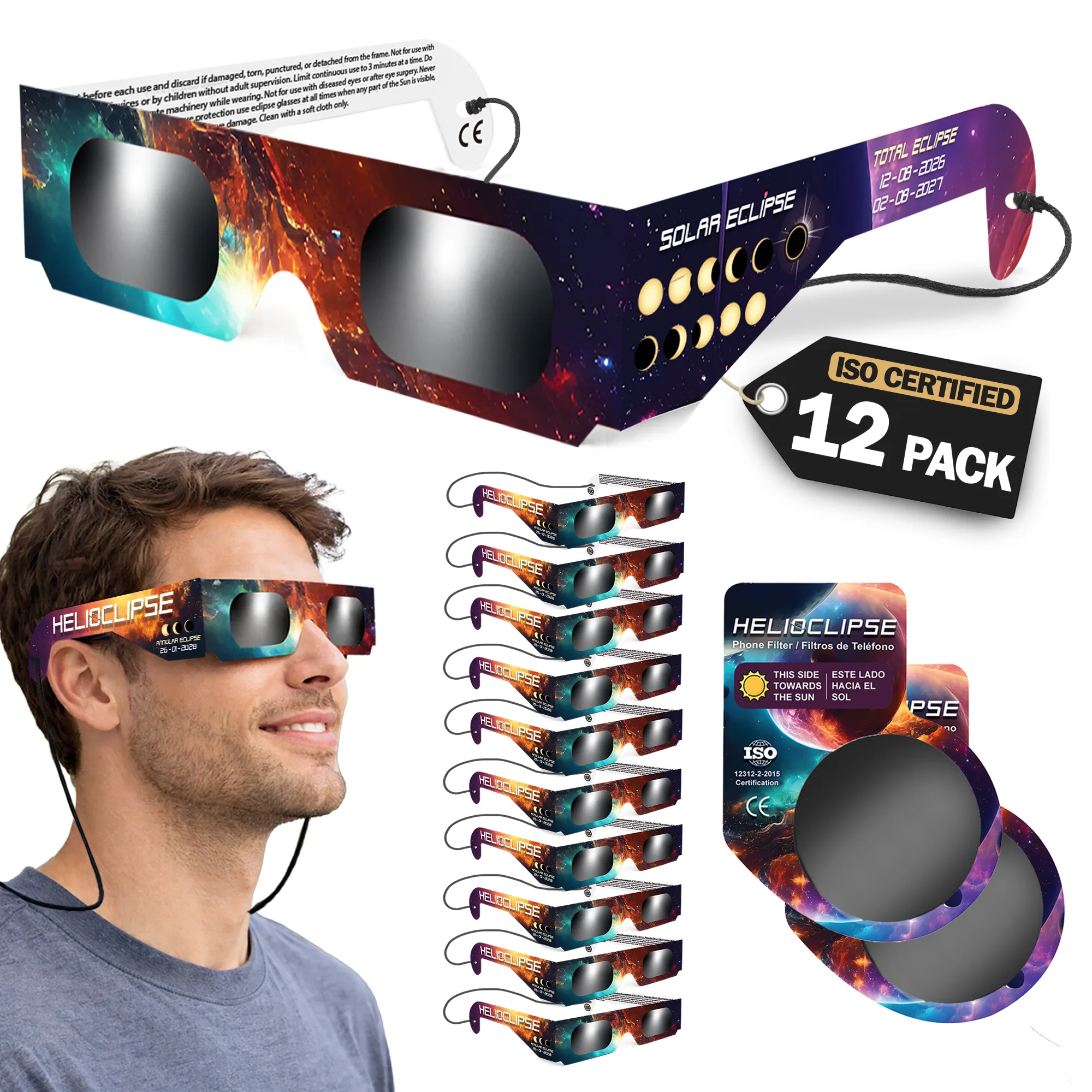
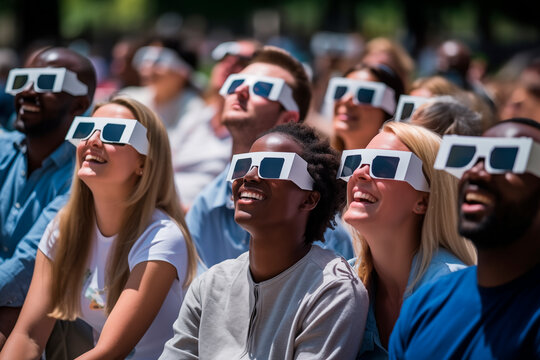
At every other time, direct solar viewing requires special-purpose solar eclipse glasses or a handheld viewer that conforms to ISO 12312-2. Ordinary sunglasses are not substitutes, regardless of how dark they appear. If your location has only a partial eclipse, there is no glasses-off moment.
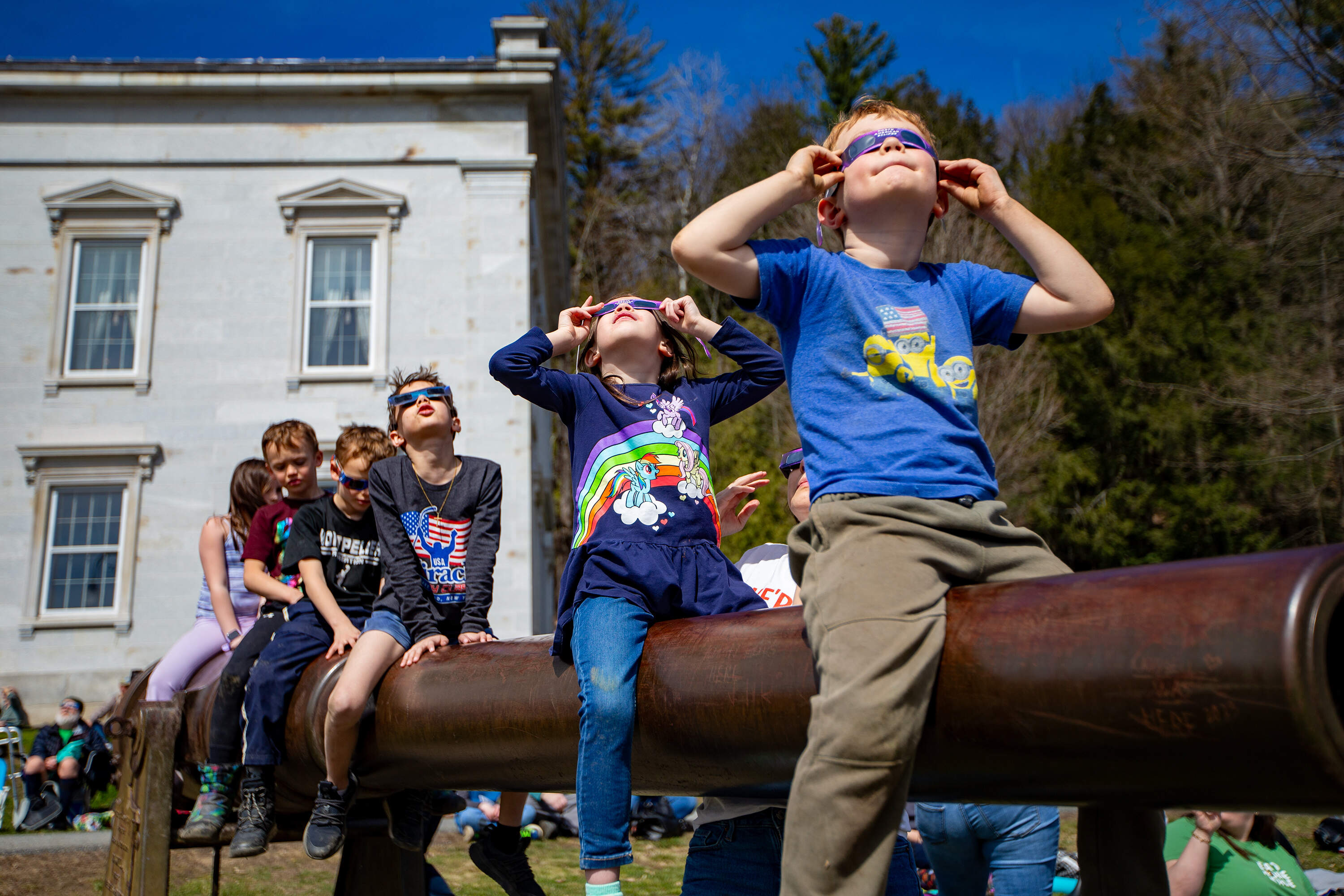
Inspect each viewer before use. Discard it if the filter is punctured, torn, scratched, detached or otherwise damaged. Help children fit their viewers while looking away from the Sun, then have them turn toward it. Anyone who wears ordinary prescription glasses can keep them on and place the eclipse viewer over them.
Solar viewers are for unmagnified viewing. Do not look through binoculars, a telescope or a camera lens while wearing eclipse glasses: concentrated sunlight can damage the filter and the eye. Optical equipment needs a correctly designed solar filter secured over the front aperture, plus knowledgeable setup and supervision.
Shopping language can be misleading. Phrases such as approved solar eclipse glasses, eclipse viewing glasses and solar eclipse glasses iso 12312-2 certified may appear in product descriptions, but wording alone is not proof of testing or traceability. NASA does not certify or approve commercial brands. Check the manufacturer information, instructions, condition of the filter and credible evidence of conformity rather than trusting a logo or an unsupported printed claim. Our ISO 12312-2 guide explains what the standard covers.
If you need viewers for a future event, order Helioclipse solar eclipse glasses early enough to inspect them and practise with the family. A pinhole projector is also a safe, inexpensive way to follow partial phases indirectly: stand with your back to the Sun and watch its projected image rather than looking through the hole.
Planning is mostly about geometry, horizon and weather
A first eclipse plan does not need to be complicated, but it does need a hierarchy. Start with geometry: identify the totality boundaries, then compare duration within the path. Next inspect the local horizon in the direction and altitude of the eclipsed Sun. Finally, build weather and transport options.
The 2026 event showed why that order matters. A beautifully clear field outside the path could deliver only a partial eclipse. A location inside totality but behind a western ridge could miss the low Sun. A theoretically excellent site could also become inaccessible if everyone depended on one narrow road.
For low-altitude eclipses, visit the site at the same clock time on an earlier day if possible. Confirm that the Sun clears trees, buildings and hills. A phone compass and inclinometer can help with orientation, but your eyes on the real horizon are more valuable. Remember that a two-degree-high Sun is only about four apparent solar diameters above a perfectly level horizon.
Weather decisions should be made with several forecasts, satellite imagery and a realistic travel radius—not a single app icon checked a week ahead. Historical cloud statistics help compare regions months in advance, but they do not predict the cloud over one field at one minute. Decide in advance when you will stop moving. Chasing a last-minute gap can be worse than accepting uncertainty at a safe, open site.
Make the plan social. Share coordinates, arrival time, parking arrangements and a fallback site with friends or family. Put viewers, water, medication, hats and a printed schedule in one bag. Schools and larger groups should assign an adult to call out phase changes while others help children use their viewers correctly.
A checklist for the final hour
Arrive early enough that nobody is still parking or arguing over directions when the eclipse begins. Then simplify.
- Confirm that everyone understands whether the site is inside totality.
- Check the local contact times and set alarms before totality and before its end.
- Inspect every solar viewer in daylight.
- Point out the unobstructed solar horizon and any traffic or terrain hazards.
- Place cameras on tripods before the critical minutes; do not improvise optical filters.
- Choose one person to call “viewers off” only after totality has genuinely begun, and “viewers on” before bright sunlight returns.
- Spend at least part of totality simply looking and listening.
A first total solar eclipse what to know 2026 guide can become dense with contacts, azimuths and equipment. The human goal is simpler: remove preventable mistakes so the group can be present when the shadow arrives.
For our purposes, an omnibus means one shared planning document containing maps, times, safety notes and fallback sites. A folder titled best beginner omnibus grounded in 2026 specifics heavy eclipse planning would still need exact coordinates and verified data; a file named beginner omnibus grounded in 2026 specifics heavy eclipse planning release would not become authoritative merely because it sounded complete. Labels never replace a current map, official tables or a weather check.
Questions first-time viewers often bring
How often is a total solar eclipse?
A total solar eclipse occurs somewhere on Earth roughly every 18 months on average, but most of the planet does not lie inside any one path. For a particular location, the wait is often measured in centuries. That rarity is geographic, not because eclipses themselves are exceptionally far apart.
When was the first total solar eclipse?
The question “when was the first total solar eclipse?” has no single historical date. Total eclipses occurred for billions of years before humans recorded them. Ancient cultures left accounts that scholars sometimes associate with eclipses, but interpretations and exact dates can be uncertain. The first total solar eclipse date in a historical list therefore depends on whether “first” means the earliest surviving report, the earliest confidently identified event, the first successful prediction, the first scientific expedition or the first photograph.
Could I tell totality had started without a schedule?
Yes—the final bright part of the photosphere disappears and the surroundings darken sharply—but do not make guesswork your safety system. Use verified local timings and pay attention to the actual Sun through your viewer. Before totality, the shrinking crescent remains visible through the filter. During genuine totality, the bright photosphere is completely absent. At the first returning bead, viewers go back on.
What should I not do during a solar eclipse?
Do not look at the uneclipsed or partially eclipsed Sun without a proper solar viewer. Do not use ordinary sunglasses, damaged viewers or homemade filter materials. Do not combine eclipse glasses with unfiltered magnifying optics. And do not assume that a high percentage of coverage means you are in totality.
You also do not need to watch continuously. During the long partial phases, brief filtered looks every few minutes make the Moon’s movement obvious. Take breaks, talk to your group and notice crescent projections under trees.
What the 2026 event taught future first-timers
The strongest lesson was that duration is not the only measure of a good site. Snæfellsnes offered about a minute more totality than Reykjavík, but both faced Atlantic weather. Northern and north-central Spain traded some duration for historically better August cloud prospects, while the low evening Sun made horizon reconnaissance essential. Mallorca’s roughly 2.7-degree solar altitude made an apparently small obstruction capable of hiding totality.
The second lesson was that percentages conceal the most important boundary. Madrid’s approximately 99% eclipse was scientifically interesting and visually impressive through a viewer, but it was still not total. Crossing into the umbra changes what the sky can show you.
The third lesson was emotional rather than technical: two minutes is long enough to remember for life and short enough to lose to a camera menu. Practise equipment beforehand, tell your group what will happen, and give yourself permission to stop documenting.
For anyone building a first total solar eclipse what to know plan now, retain the sequence: map first, safe viewers second, horizon and weather next, photography last. That structure works for a family outing, a school group or a journey across a continent.
Frequently asked questions
What should I avoid doing when watching a solar eclipse?
Do not look at the Sun without proper solar viewers during any partial phase, including when 99% or more of the solar disk is covered. There is also no safe glasses-off interval during an annular eclipse; ordinary naked-eye viewing is safe for a lunar eclipse because it is a different event.
Where do I need to stand to experience totality?
You must be inside the calculated path of totality, where the Moon’s inner shadow reaches Earth, and the Sun must be above the local horizon. Being in a country or region associated with the eclipse is not enough, because even a modest move can mean shorter totality or no totality at all.
What is the main thing a first-time total-eclipse viewer needs to understand?
The essential distinction is between totality and a partial eclipse: only totality reveals the solar corona around the Moon’s dark silhouette. Outside the narrow path of totality, even a very high percentage of coverage remains a partial eclipse and requires proper solar viewers throughout.
How much planning does a first total solar eclipse require?
It requires more than checking an eclipse time, because totality occurs only within a narrow, moving shadow. Check that your exact location is inside the path of totality and that the Sun will be visible above the local horizon; a country-level location is not precise enough.
How should I use an eclipse map to plan for a future total eclipse?
Use a detailed eclipse map to test an exact location rather than relying on a country or regional label. Confirm that your pin falls inside the path of totality and that the Sun will be above the local horizon at the relevant time.
On-site next steps
- Use the Helioclipse Eclipse Explorer to inspect totality boundaries, local circumstances and the difference between a pin inside or outside the path.
- Prepare for future partial phases with ISO 12312-2 certified Helioclipse viewers, and inspect every viewer before use.
- Continue planning with our eclipse guides and explainers for safety, weather, geography and family observing.
Sources & further reading
- NASA Science — Total Solar Eclipse on August 12, 2026
- National Solar Observatory — August 12, 2026 Solar Eclipse Map
- NASA Earth Observatory — Stops Along the Path of Totality
- Space.com — Total solar eclipse 2026: Everything you need to know
- Space.com — What to expect from five stages of the 2026 total solar eclipse
- American Astronomical Society — How to View a Solar Eclipse Safely
- American Astronomical Society — About the ISO 12312-2 Standard for Solar Viewers
- NASA Science — Eclipse Viewing Safety
- American Astronomical Society — Phenomena You’ll Experience at a Total or Annular Eclipse
- NASA Science — Why Do Eclipses Happen?