August 12, 2026 total solar eclipse: what to expect and how to plan ahead
On Wednesday, August 12, 2026, the Moon’s shadow crossed the Arctic and North Atlantic before reaching Iceland, northern Spain, and a tiny corner of Portugal. It was a total eclipse only within a narrow corridor. Across a much wider area—including the United Kingdom, Ireland, much of Europe, northwestern Africa, Canada, Alaska, and parts of the northern contiguous United States—the eclipse was partial.
That distinction shaped everything. Inside the path, observers could see the solar corona during a brief total phase lasting generally less than two minutes, with a global maximum of about 2 minutes 18 seconds. A few kilometres beyond the path’s edge, even 99% coverage remained a partial eclipse: the sky did not undergo the same transformation, the corona did not appear in the same way, and certified solar viewers had to remain on throughout.
You can still examine the route, compare locations, and replay the geometry with our Eclipse Explorer and 3D map. The same planning method—check the path first, then exact local circumstances, horizon, weather, and access—is valuable for every future eclipse.
The essential facts at a glance
The solar eclipse of August 12, 2026 began over northern Russia, crossed Greenland and the North Atlantic, reached western Iceland, and continued into northern Spain. The path left land near Spain’s Mediterranean coast and the Balearic Islands, with a very small part of northwestern Portugal also inside totality.
NASA reported that the Moon’s umbral shadow—the dark central shadow responsible for totality—followed a track roughly 293 kilometres (182 miles) wide and took about 96 minutes to cross the planet. Totality lasted less than two minutes for most land-based observers, although locations near the centre of the path over Greenland, Russia, or the North Atlantic could receive more than two minutes. The calculated global maximum was approximately 2 minutes 18 seconds.
The event unfolded at very different solar elevations along its route. Greenland and Iceland saw totality in the late afternoon or early evening, with the eclipsed Sun roughly 24–25 degrees above the western horizon at several representative sites. In Spain, totality arrived shortly before sunset. The Sun stood about 12 degrees high at A Coruña, around 8 degrees at Burgos and Segovia, and only about 2.7 degrees above the west-northwestern horizon in Mallorca.
Those numbers explain why the total solar eclipse 2026 path could not be reduced to a list of countries. Iceland offered a higher Sun but a substantial cloud risk. Inland Spain generally offered stronger prospects for clear skies but demanded a completely unobstructed western horizon. Mallorca placed an eclipsed Sun almost on the sea horizon, a beautiful but unforgiving geometry.
Why totality and 99% partial were fundamentally different
Why was August 12 2026 a total solar eclipse rather than an annular one? From locations inside the umbra, the Moon appeared large enough to cover the Sun’s bright photosphere completely. That exposed the corona—the faint, structured outer atmosphere normally overwhelmed by daylight—and produced the rapid darkness, temperature change, altered horizon colours, and behaviour of wildlife associated with totality.
Outside the umbra, observers remained in the Moon’s penumbra. They saw a crescent Sun, sometimes an extraordinarily thin one, but some portion of the photosphere remained visible. That remaining sunlight was enough to prevent genuine totality.
Madrid and Barcelona demonstrated the point dramatically. NASA listed both cities at approximately 99% coverage, yet both remained outside the path. Madrid’s maximum occurred at about 8:32 p.m. local time, while Barcelona’s occurred at about 8:29 p.m. Their deep partial eclipses were striking, but neither city experienced the corona or a safe glasses-off interval.
By contrast, León was inside the path. NASA’s rounded local timetable placed the beginning of the partial phase at 7:32 p.m., totality from approximately 8:28 to 8:30 p.m., and the remaining partial phase until about 9:22 p.m. The difference between León and Madrid was not merely one percentage point on a table. It was the difference between seeing a sliver of photosphere and seeing none at all.
For a fuller explanation of the sequence, use our guide to eclipse phases and when solar glasses come on or off.
Reading the August 12, 2026 eclipse path correctly
A useful August 12 2026 total solar eclipse map needs more than a broad coloured stripe. It should let you distinguish the northern and southern limits, estimate your distance from the centre line, inspect the terrain, and retrieve local contact times. The August 12, 2026 eclipse path also needs to be read alongside the Sun’s altitude and azimuth: a point may be securely inside totality yet still have a mountain, building, tree line, or coastal headland blocking the low Sun.
Different publishers punctuate dates differently, so the labels august 12, 2026 solar eclipse path and august 12th 2026 total solar eclipse path refer to the same event. Likewise, the August 12 2026 total solar eclipse path is the narrow umbral corridor—not the enormous region from which some partial phase was visible. An August 12, 2026 eclipse path graphic that combines both zones should make that distinction explicit.
Timing labels require equal care. The August 12 2026 total solar eclipse time was not one universal local clock reading. Maximum eclipse occurred at a single astronomical instant globally, but civil times varied by longitude and time zone, while first contact, totality, and last contact differed from place to place. Always confirm whether a table uses UTC, local daylight-saving time, or another regional convention.
Even the solar eclipse of August 12, 2026 date line can conceal practical complications: in an astronomical table the event has one UTC date, but planning still requires the correct local date, time-zone rules, and daylight-saving offset. For this eclipse, all cited European examples remained on August 12 locally.
Where totality happened—and what each region demanded
Greenland and the North Atlantic
The shadow crossed remote parts of Greenland, where access, transport, accommodation, and rapidly changing maritime weather were major constraints. Scoresby Sund was a prominent planning area: published circumstances placed totality near 4:35 p.m. local time, lasting about 1 minute 46 seconds with the Sun approximately 24 degrees above the west.
The centre line over Greenland and the North Atlantic offered some of the event’s longest durations, approaching the 2-minute-18-second global maximum. But duration alone did not make a site practical. A remote location without flexible transport or reliable shelter could leave observers committed to one cloud deck.
An August 12 2026 total solar eclipse cruise therefore involved a genuine trade-off rather than an automatic advantage. A ship might reposition toward a clearer patch or intercept the shadow near the longer-duration centre line, but maritime cloud, swell, deck vibration, and limited manoeuvring windows still mattered. Travellers also needed to understand whether an itinerary guaranteed an umbral intercept or merely visited a region associated with the eclipse.
Iceland
Western Iceland lay inside totality, including Reykjavík and parts of the Reykjanes and Snæfellsnes peninsulas. NASA’s rounded timetable for Reykjavík put the partial phase at 4:47 p.m., totality at approximately 5:48–5:49 p.m., and the end of the partial phase at 6:47 p.m. More detailed circumstances gave Reykjavík about 1 minute 1 second of totality, with the Sun roughly 25 degrees above the west.
Farther west, Snæfellsjökull National Park lay closer to the centre of the track and could receive about 2 minutes 10 seconds—more than twice Reykjavík’s duration. That was a meaningful gain, but only if roads, parking, terrain, and cloud allowed observers to reach and remain at a workable site.
The August 12 2026 total solar eclipse Iceland choice was therefore a classic eclipse dilemma: a relatively comfortable solar altitude and potentially long totality set against the North Atlantic’s changeable cloud. A rigid plan built around one scenic overlook was weaker than a plan with several road-accessible sites and a decision deadline based on short-range forecasts.
Northern Spain and the Balearic Islands
Spain offered the event’s broadest range of accessible land options, from Galicia and the north coast through Castilla y León, Aragón, Valencia, and parts of the Balearic Islands. It also presented the most severe horizon problem because totality arrived late in the evening.
Representative published circumstances show the contrast:
- A Coruña: about 1 minute 15 seconds of totality near 8:27 p.m. CEST, with the Sun around 12 degrees high.
- Gijón: about 1 minute 46 seconds near 8:26 p.m., with the Sun around 10 degrees high.
- Burgos: about 1 minute 44 seconds near 8:28 p.m., with the Sun around 8 degrees high.
- Segovia: roughly 54 seconds near 8:31 p.m., also around 8 degrees high.
- Sigüenza: about 1 minute 38 seconds near 8:30 p.m., with the Sun close to 7 degrees high.
- Mallorca: about 1 minute 36 seconds near 8:31 p.m., but with the Sun only about 2.7 degrees above the horizon.
At 8 degrees altitude, an obstacle subtending just a few degrees can matter. At 2.7 degrees, even a modest ridge, hotel, line of trees, or haze bank can erase the view. A phone compass and topographic profile were more valuable here than a postcard-perfect foreground.
Our detailed guide to the 2026 path across Spain explains why being inside the boundary and having a clear western sight line were separate tests.
What the rest of Europe and North America saw
The August 12 2026 total solar eclipse UK experience was partial everywhere. NASA listed London at 91% coverage, with the eclipse beginning around 6:17 p.m., reaching maximum near 7:13 p.m., and ending around 8:06 p.m. local time. That was a deep and worthwhile partial eclipse—but there was no safe moment to remove solar viewers.
Ireland was also outside totality. Dublin reached approximately 94% coverage near 7:10 p.m., between a 6:12 p.m. start and an 8:05 p.m. finish. Lisbon reached about 95% near 7:36 p.m.; only a small corner of extreme northwestern Portugal entered the totality corridor. Paris reached roughly 92%, Berlin 85%, Oslo 83%, and Milan 92%, according to NASA’s representative city table.
North America saw only a partial eclipse. Coverage generally increased toward Alaska and northeastern Canada but remained modest in much of the contiguous United States. NASA listed Fairbanks at 37%, Anchorage at 28%, Bangor at 24%, Boston at 16%, New York City at 9%, Detroit at 3%, and Washington, D.C., at 4%. St. John’s, Newfoundland, reached approximately 53%.
The United States therefore had no 2026 totality destination. The event was not a repeat of April 2024: anyone seeking the corona had to travel to the transatlantic path, while observers at home needed solar viewers for every direct look.
The phrases August 12 2026 total solar eclipse India and August 12 2026 total solar eclipse Australia can create a false impression of worldwide totality. Neither country lay in the totality corridor. Exact partial visibility always has to be checked for the observer’s coordinates rather than inferred from the event’s global name.
The low Sun changed the planning rules
For Spain especially, “inside the path” was necessary but insufficient. The eclipsed Sun’s low western position required a site inspection or a reliable terrain model. A horizon that looked clear at noon could hide the Sun at 8:30 p.m.; nearby relief that seemed small on a road map could subtend several degrees.
A practical site check included four questions:
- What was the Sun’s altitude and azimuth at totality? A generic sunset direction was not precise enough.
- What occupied that line of sight? Terrain, buildings, trees, cranes, and summer haze all counted.
- Could the group leave if cloud developed? A beautiful dead-end road was a poor mobility plan.
- Would the site remain accessible after sunset? Spain’s partial phase continued after totality, and some locations reached sunset before the eclipse formally ended.
Valencia illustrates the timing. NASA listed totality from about 8:32 to 8:33 p.m. local time, with sunset at approximately 9:01 p.m. before the partial phase had fully completed. Zaragoza similarly reached totality around 8:29–8:30 p.m., with sunset at about 9:07 p.m. The eclipse and the horizon were inseparable.
This is why we recommend choosing a primary site, two realistic alternatives, and a latest-departure time rather than collecting a dozen pins that cannot be reached. Our guide to eclipse travel, traffic, and backup routes develops that approach.
Weather: climate chooses the region, forecasts choose the site
Long-range climate patterns help compare broad areas, but they cannot identify a clear field on a specific afternoon. Iceland’s maritime environment carried a higher cloud risk, while inland north-central Spain generally offered better historical odds of clear August skies. Northern coastal Spain was more exposed to Atlantic cloud, and Mediterranean sites traded lower climatological cloud risk against a much lower Sun.
The best weather plan operated on several time scales. Months ahead, observers selected a region with acceptable climate and transport. About a week out, ensemble forecasts revealed whether a broad pattern favoured Iceland, Atlantic Spain, or the interior. During the final 48 hours, satellite imagery, high-resolution forecasts, and local cloud behaviour became more useful than seasonal averages.
Mobility still had limits. Chasing a small gap visible on satellite could put a group into traffic or behind terrain just as totality arrived. A sound decision compared forecast confidence, drive time, road capacity, horizon quality, and the risk of abandoning a decent site for an uncertain one.
For a reusable decision framework, see our guide to cloud cover and when to move on eclipse day.
What observers experienced during the eclipse
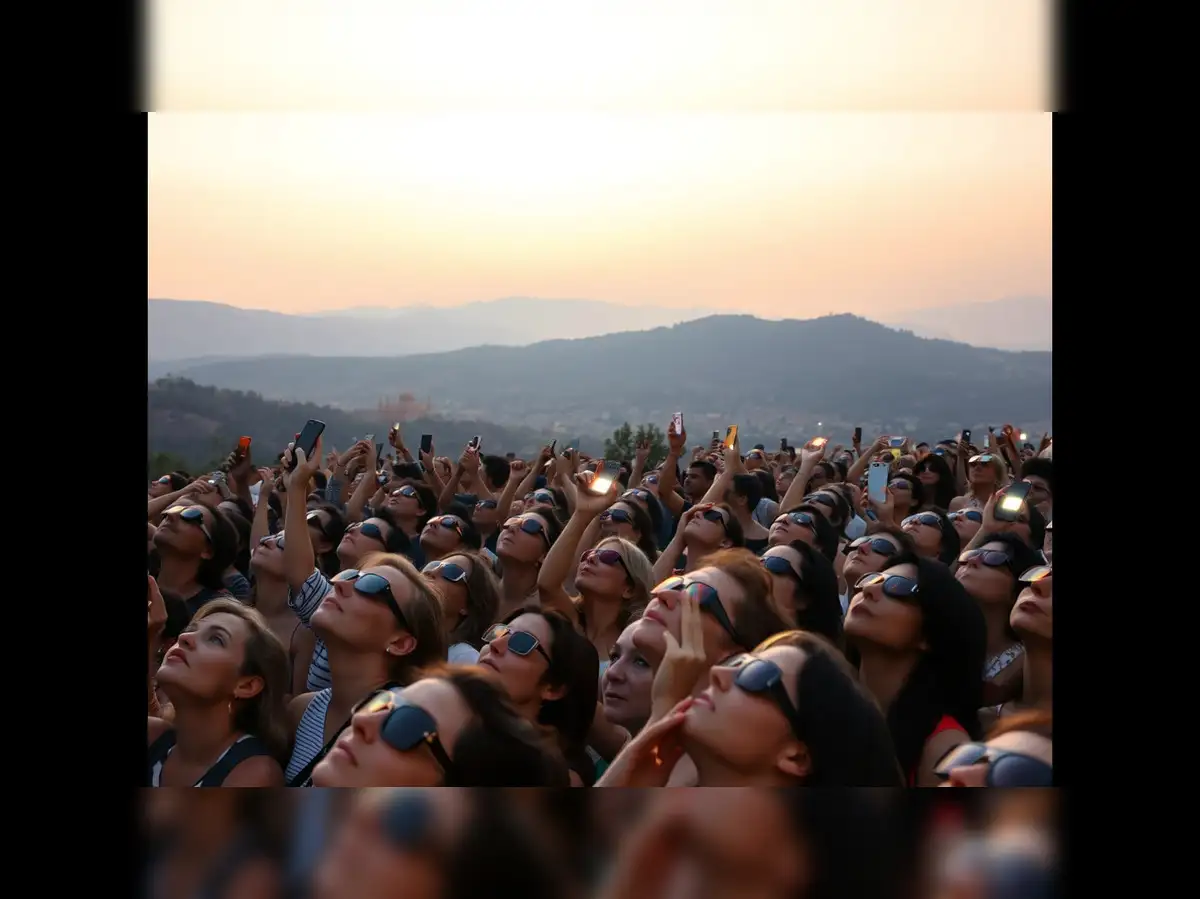
The partial phase developed slowly, over roughly an hour before totality at many sites. Through a safe solar viewer, the Moon first appeared as a small notch on the Sun and then advanced across the disk. Shadows became unusually crisp. Gaps between leaves acted as pinhole projectors, scattering crescents across walls and pavement.
The final minutes inside the path felt entirely different. Ambient light faded with a metallic, unfamiliar quality rather than like an ordinary sunset. The western horizon still carried colour, but darkness approached within the moving lunar shadow. Temperatures could fall, birds might quiet, and bright planets or stars could become visible if the sky was transparent.
Only when the photosphere was completely covered could unaided observers inside the path remove their viewers. The corona then surrounded the black silhouette of the Moon. Depending on solar activity and atmospheric clarity, observers might also notice pink prominences near the lunar edge.
Totality ended abruptly. The first returning point of photosphere was intensely bright, so viewers had to go back on immediately. Anyone outside the path—including places with 99% coverage—never reached a glasses-off phase.
Eye safety without confusion
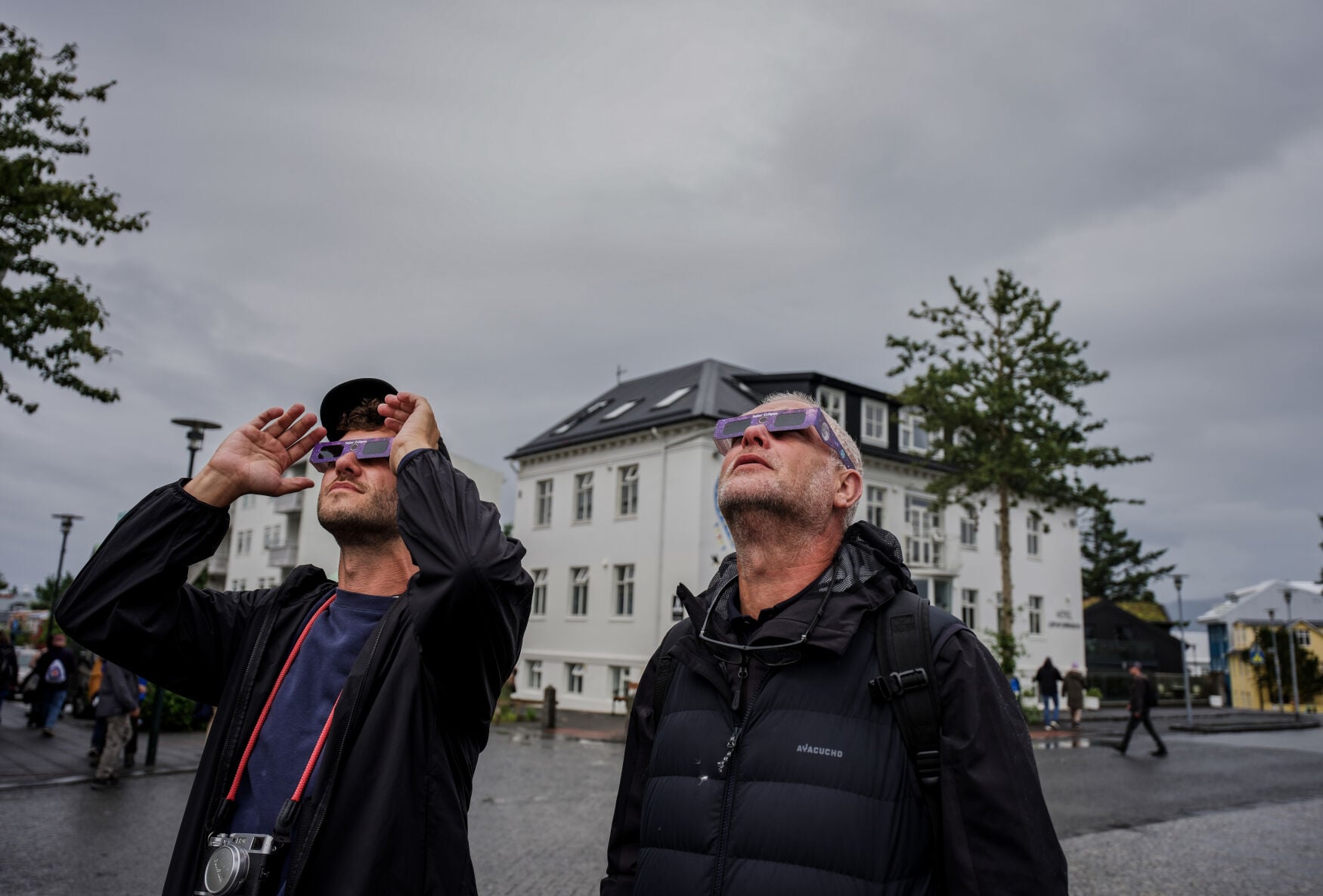
During every partial phase, direct viewing required a special-purpose solar viewer conforming to ISO 12312-2. Ordinary sunglasses were not adequate, regardless of darkness or polarization. Viewers needed inspection before use: scratched, punctured, torn, wet, or detached filter material was reason to discard them.
Only observers confirmed to be inside totality could remove viewers, and only after the Sun’s bright face was completely hidden. The moment any bright photosphere returned, viewers had to be replaced. Children benefited from rehearsing that sequence with an adult before looking up.
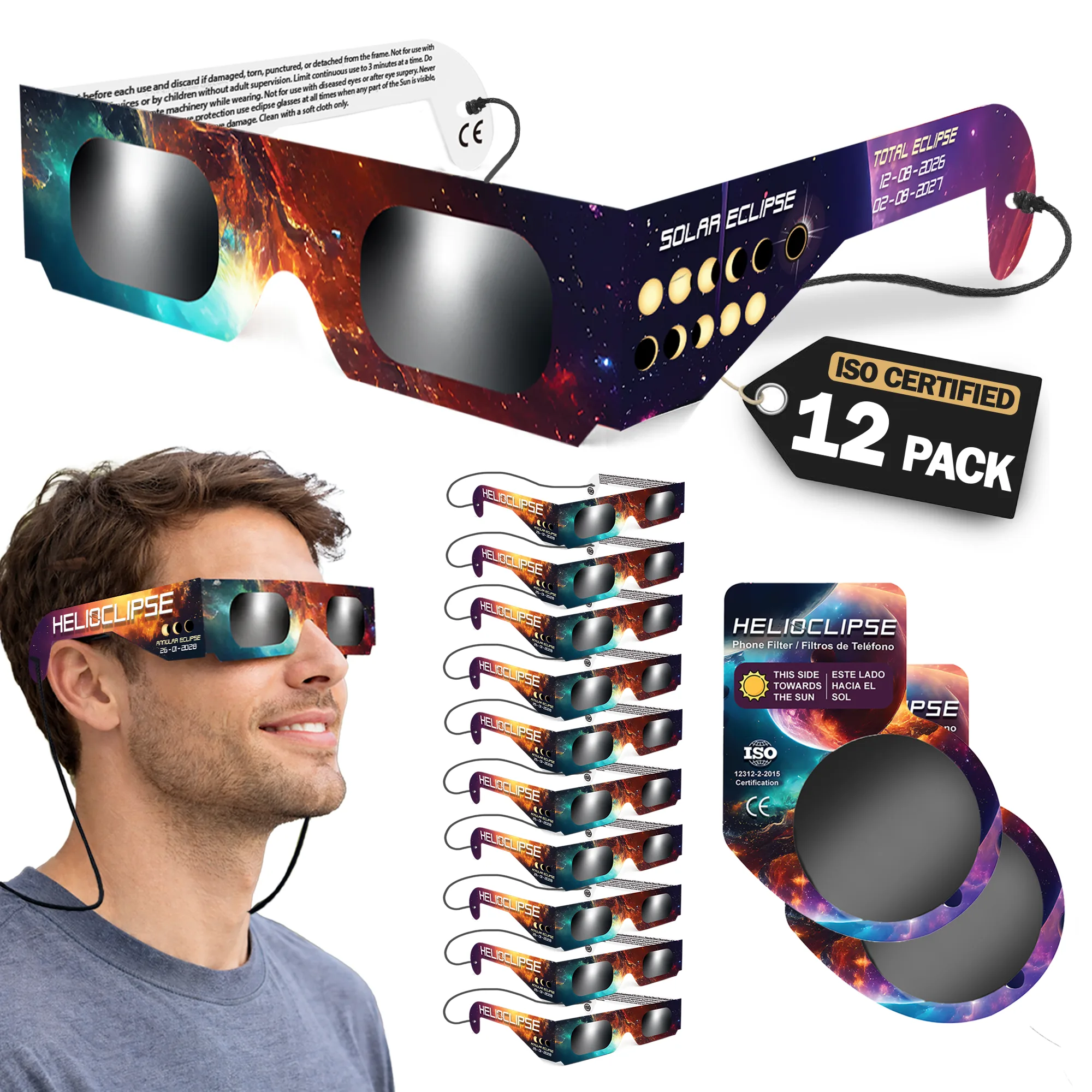
Marketing language also needs scrutiny. Phrases such as approved solar eclipse glasses and eclipse glasses nasa approved are misleading because NASA does not approve individual viewer brands. A relevant description is solar eclipse glasses iso 12312-2 certified, but responsible purchasing also means checking the supplier, manufacturer information, instructions, filter condition, and credible evidence behind the conformity claim. Our Helioclipse eclipse glasses are presented with their applicable product and safety information so you can prepare your group without relying on vague marketplace wording.
Eclipse glasses must never be placed between your eyes and binoculars, a telescope, or a camera lens. Concentrated sunlight can damage the viewer and your eyes. Magnifying optics require an appropriate solar filter secured over the front aperture, with equipment and procedures checked by someone who understands solar observing.
A pinhole projector is a safe alternative for partial phases because you look at a projected image, not through the hole at the Sun. A colander, perforated spoon, or overlapping fingers can create many tiny solar crescents on a shaded surface.
A planning checklist that scales from one family to a large group
A strong eclipse plan begins with geometry, not accommodation. First confirm that the exact site lies inside the totality boundary—or accept explicitly that the experience will be partial. Then retrieve local contact times, duration, solar altitude, and azimuth from a reliable map or ephemeris.
Next, inspect the site. Check the western horizon, legal access, parking capacity, toilets, shade, drinking water, and a safe place for children to wait through the long partial phase. If the group includes anyone with limited mobility, evaluate the final approach in realistic conditions rather than assuming that a map pin is accessible.
Share one written plan with everyone: meeting point, departure time, backup sites, weather decision deadline, and what to do if mobile networks become congested. Download maps and key timings offline. Give each driver the plan instead of keeping it on one phone.
Finally, prepare viewers well before any future event. Count adults and children, add spares, inspect every filter, and practise putting viewers on while facing away from the Sun. Families can share viewers during the slow partial phase, but having enough for the final minutes reduces confusion. Tell schools, relatives, and friends early; safe equipment and sensible transport become harder to arrange as an eclipse approaches.
Frequently asked questions
Where was totality visible during the August 12, 2026 solar eclipse?
Totality was visible only within a narrow corridor crossing the Arctic and North Atlantic, including western Iceland, northern Spain, and a very small part of northwestern Portugal. Outside that path, including the United Kingdom, Ireland, much of Europe, northwestern Africa, Canada, Alaska, and parts of the northern contiguous United States, observers saw a partial eclipse.
Could observers in North America see the August 12, 2026 eclipse?
Yes, parts of Canada, Alaska, and the northern contiguous United States could see a partial eclipse. Totality was not visible there, so certified solar viewers needed to remain on throughout the event.
Does the article discuss any biblical meaning of solar eclipses?
No. The article focuses on the eclipse path, the difference between total and partial viewing, and practical planning factors such as local circumstances, horizon, weather, and access. It does not address biblical interpretations or religious meanings.
Is it possible to view this eclipse through a telescope?
The excerpt does not provide telescope-viewing instructions. It states that certified solar viewers had to remain on during all partial phases, including locations just outside the path where coverage reached 99%.
What were the main planning considerations for the August 12, 2026 total solar eclipse?
First, confirm whether your location was inside the narrow path of totality or in the much wider partial-eclipse region. Then check exact local timing, the Sun's height and horizon direction, weather prospects, and access; these were especially important in Spain, where totality occurred shortly before sunset.
On-site next steps
- Use the Helioclipse Eclipse Explorer to examine the path, compare total and partial locations, and understand how quickly circumstances change across a boundary.
- Review ISO 12312-2 eclipse viewers in the Helioclipse shop when preparing for future solar observing, family events, or school activities.
- Browse our eclipse planning and safety guides for weather strategy, observing techniques, and future events.
Sources & further reading
- Total Solar Eclipse on August 12, 2026 — NASA Science
- Guide for the Total Eclipse of 2026 — EclipseWise
- Solar and Lunar Eclipses in 2026 — Sky & Telescope
- Total solar eclipse 2026: Everything you need to know — Space.com
- How to see the 12 August 2026 partial solar eclipse — Royal Museums Greenwich
- How to View a Solar Eclipse Safely — American Astronomical Society
- About the ISO 12312-2 Standard for Solar Viewers — American Astronomical Society
- Eclipses — NASA Science
- Why Do Eclipses Happen? — NASA Science
- Eclipses Frequently Asked Questions — NASA Science