Superzoom phone attachments and “clever” rigs: how magnification changes the danger, not the rules
A clip-on telephoto lens can make the Sun look larger on your phone, but it cannot make the Sun safer. Add mirrors, a folded periscope, a monocular, or a homemade mounting bracket, and the setup starts behaving less like an ordinary phone and more like a small optical instrument—one that can concentrate intense sunlight onto a sensor or into an eye.
Our phone periscope telephoto solar eclipse eye safety 2026 guide therefore begins with a rule worth sharing with everyone in your group: magnification changes the hazards and the required equipment, not the fundamental viewing rules. Never look directly at the uneclipsed or partially eclipsed Sun without suitable eye protection, and never aim magnifying optics at it unless a purpose-made solar filter is secured over the front of the complete optical system.
That distinction matters for the total solar eclipse of August 12, 2026. Totality provides a brief exception for unaided direct viewing—but only from inside the path of totality and only while the Sun’s bright face is completely covered. Partial phases remain hazardous. You can check whether your location is inside that path with our Eclipse Explorer and 3D map before designing any photography plan.
Optical zoom is not just a bigger crop
Digital zoom enlarges and crops the pixels already captured by a phone. It may reduce image quality, but it does not add a new light-gathering element in front of the camera. Optical magnification is different. A clip-on telephoto attachment, monocular adapter, telescope, or periscope-style accessory changes the path of the incoming light and forms a magnified image.
The core warning is simple: optical magnification concentrates sunlight—sensor risk and peripheral eclipse positioning risk both rise when a longer optical system is pointed toward the Sun. The amount of energy reaching a particular component depends on the aperture, focal length, construction, alignment, exposure time, and phone design. There is no useful universal promise that an unfiltered phone will survive because somebody else’s did.
A longer attachment also narrows the field of view. That makes the Sun harder to acquire and easier to lose, encouraging the photographer to sweep the rig across the sky, squint along its edge, or peer around the screen. The most immediate danger may therefore be neither a dramatic sensor failure nor a hot lens barrel. It may be the quick, unprotected glance taken while trying to aim the device.
This is why a phone solar eclipse lens should be treated according to what it physically does, not what the seller calls it. A phone lens eclipse setup that contains magnifying optics belongs in the same safety conversation as a camera telephoto lens, binoculars, or a small telescope.
The filter belongs in front of the optics
For partial phases, annular eclipses, and the ordinary uneclipsed Sun, a camera needs a suitable solar filter secured over the front opening—the point where sunlight first enters the optical system. Putting a filter behind a telephoto attachment allows concentrated sunlight to travel through the accessory before it reaches the filter. That can expose internal parts to heat and can place excessive energy on material not designed for that position.
Do not improvise a camera filter from sunglasses, smoked glass, photographic neutral-density material, food packaging, exposed film, or an eclipse viewer taped somewhere inside a homemade rig. Do not assume that a visually dark material blocks the necessary ultraviolet and infrared radiation. A purpose-made camera or smartphone solar filter must be suitable for the optics, cover the complete entrance aperture, remain secure while the device is tilted, and be used according to its manufacturer’s instructions.
A loose filter is not a small defect. If wind, a bumped tripod, or a hand on the zoom control exposes even part of the aperture, direct sunlight can enter the system. Test the mechanical fit indoors, then practice outdoors on the normal Sun only with the proper filter already installed. If you cannot verify that the filter is appropriate for the complete attachment, do not point that rig at the Sun.
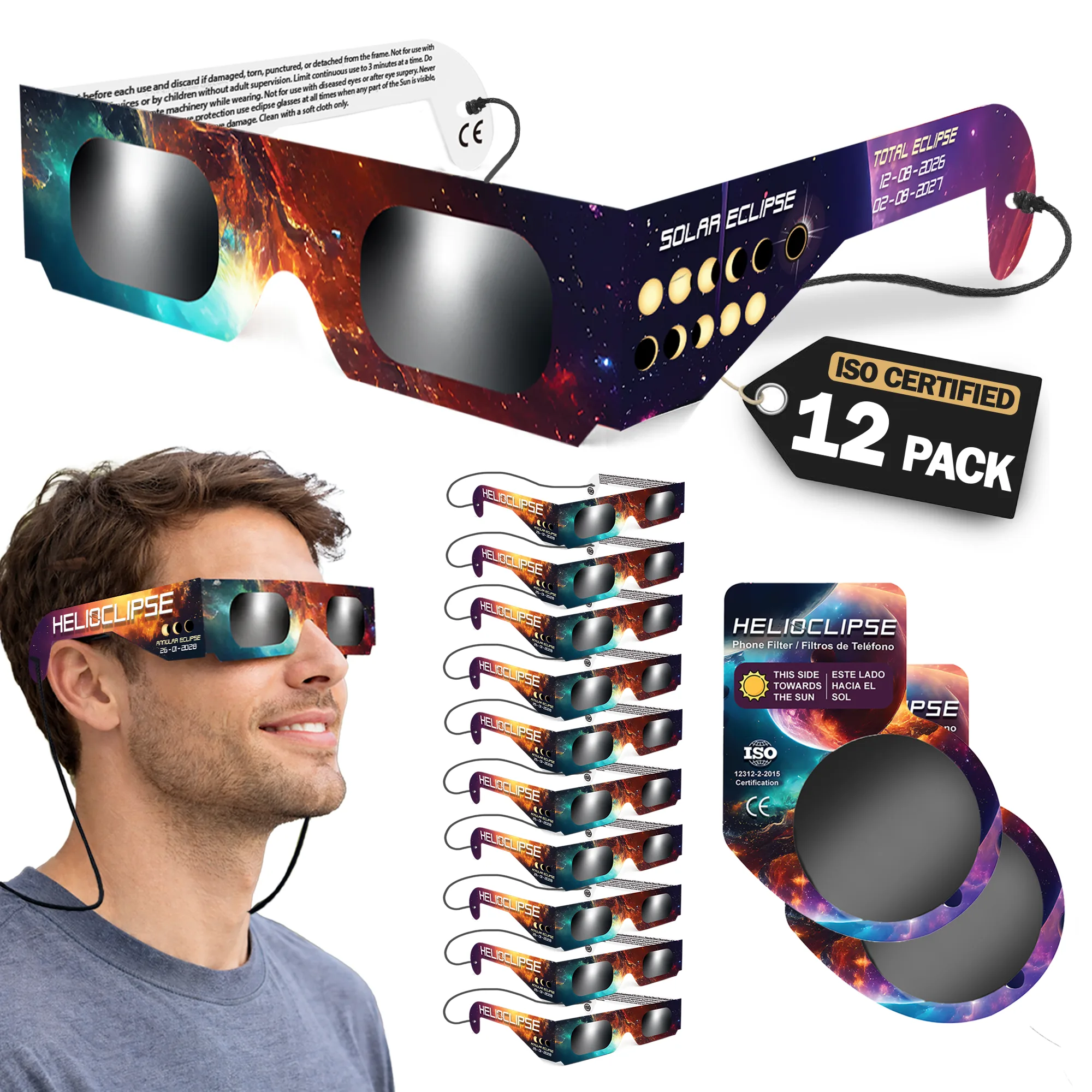
The label phone solar eclipse glasses can blur two separate products: a viewer made for human eyes and a filter engineered for a phone camera. They are not automatically interchangeable. Ordinary solar eclipse glasses protect eyes during direct, unmagnified viewing when used correctly; they are not a universal filter for telephoto attachments, binoculars, or telescopes.
Why eclipse glasses do not make magnifying optics safe
Never look through a camera lens, binoculars, a monocular, or a telescope while wearing eclipse glasses in front of your eyes. The optics can concentrate sunlight onto the viewer material, damage it, and send dangerous radiation into the eye. The correct solar filter for magnifying equipment goes over the front of the equipment, before the light is collected and focused.
This is one of the most consequential differences between direct viewing and optical viewing. ISO 12312-2 applies to filters intended for direct observation of the Sun, including eclipse glasses and handheld viewers. It does not turn a direct-viewing product into a universal camera or telescope filter. Optical equipment requires a filter selected and mounted for that equipment, ideally with advice from an experienced solar observer or astronomy specialist.
Marketing language can add confusion. Phrases such as “approved solar eclipse glasses” and “eclipse glasses nasa approved” should prompt scrutiny because NASA does not approve particular viewer brands. Listings described as “solar eclipse glasses iso 12312-2 certified” or simply “certified solar eclipse glasses” still need a traceable manufacturer, credible conformity information, clear instructions, and undamaged filter material.
For direct viewing, inspect every viewer before eclipse day. Discard one that is torn, punctured, deeply scratched, separating from its frame, or otherwise damaged. Our guide to ISO 12312-2 and eclipse viewers explains what the standard does—and does not—tell your family.
The screen is not eye protection
A phone screen shows an electronic image, so looking at the screen is not equivalent to looking through an optical viewfinder. That does not make the process automatically safe. When you hold a phone toward the Sun, the device may cover only part of the bright sky. Your eyes can catch the Sun directly beside the phone while you align the shot, check the attachment, or follow a moving image on an unstable tripod.
The display can also create false reassurance. Automatic exposure may turn the Sun into a small white disk, a dim blob, or a flare. That is a property of the camera’s exposure and display processing—not evidence that the real Sun has become safe to view. Clouds, haze, or a deep partial phase can reduce visible brightness without removing the need for protection.
So, how to use your phone for the solar eclipse? Decide on one modest composition, install the correct filter before aiming, stabilize the device, and rehearse the controls without repeatedly looking toward the Sun. Keep your own certified viewer available whenever you need to look up during a partial phase. If the accessory makes alignment awkward or encourages you to sight along the lens, remove it and choose a wide environmental photograph instead.
NASA’s photography guidance makes that alternative attractive: photograph the changing landscape, projected crescents beneath leafy trees, the reactions of your family, and the unusual quality of the light. Those images can tell a richer story than a shaky, overexposed dot made with an unfamiliar superzoom.
Totality is real—but it is not a shortcut
During a total solar eclipse, people located inside the path of totality may view the Sun without eclipse glasses only after the Moon has completely covered its bright face. The safe interval ends as soon as any bright photosphere reappears. Outside the path, the eclipse remains partial and there is no glasses-off interval at all.
A phone rig makes that transition harder to manage. You may be watching a display instead of the sky, handling a filter, adjusting exposure, or trying to reacquire the Sun at the exact moment conditions change. With several lenses or a periscope attachment, it may also be unclear which aperture is exposed. The fact that camera filters may be removed during totality does not make an improvised removal sequence wise for a first-time observer.
For August 12, 2026, establish your exact location and local contact times in advance. The partial phases last far longer than totality, so a guessed transition is unacceptable. Our guide to eclipse phases and when to use solar glasses explains the sequence. If you cannot confidently identify the beginning and end of totality at your position, leave the eye protection and camera filter in place and enjoy the changing light safely.
Annular eclipses never provide this exception: the bright ring is direct sunlight. Partial eclipses do not provide it either, no matter how thin the remaining solar crescent appears.
What eye protection is needed for a solar eclipse?
For direct viewing of the uneclipsed, partially eclipsed, or annularly eclipsed Sun, use special-purpose solar viewers that conform to ISO 12312-2 and come from a source you can verify. Regular sunglasses are not sufficient, regardless of how dark or polarized they are. Children should be supervised, and everyone should put the viewer over their eyes before looking up, then turn away before removing it.
The question what eye protection is needed for a solar eclipse? has a second answer when optics enter the scene. Your eyes need certified direct-viewing protection whenever you look toward the partial Sun without magnification, while the camera or telephoto attachment needs its own suitable front-mounted solar filter. Wearing eclipse glasses does not compensate for an unfiltered optical rig.
No eye protection is required for a lunar eclipse. A lunar eclipse involves looking at the Moon, which is safe with unaided eyes, binoculars, or a telescope. That familiar fact should never be carried over to a solar eclipse, where the object being observed is the Sun itself.
Safe viewing without direct sight of the Sun
A pinhole projector for solar eclipse viewing forms a small image of the Sun on another surface. You stand with your back to the Sun and watch the projected image rather than looking through the hole. It is an excellent choice for children, groups, and anyone who would rather leave phone telephoto experiments out of eclipse day.
For families working out how to see solar eclipse safely at home, a simple projection activity can make the changing crescent visible on a card or inside a box. Instructions explaining how to make a pinhole projector for solar eclipse viewing should always preserve the same geometry: sunlight enters through the small opening, the image lands on a screen, and nobody looks through the opening at the Sun.
That also resolves two commonly confused aims. If you are deciding how to look at solar eclipse without glasses, indirect projection is the safe method; it is not a way to look directly at the Sun. Likewise, how to watch a solar eclipse safely without glasses means watching a projected solar image, tree-shadow crescents, or an authoritative broadcast—not squinting, using clouds as a filter, or holding a phone between your face and the Sun.
Natural pinhole effects can be surprisingly beautiful. Gaps between leaves project dozens of tiny crescents onto the ground, while a colander or crossed fingers can create a grid of solar images. Photograph those projections with the Sun outside the frame and you can record the eclipse without aiming a magnifying attachment at it.
A safer phone-photography plan
A successful plan is deliberately boring before the eclipse and delightfully simple during it.
- Choose the image first. Decide whether you want a filtered solar disk, a wide landscape, projected crescents, or the people sharing the event. Do not add magnification merely because an attachment is available.
- Classify every optical part. A clip-on telephoto, monocular, periscope, binocular adapter, or telescope changes the setup. If you cannot trace the full light path, do not aim it at the Sun.
- Use the correct front-mounted filter. It must be intended for solar imaging with that optical arrangement, cover the full entrance aperture, and remain secure when the rig moves.
- Practice before eclipse day. Rehearse framing, focus, exposure, timers, and filter handling on the uneclipsed Sun with the proper filter installed. Stop if anything shifts, heats unexpectedly, or becomes difficult to control.
- Protect the photographer. Keep certified viewers within reach, avoid sighting along the phone, and do not let a child handle a magnifying solar rig unsupervised.
- Know the eclipse type and your position. Partial and annular eclipses require protection throughout. The totality exception applies only inside the path and only while the bright solar face is completely hidden.
- Be willing to abandon the shot. A missed phone image costs nothing. A direct glance through unfiltered magnifying optics can cause severe injury.
Friends and family should hear the plan before the event begins. Tell them which equipment is safe for direct viewing, which filter belongs to the camera, and who is responsible for supervising children. Order certified viewers early enough to inspect and replace them if necessary; eclipse morning is too late to discover that a packet is damaged or untraceable.
Frequently asked questions
What should I wear or use to view a solar eclipse safely?
Use suitable eye protection whenever viewing the uneclipsed or partially eclipsed Sun directly. During totality, unaided viewing is only an exception when you are inside the path of totality and the Sun’s bright face is completely covered.
What are the main things I should avoid while watching an eclipse?
Do not look directly at the uneclipsed or partially eclipsed Sun without suitable eye protection. Do not aim binoculars, telescopes, telephoto attachments, or other magnifying optics at the Sun unless a purpose-made solar filter is secured over the front of the complete optical system.
Does this guidance apply to a lunar eclipse sometimes called a Blood Moon?
This excerpt addresses solar eclipses and does not provide guidance for lunar eclipses. Its warnings specifically concern the uneclipsed or partially eclipsed Sun and magnifying optics aimed at the Sun.
Is special eye protection needed during the partial phases of a solar eclipse?
Yes. Partial phases remain hazardous, so direct viewing requires suitable eye protection. The brief unaided-viewing exception applies only during totality, from inside the path of totality, while the Sun’s bright face is completely covered.
How can I use a phone with a telephoto attachment to photograph an eclipse more safely?
Treat any attachment with magnifying optics as a small optical instrument, not as an ordinary phone camera. Secure a purpose-made solar filter over the front of the complete optical system before aiming it at the Sun, and avoid unprotected glances while trying to acquire or track the Sun.
On-site next steps
- Choose and order Helioclipse solar eclipse glasses for direct, unmagnified viewing during the partial phases. Do not substitute them for a purpose-made filter on magnifying optics.
- Use the Helioclipse Eclipse Explorer to confirm whether your location experiences totality or only a partial eclipse and to check the local phase sequence.
- Read our eclipse safety and planning guides with your family or group before assigning anyone to photography duty.
Sources & further reading
- How to Use Your Smartphone to Shoot a Solar Eclipse — Sky & Telescope
- Can You Photograph the Solar Eclipse With Your Phone or Tablet? — Space.com
- Five Tips for Photographing the Annular Solar Eclipse on Oct. 14 — NASA Science
- How to Shoot Solar-Eclipse Images & Videos — American Astronomical Society
- A Guide to Smartphone Astrophotography — NASA
- Eclipse Viewing Safety — NASA Science
- How to View a Solar Eclipse Safely — American Astronomical Society
- Suppliers of Safe Solar Viewers & Filters — American Astronomical Society
- Eclipse Basics — American Astronomical Society
- Eclipses — NASA Science