Eclipse viewing with kids: simple rules, gear, and calm routines
A solar eclipse can turn an ordinary afternoon into a family memory that children retell for years. The Moon appears to take a bite from the Sun, daylight changes character, shadows sharpen, and—if you are inside the path of a total eclipse—the bright solar surface may disappear completely for a few extraordinary minutes.
The safest family plans are not frightening or complicated. They use suitable equipment, repeat one clear routine, and give children interesting things to do between brief looks at the Sun. You can explore what type of eclipse is visible at your location with our Eclipse Explorer and 3D map before deciding what your family will watch.
Good solar eclipse kids families safety guidance starts with an important distinction: an eclipse does not make sunlight unusually dangerous. Looking directly at the bright Sun is hazardous on any day. During an eclipse, curiosity simply makes children and adults more likely to try it.
The family rule that matters most
Teach one physical sequence rather than a long warning:
- Stand still and look down.
- Place the solar viewer securely over both eyes.
- Keeping it in place, look up at the Sun.
- Look down again before removing it.
Practice this indoors several times before eclipse day. Make it a slow family countdown: “Still, cover, look, turn away.” A rehearsal is more useful than expecting an excited four-year-old to remember technical instructions in a noisy crowd.
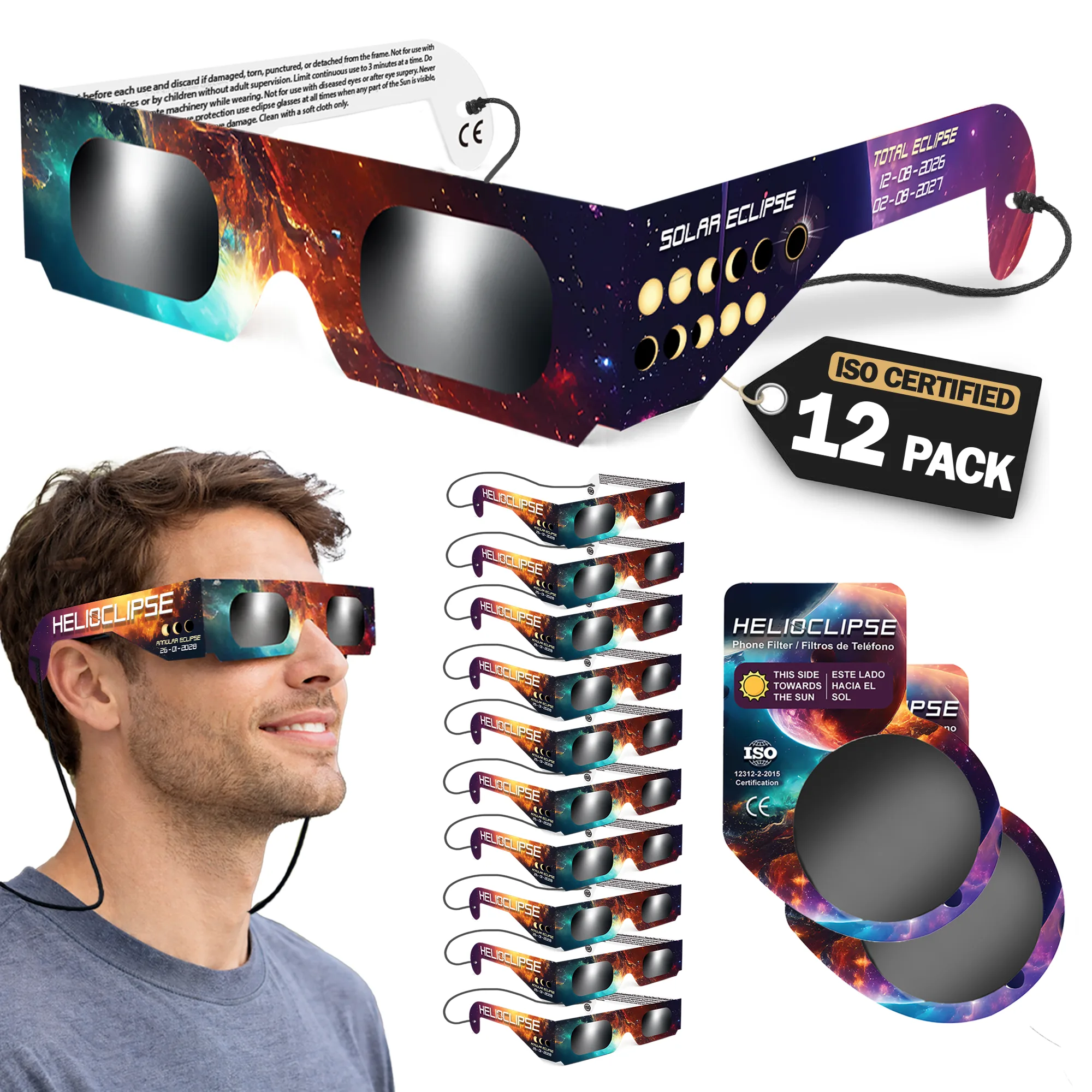
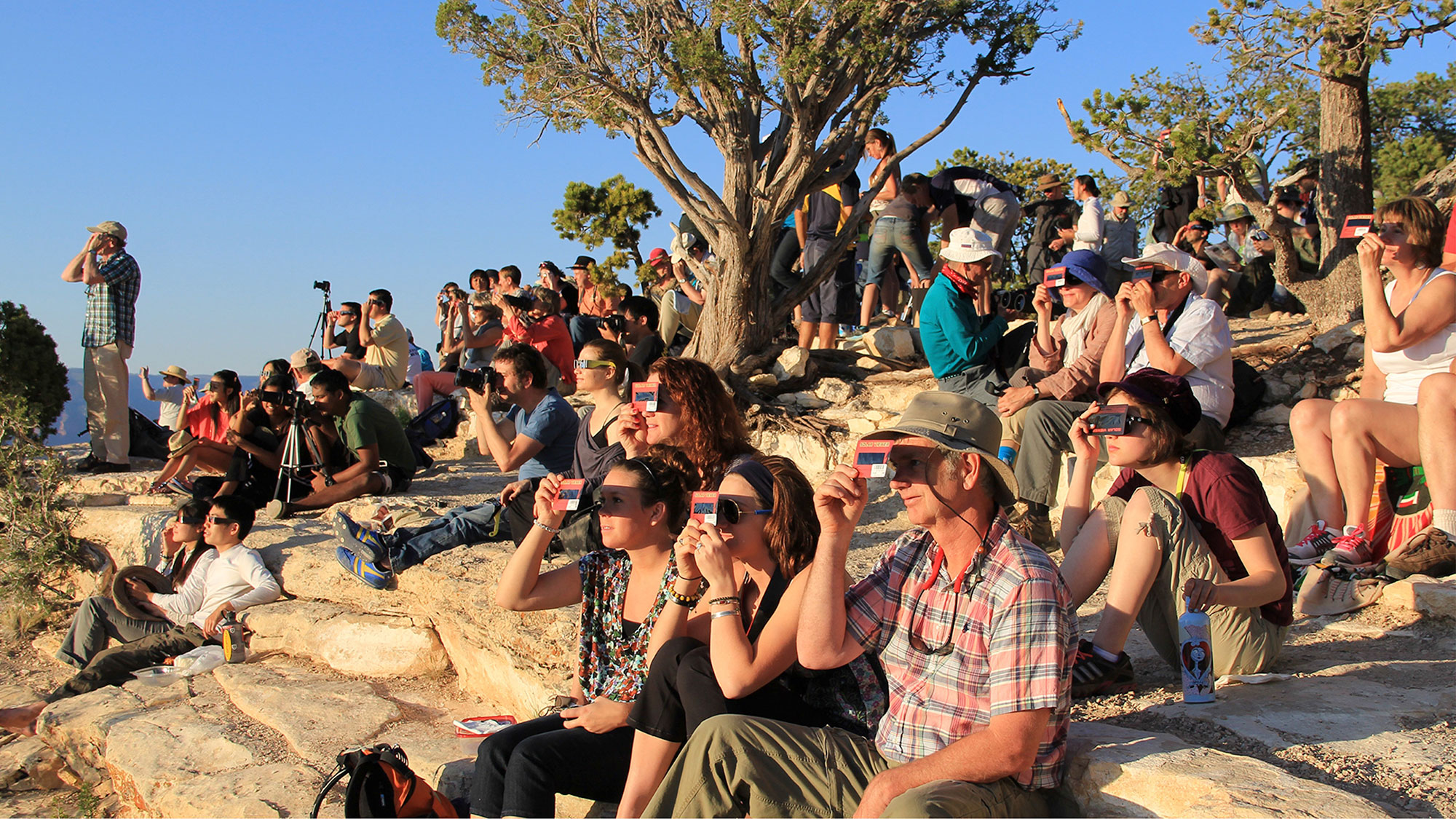
Children should use solar eclipse glasses or handheld viewers only under active adult supervision. Ordinary sunglasses are not adequate, however dark their lenses appear. For direct, unmagnified viewing, use viewers that conform to ISO 12312-2, inspect them before use, and discard any with scratches, punctures, tears, loose filters, or damaged frames. Our guide to ISO 12312-2 and eclipse viewers explains what that standard covers—and what a printed claim cannot prove by itself.
A useful solar eclipse kids families safety 2026 guide should not bury this routine beneath travel advice or scientific vocabulary. Equipment matters, but calm repetition is what helps a child use that equipment correctly.
Is eclipse viewing safe for children?
Parents often put the concern plainly: is eclipse safe for kids? Yes, children can enjoy a solar eclipse safely when they use appropriate solar viewers correctly or observe by an indirect method. Age alone does not make eclipse light more dangerous, but younger children may not reliably keep a wearable viewer in place.
That difference should shape your plan. A responsible seven-year-old who has practiced the routine may be comfortable with well-fitting viewers. A toddler who pulls at anything on their face is a better candidate for pinhole projection, crescent shadows beneath a tree, or an indoor livestream. The goal is participation, not forcing every child to look directly at the Sun.
The retina has no pain receptors that provide an immediate warning when intense sunlight is harming it. A child therefore cannot depend on discomfort to know when to turn away. Keep the message factual: “Sunlight is too bright for our eyes, so we use our special viewers before we look up.” There is no need for frightening images or repeated threats of blindness.
If anyone notices blurred vision, a central spot, distorted shapes, altered color vision, or unusual sensitivity to light after looking at the Sun, stop observing and contact a qualified eye-care professional promptly. Do not wait for pain; retinal injury may be painless and symptoms can be delayed.
Choose viewers that fit—and check every one
ISO 12312-2 applies to nonmagnifying viewers intended for direct observation of the Sun. It is not the standard for ordinary sunglasses, and it does not turn wearable glasses into a filter for cameras, binoculars, or telescopes. Those optical devices concentrate sunlight and require securely mounted filters made for the front aperture of the instrument.
Before eclipse day, inspect every viewer under normal room light. Check the filter area and the points where it joins the frame. Store cardboard viewers flat, clean, and dry so they cannot be bent, punctured, or scraped by keys and toys. Write each child’s name on the frame if that makes distribution calmer, but do not write on or alter the filter itself.
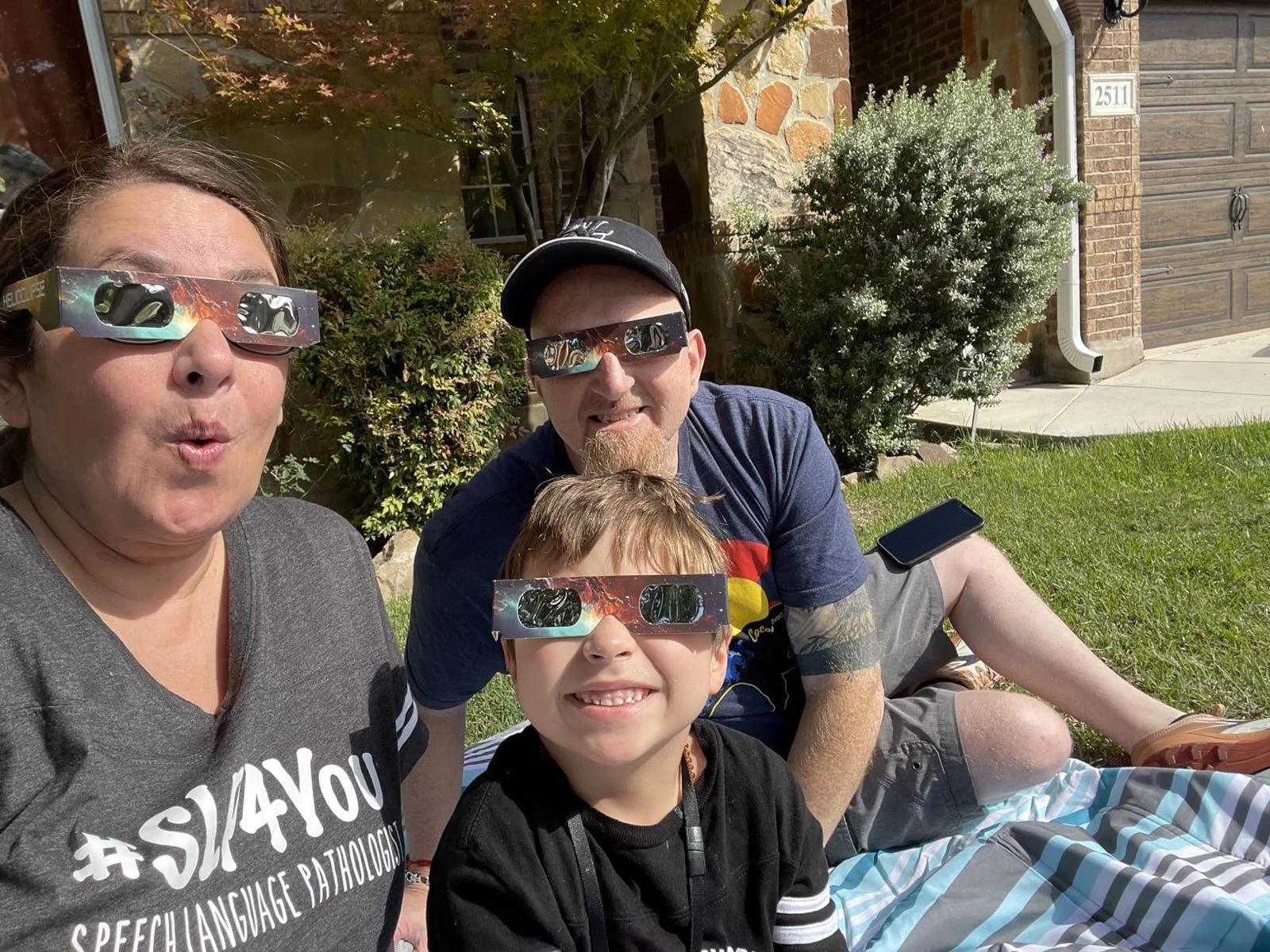
Fit matters. A viewer should cover both eyes without allowing a child to peek over, under, or around it. If wearable frames slide on a small face, use a suitable handheld viewer that an adult can help position, or choose indirect projection instead. Children who wear prescription glasses should keep them on and place eclipse viewers over them.
Marketplace wording can be confusing. Phrases such as approved solar eclipse glasses, eclipse glasses nasa approved, or solar eclipse glasses iso 12312-2 certified may appear in product descriptions, but wording alone is not evidence of compliance. NASA does not approve particular viewer brands. Look for traceable product information, usage instructions, the applicable ISO designation, and a trustworthy supply chain rather than relying on a badge or search-result claim.
Order equipment early enough to inspect it, practice with it, and replace anything unsuitable. Helioclipse offers ISO 12312-2 certified solar eclipse glasses for family and group planning.
What children will actually experience
A child may wonder, what happens during a solar eclipse for kids? The experience begins slowly. During a partial phase, the Moon moves across the Sun over roughly an hour or more, depending on the event and location. Through a safe viewer, the Sun gradually changes from a circle to a shape that looks as though a curved bite has been removed.
Most of that progression is subtle. There is no need to stare continuously. Take a short, supervised look every five or ten minutes, then compare the changing shape with a drawing made after the previous look. This rhythm reduces viewer fatigue and leaves time for snacks, play, projection experiments, and noticing the environment.
As more of the Sun is covered, the light may become silvery or strangely flat. Shadows can grow unusually crisp. The tiny gaps between leaves act like pinhole projectors, covering the ground with many small crescent Suns. Children often find this more surprising than the filtered view because an ordinary tree suddenly becomes part of the experiment.
Inside the path of totality, the final minutes are dramatically different: the sky darkens quickly, the air may cool, and bright planets or stars can appear. Only during the brief total phase—when the Moon completely covers the Sun’s bright face—is unaided viewing safe. As soon as any bright sunlight returns, viewers must go back on.
That exception applies only inside the path of totality. During every partial or annular eclipse, and outside the totality path during a total eclipse, there is no glasses-off moment. Review our family-friendly guide to when glasses go on and off during each eclipse phase before attending a total eclipse.
With younger children, designate one adult as the phase caller. That person watches the official timing and the Sun safely instead of taking photographs. If the adult cannot confidently confirm that totality has begun, everyone keeps their viewers on. Missing a few seconds is better than improvising.
Build a calm eclipse-day routine
Family safety messaging from pediatric or astronomy-outreach eclipse planning works best when it treats comfort as part of safety. Hungry, overheated, overtired children are less likely to follow instructions, so plan the outing as several hours outdoors rather than as a two-minute sky show.
Before leaving home
- Inspect and count the viewers.
- Practice “stand still, cover, look, turn away.”
- Explain whether your location will have totality or only a partial eclipse.
- Pack water, familiar snacks, sunscreen, hats, and weather-appropriate clothing.
- Bring a blanket or folding chairs and a simple activity for the slow partial phases.
- Download timings or save them offline in case mobile networks become congested.
- Choose one adult to supervise viewing and another, if available, to manage younger siblings and supplies.
At the observing site
Arrive before the eclipse begins. Find a place where children can sit away from roads, steep drops, open water, and crowded walkways. The best places and timing for solar eclipse kids families safety are not determined by maximum duration alone: reliable access to toilets, shade, drinking water, and an uncomplicated route home can matter more than gaining a few extra seconds of totality.
Tell children what will happen next. “We have ten minutes until our next viewer check” is easier to manage than a vague wait. If a child loses interest, let them play in a shaded area with an adult. Safe eclipse participation does not require watching every phase.
During each direct look
Hand out inspected viewers while everyone faces away from the Sun. Check that each viewer covers both eyes, give the signal to look, and keep each look brief. Then tell everyone to turn away before lowering the viewers. Collect them if children are likely to play with, fold, or swap them.
This is eclipse viewing with kids: simple rules, gear, and calm routines in practice—not constant warnings, and not a test of whether a preschooler can behave like an astronomer.
Babies, toddlers, and children who dislike eyewear
The practical question how to protect a baby from a solar eclipse? has a reassuring answer: a baby does not need special indoor protection merely because an eclipse is happening. Buildings do not need covered windows, and eclipse light does not create a new environmental radiation hazard.
Outdoors, use the same precautions you would use around bright sunlight on any day. Keep the baby comfortably shaded, position the stroller or carrier so the baby is not facing the Sun, and use age-appropriate sun protection. A stroller canopy should provide shade without blocking ventilation. An adult should remain attentive rather than assuming the baby cannot turn toward a bright source.
Babies and young toddlers cannot reliably use wearable solar viewers, so do not depend on glasses remaining over their eyes. Let them experience the changing light from a shaded position, observe projected crescents on the ground, or watch a reputable broadcast indoors. If managing the event feels stressful, staying inside is a perfectly good family choice.
Projection also works well for children with sensory sensitivities, motor difficulties, or discomfort around face-worn equipment. Give them control over how close they stand to the projected image, warn them about cheering or sudden crowd noise near totality, and bring hearing protection if they normally use it.
Projection turns waiting into an experiment
A pinhole projector lets children observe the Sun indirectly. Make a small hole in a piece of card, stand with your back to the Sun, and allow sunlight through the hole onto a second pale surface. Watch the projected image—not the hole and not the Sun. During the partial phase, the projected circle becomes a crescent.
A colander, perforated spoon, or crossed fingers can create many tiny images at once. Leafy trees do the same thing naturally. Ask children to count the crescents, trace one on paper, or compare how the image changes when the projection surface moves farther from the hole.
Make the device beforehand, but test it only with close adult supervision. A pinhole is not something to look through. Keep the Sun behind the observers and describe the activity as “making the Sun’s picture land on the ground.”
For a group, projection has another advantage: several children can examine one image without taking turns wearing viewers. It is an excellent fallback if glasses do not fit, a child refuses them, or an inspected viewer becomes damaged.
Phones, cameras, binoculars, and telescopes
A phone screen can display a remotely streamed eclipse safely, but holding up an unfiltered phone does not make direct solar observation safe. Children may look around the device toward the Sun, and a phone camera can also be damaged by concentrated or prolonged sunlight depending on its optics and exposure.
Do not place eclipse glasses over a camera lens and assume the combination is safe. Do not look through binoculars, a telescope, or a camera while wearing eclipse glasses. Magnifying optics concentrate solar energy and can damage the wearable filter as well as the eye behind it.
Any camera, telescope, or binocular setup requires a suitable solar filter secured over the front aperture and competent adult operation. Families who have not practiced with that equipment should leave it at home and enjoy the event without it. The simplest family photograph is often everyone looking down after a supervised view, with the changing light and shared excitement telling the story.
Solar and lunar eclipses are different safety situations
Two common questions deserve direct answers: is lunar eclipse safe for kids? And what are the do's and don'ts during the lunar eclipse? A lunar eclipse is safe to watch with unaided eyes, binoculars, or a telescope because you are looking at the Moon passing through Earth’s shadow—not at the bright solar surface.
For a lunar eclipse, the practical concerns are ordinary nighttime ones: warm clothing, traffic, uneven ground, bedtime, and responsible supervision. No solar viewers are needed. In fact, solar viewers are far too dark for looking at the Moon.
Questions about pregnancy also sometimes arise, including what should pregnant ladies do during an eclipse? There is no scientific evidence that an eclipse creates a special pregnancy hazard. Pregnant viewers can follow the same eye-safety rules as everyone else and account for normal outdoor needs such as hydration, heat, comfortable seating, medication schedules, and access to toilets. Cultural or spiritual traditions are personal choices, not substitutes for solar eye protection.
The distinction is simple: a lunar eclipse is an event involving the normally safe-to-view Moon; a solar eclipse directs attention toward the Sun, so direct viewing requires appropriate protection except during confirmed totality.
Keep the science simple without making it dull
You can explain a solar eclipse in one sentence: the Moon passes between Earth and the Sun, and its shadow falls on part of Earth. The Moon does not produce the darkness by changing the Sun; it temporarily blocks our view of the Sun from a particular place.
Ask younger children to make three balls represent the Sun, Moon, and Earth. A lamp can stand in for the Sun while one child moves a small ball between the lamp and a larger ball. The shadow is narrow, which helps explain why one town can experience totality while another sees only a partial eclipse.
Older children can record the Sun’s changing shape at regular intervals, measure air temperature in the shade, or note changes in animal behavior and ambient light. Avoid asking them to watch continuously. Good observing means making careful, separated checks—not keeping eyes fixed on the event.
The solar eclipse 2026 brought this contrast into focus for families across a broad partial-eclipse region and a much narrower totality path. The same planning lesson applies to every event: check your exact location rather than relying on a country-level description. A move of tens of kilometres can change whether totality occurs at all, while a much smaller move within the path can change its duration.
Frequently asked questions
Can children watch a solar eclipse safely?
Yes, children can watch safely when they use appropriate solar viewers correctly or watch by an indirect method. They should be actively supervised, and families should practice the routine of looking down, putting the viewer over both eyes, looking up, then looking down before removing it.
What will my child notice during a solar eclipse?
The Moon appears to cover part of the Sun, and daylight can change character while shadows become sharper. If you are in the path of a total eclipse, the Sun’s bright surface may disappear completely for a few minutes.
How can I keep a baby safe during an eclipse?
Do not rely on a baby or toddler to keep a wearable solar viewer in place. Indirect viewing, such as pinhole projection or watching crescent-shaped shadows beneath a tree, is a better option for children who pull at things on their face.
How can I explain a solar eclipse to a young child?
You can say that the Moon moves in front of the Sun and makes it look as if a bite has been taken out of it. Remind them that they must never look at the Sun without a suitable solar viewer or an indirect viewing method.
Do I need special eclipse precautions if I am pregnant?
The excerpt does not give specific guidance for pregnancy. Its safety advice focuses on avoiding direct viewing of the Sun and using suitable solar viewers correctly or choosing an indirect viewing method.
On-site next steps
- Choose and order your family’s Helioclipse solar viewers early enough to inspect them and rehearse the viewing routine.
- Use the Eclipse Explorer to confirm whether your exact observing site is inside totality, outside it, or within a partial or annular eclipse zone.
- Pack one simple projection activity as a backup, especially for babies, toddlers, and children who may not tolerate wearable viewers.
Sources & further reading
- Solar Eclipse Activities for Kids and Families — Sky & Telescope
- What to Expect: A Solar Eclipse Guide — NASA Science
- Eclipse Viewing Safety — NASA Science
- How Can My Child Watch a Solar Eclipse Safely? — KidsHealth
- Preparing for the Eclipse — American Astronomical Society education resource
- How to View a Solar Eclipse Safely — American Astronomical Society
- About the ISO 12312-2 Standard for Solar Viewers — American Astronomical Society
- Suppliers of Safe Solar Viewers & Filters — American Astronomical Society
- Eclipses Frequently Asked Questions — NASA Science
- Eclipses — NASA Science