Eclipse travel without the chaos: routes, crowds, and backup plans for 2026
For less than two minutes in many inhabited parts of the path, daylight will collapse into totality on August 12, 2026. The Sun’s corona will appear, the horizon will change color, and a journey that took months to arrange will suddenly come down to where you are standing—and whether a cloud, ridge, or traffic queue is standing between you and the sky.
That is why successful 2026 eclipse travel is not about finding one famous viewpoint and hoping for the best. It is about building a trip with options. Start by checking exact locations in our Eclipse Explorer and 3D map, then design your accommodation, routes, viewing sites, and departure around the geometry you find there.
Our 2026 eclipse travel tips crowds 2026 guide is built around one principle: protect the astronomical objective first, then fit the holiday around it. The best itinerary is rarely the one with the prettiest brochure photograph. It is the one that gets you inside totality, gives you a clear western horizon, and leaves enough flexibility to respond calmly when the forecast changes.
First decide whether you are travelling for totality
The Moon’s dark central shadow—the umbra—will cross parts of Greenland, Iceland, Spain, and a small corner of Portugal on August 12, 2026. Inside that narrow path, the Moon completely covers the bright face of the Sun. Outside it, observers see a partial eclipse, even when almost all of the solar disk is covered.
That distinction is enormous. NASA’s city table gives both Madrid and Barcelona approximately 99% coverage, but neither city is in totality. That remaining sliver of photosphere is still intensely bright, so the corona does not emerge and certified solar viewers remain necessary throughout. By contrast, León, Zaragoza, and Valencia are listed for totality, with the total phase occurring at roughly 8:28–8:33 p.m. local time.
If you are travelling specifically to experience the corona and the sudden darkness of totality, confirm that every proposed site lies inside the path—not merely “near the eclipse.” Our detailed guide to the 2026 path across Spain explains why the centerline, edge, and partial zone produce different experiences.
A single eclipse 2026 best place to see recommendation would conceal the real trade-offs. The 2026 eclipse best place to view depends on whether you value road mobility, a longer total phase, better seasonal weather odds, easier access, or a broader holiday that remains rewarding under cloud. The best places and timing for 2026 eclipse travel tips crowds therefore have to be evaluated together: a technically excellent site becomes a poor choice if its only access road locks up before you arrive.
Three geographic realities, three different trips
Spain: accessible, late, and low
Spain is likely to be the practical choice for many European travellers, but its late-evening geometry demands unusually careful site selection. The path crosses the country diagonally from the northwest toward the east and the Balearic Islands. A reported maximum near Spain is about 1 minute 44 seconds, while sites closer to the edge may receive only tens of seconds.
In northwestern Spain, totality occurs with the Sun roughly 10°–12° above the west-northwestern horizon. Farther east and around the Balearic Islands, it may be only about 2°–5° high. At an altitude of 3°, a ridge, apartment block, tree line, or seemingly modest hill can erase the critical view. A beach facing east may be wonderful at sunrise and useless for an eclipse happening low in the opposite direction.
NASA lists León’s partial phase beginning at 7:32 p.m., totality from approximately 8:28 to 8:30 p.m., and the partial eclipse ending at 9:22 p.m., all local time. Valencia’s totality is listed from about 8:32 to 8:33 p.m.; sunset arrives before the theoretical end of the partial phase. Zaragoza has a similar late schedule, with totality at approximately 8:29–8:30 p.m. These rounded city times are useful for orientation, but your exact coordinates determine the contacts and duration.
Spain also combines the eclipse with peak summer travel. Roads from Madrid toward Castile and León, and routes around Zaragoza, Tarragona, Valencia, and the Catalan corridor, may carry both ordinary holiday traffic and eclipse-day movement. We cannot responsibly predict a particular queue or journey time this far ahead. We can say that a plan requiring a fast drive from Madrid or Barcelona shortly before totality has almost no resilience.
Iceland: a higher Sun, longer totality, fewer road alternatives
Western Iceland offers the longest reported totality on land for this eclipse—about 2 minutes 13.7 seconds at the most favorable location—and the Sun will be around 25° above the southwestern horizon. That is a much less fragile sightline than the very low Sun in eastern Spain.
The path includes Reykjavík and parts of the Reykjanes Peninsula, Snæfellsnes Peninsula, and Westfjords. NASA’s rounded table gives Reykjavík a partial beginning at 4:47 p.m., totality from approximately 5:48 to 5:49 p.m., and a partial end at 6:47 p.m. local time. Exact duration varies by position, so being in Reykjavík does not automatically deliver the maximum available in Iceland.
The trade-off is mobility. Iceland’s principal roads can be excellent, but many secondary routes are narrow, and some areas offer few practical alternatives when traffic builds or weather closes in. A backup site 120 kilometres away is not meaningful if reaching it requires retracing the same congested road. Build your Iceland plan as a network of reachable sites, not as a collection of attractive pins scattered across a map.
Greenland: remarkable totality with expedition-level constraints
Around Scoresby Sund in eastern Greenland, reported totality reaches approximately 2 minutes 17 seconds, with the Sun about 25° above the western horizon. The setting is extraordinary, but transport, cost, weather, and medical contingencies are fundamentally different from a road trip in Spain.
For most visitors, Greenland is not a destination where they can simply change valleys after breakfast. Access may depend on aircraft, ships, or a fixed expedition itinerary. A large weather system can affect a broad region for days, and local mobility may be limited. Choose this experience because the Arctic journey itself matters to you—not because a package implies that the sky can be guaranteed.
What is an eclipse chaser?
What is an eclipse chaser? In practical terms, it is someone who treats the Moon’s shadow as a moving target rather than a ticketed attraction. Experienced chasers compare path geometry, cloud forecasts, roads, terrain, and the position of the Sun. They may choose an ordinary field over a celebrated monument because the field has a clean horizon and three ways out.
You do not need to become an obsessive traveller to borrow that mindset. For a first 2026 eclipse trip, it means separating fixed decisions from flexible ones. Your flight or long-distance train may be fixed months ahead. Your regional base may be fixed several nights ahead. Your exact viewing site should remain adjustable until the useful weather forecast comes into range.
The practical question—should I travel during a solar eclipse?—has two answers. Travel is worthwhile if totality matters to you and you can enter the path without creating financial or logistical strain. It may not be worthwhile if the trip depends on a same-day connection, a non-refundable chain of transfers, or a promise that one exact site will be clear. A partial eclipse from home can still be beautiful and shared safely; it simply is not a substitute for totality.
Build a route plan with three layers
A robust route is not just the line from your hotel to your preferred field. Give the day three layers: a base, an observing zone, and a final site.
Your base should already be inside the path if possible. Staying within totality the night before removes the riskiest journey from eclipse morning. It also lets you inspect the western horizon at approximately the same clock time on August 11, when buildings, hills, and tree lines will be obvious.
Your observing zone is a manageable area with several sites under different cloud regimes. In Spain, that might mean choosing a base from which open parts of Castile and León or the Ebro Valley are reachable without crossing a major city. In western Iceland, it could mean choosing between coastal and inland options while avoiding a plan that relies on one single-lane bottleneck.
Your final site needs legal access, safe parking, toilets or a realistic sanitation plan, mobile reception if available, and enough open space for your group. Never stop on a live carriageway or block agricultural gates. If authorities establish controlled viewing areas, parking rules, fire restrictions, or road closures, those instructions override an informal plan made from satellite imagery.
Set decision times in advance. For example: choose the broad zone the previous evening, choose the route early on eclipse morning, and stop making long-distance moves several hours before totality unless a clearly better forecast and viable road justify the change. Constant indecision can leave you travelling when you should be setting up.
Treat the western horizon as part of the weather
Ordinary forecasts often summarize cloud directly overhead. In Spain, that is not enough. During totality you will be looking through a long wedge of atmosphere toward the west or west-northwest, especially where the Sun is only a few degrees high. A distant cloud bank outside your immediate forecast area may matter more than blue sky above your head.
Check forecasts from national meteorological services, compare more than one model, and examine satellite imagery as eclipse day approaches. But do not confuse August climate averages with a forecast for one evening. Climate helps you select a region months in advance; weather helps you select a site during the final days and hours.
Terrain deserves equal attention. Use the Eclipse Explorer to establish path position and timing, then inspect the actual viewing direction with terrain information and an on-site visit. A hill only a few kilometres away can subtend several degrees. In eastern Spain or Mallorca, where totality can occur 2°–5° above the horizon, that can decide the entire experience.
Our guide to cloud cover and eclipse-day mobility goes deeper into forecast timing, satellite views, and the point at which chasing a gap becomes riskier than staying put.
Crowd planning starts with the journey after totality
Eclipse traffic is asymmetric. Arrivals are spread across many hours or days; departures can begin within minutes of the Sun reappearing. Evidence from earlier eclipses shows why otherwise ordinary roads can bottleneck after totality, especially where traffic funnels toward the same motorway, bridge, ferry, or metropolitan area.
Do not plan to race back to Madrid or Barcelona immediately after the eclipse. In Spain, totality ends close to sunset, so tired drivers, unfamiliar rural roads, and concentrated departures will coincide with fading light. Stay in the path overnight if you can. If that is impossible, pack food and water, keep the fuel or battery level comfortably above what the normal route requires, and identify a safe place to wait while the first departure wave disperses.
There is a reward for patience: the Perseid meteor shower peaks around the night of August 12–13. Moonlight and local conditions will affect what you see, but a rural overnight stop can turn the urge to flee into a second skywatching experience. It is a much better ending than spending totality mentally calculating how quickly you can reach the car.
Families should agree on a meeting point in case mobile networks become overloaded. Download maps for offline use, write the accommodation address on paper, and give children a contact card. Tell friends or relatives your broad plan before leaving, but avoid broadcasting an improvised roadside location that cannot safely absorb more vehicles.
Tours and packages: buy logistics, not certainty
Commercial support can simplify accommodation, transfers, meals, and local permissions. It cannot guarantee clear skies. When comparing 2026 eclipse travel packages and 2026 eclipse tour packages, look for operational detail rather than superlatives: Is the advertised site definitely inside totality? What is the approximate duration? Is the low western horizon unobstructed? Is there a weather-mobility policy? What happens if roads close?
Even the best 2026 eclipse tours must work within local transport and forecast limits. Ask whether buses can change sites, when that decision would be made, and whether every alternative remains inside the path. Some organized 2026 eclipse trips may sensibly prioritize a comfortable fixed event; others may emphasize mobility. Neither model is automatically wrong, but you should know which experience you are buying.
Read cancellation terms and accessibility information carefully, and verify claims against independent eclipse maps. Avoid any 2026 eclipse trip marketed as though totality were visible from Madrid or central Barcelona. Approximately 99% coverage is still partial there. Likewise, “near the centerline” is not useful if a mountain blocks the eclipsed Sun.
Pack for waiting, not only watching
The central spectacle is brief, but the day is long. Carry water, food, sun protection, medication, power banks, offline maps, layers, a small first-aid kit, and more time than you think you need. In rural Spain, August heat and limited shade may matter for hours before the late eclipse. In Iceland or Greenland, wind and rapidly changing conditions require a very different clothing system.
Pack solar viewers before you travel rather than assuming they will be available at the destination. The terminology around products can be confusing: phrases such as approved solar eclipse glasses or eclipse glasses nasa approved may appear in casual product language, but NASA explicitly states that it does not approve individual viewer brands. What matters is credible conformity with ISO 12312-2, clear manufacturer information and instructions, and an undamaged filter.
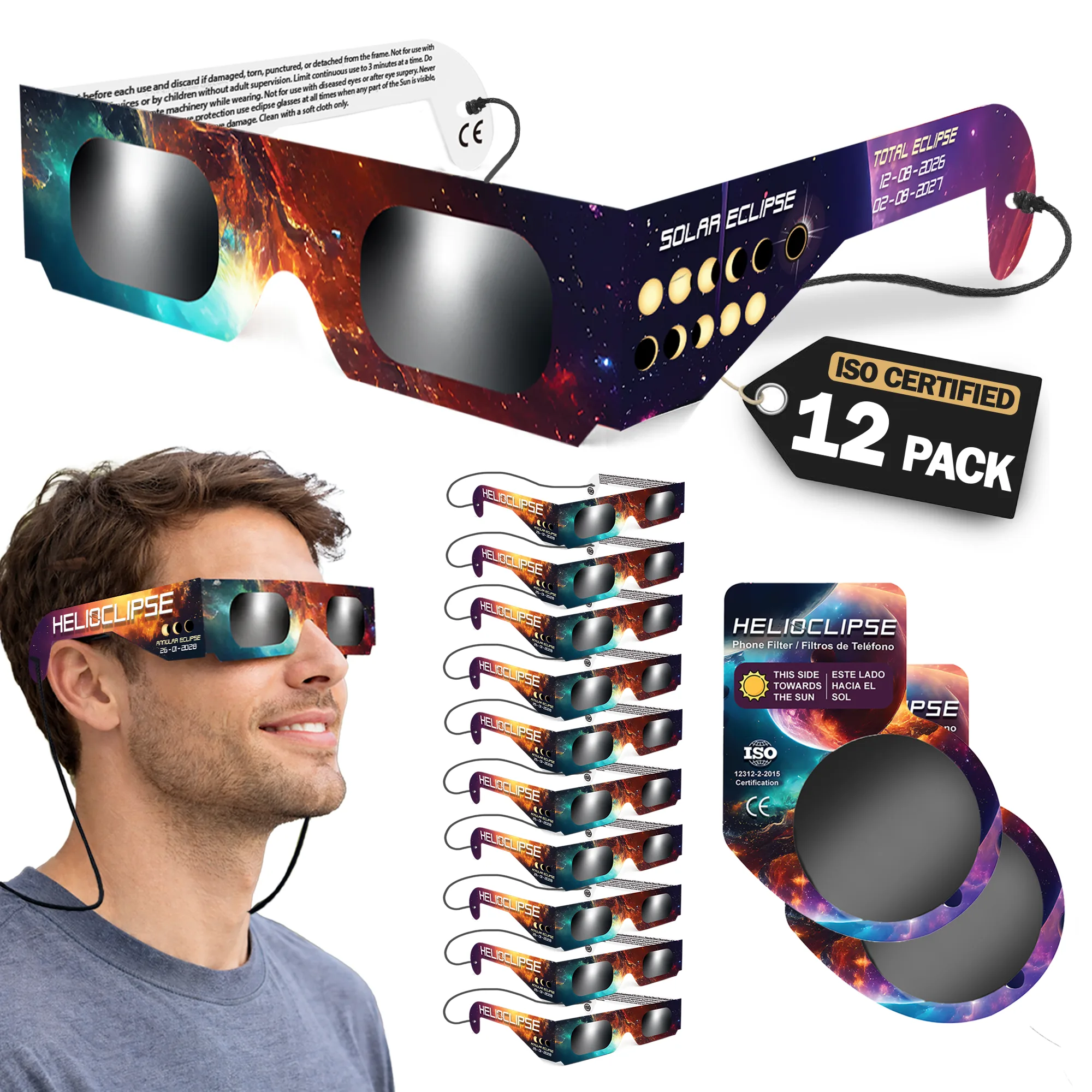
When buying solar eclipse glasses iso 12312-2 certified for your group, inspect every viewer before use and bring spares. Our Helioclipse solar eclipse glasses provide a direct place to prepare your family or group early rather than improvising at a crowded destination. Certified solar eclipse glasses are for direct, unmagnified viewing; they are not filters for cameras, binoculars, or telescopes.
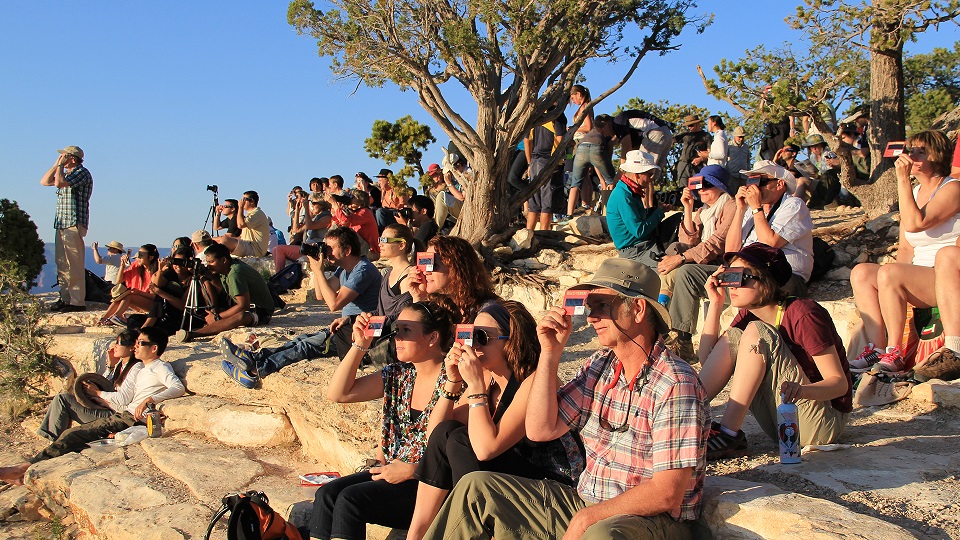
Ordinary sunglasses are never sufficient, however dark they appear. During every partial phase, use proper solar viewers or an indirect method such as pinhole projection. Only observers inside the path may remove viewers during the brief interval when the Sun’s bright face is completely covered. Put them back on immediately when any bright photosphere reappears. Our guide to eclipse phases and viewer use is worth sharing with everyone in your group before the journey.
Your backup plan needs a stopping rule
A good Plan B is not “drive toward blue sky.” It names a destination, route, latest departure time, fuel stop, parking option, and threshold for abandoning the move. Plan C should be simpler still: remain at the base, watch whatever the weather permits, and use an official live broadcast if clouds win.
Write a short decision sheet before the final forecast arrives:
- Primary site: exact coordinates, expected duration, western horizon, parking, and access rules.
- Backup site: why its weather exposure differs and how long the route takes under normal conditions.
- No-move time: the latest point at which changing sites remains safe and realistic.
- Partial-eclipse plan: viewers, pinhole projection, and activities if you are outside totality or clouded out.
- Departure plan: overnight stay, delayed exit, or multiple legal routes away from the area.
This is the heart of eclipse travel without the chaos: routes, crowds, and backup plans should reduce decisions when everyone is tired and excited. They should not create a frantic scavenger hunt across unfamiliar roads.
The event itself will not wait. The shadow crosses each location on its own schedule, totality ends within moments, and the partial phase continues toward sunset. Your job is not to control every variable. It is to remove the avoidable failures so that, when the light begins to change, you can stop managing logistics and look up safely.
Frequently asked questions
What does the term “eclipse chaser” mean?
The excerpt does not define the term “eclipse chaser.” It describes travelers who plan around reaching the path of totality and keep flexible options for weather, routes, and viewing locations.
Are free certified solar viewers available for eclipse travelers?
The excerpt does not say where to obtain certified solar viewers or whether any are free. It does state that certified solar viewers are necessary throughout a partial eclipse.
What viewing mistake should I avoid during a solar eclipse?
Do not assume that being near the path, or seeing about 99% coverage, is the same as experiencing totality. Outside the narrow totality path, the remaining visible part of the Sun is still intensely bright, so certified solar viewers are required throughout.
What can I use to watch the eclipse if I do not have certified solar viewers?
The excerpt does not provide an alternative to certified solar viewers for viewing a partial eclipse. It says these viewers remain necessary throughout the event for locations outside totality.
What time is the February 17 solar eclipse?
The excerpt provides no information about a solar eclipse on February 17. It discusses the total solar eclipse on August 12, 2026, with totality in listed Spanish cities occurring at roughly 8:28–8:33 p.m. local time.
On-site next steps
- Explore exact path boundaries, local circumstances, and candidate locations with the Helioclipse 3D eclipse map.
- Compare your primary and backup sites for total versus partial viewing, expected duration, and horizon direction.
- Prepare your group early with ISO 12312-2 eclipse viewers, then inspect them again before eclipse day.
- Read our full August 12, 2026 planning guide and share the route and safety plan with everyone travelling.
Sources & further reading
- NASA Science: Total Solar Eclipse on August 12, 2026
- EclipseWise: Guide for the Total Solar Eclipse of 2026
- Space.com: Eclipse chasers share insider tips, travel advice and skywatching secrets for the 2026 total solar eclipse
- Space.com: Spain’s total solar eclipse 2026 comes with a catch
- Astronomy: Where are the best places to see the 2023 and 2024 solar eclipses?
- American Astronomical Society: How to View a Solar Eclipse Safely
- American Astronomical Society: About the ISO 12312-2 Standard for Solar Viewers
- NASA Science: Eclipse Viewing Safety
- NASA Science: Types of Solar Eclipses
- NASA Science: Why Do Eclipses Happen?