Cloud cover and eclipse day: how to read the sky and when to move
You can predict a solar eclipse centuries in advance, but you cannot promise a clear patch of sky at one precise place and minute. That mismatch—perfect celestial timing, imperfect terrestrial weather—is what makes the final days of eclipse planning so tense.
The answer is not to chase every optimistic forecast icon. It is to separate climate from weather, learn what different cloud layers mean, and preserve enough mobility to act when the evidence becomes useful. Start by confirming the eclipse geometry and local circumstances in our Eclipse Explorer. Weather cannot rescue a site outside the path of totality, and a clear horizon cannot turn a partial eclipse into a total one.
This eclipse day weather cloud forecast guide gives you a practical decision process rather than a guarantee. The goal is simple: improve your odds without trading them for traffic, dangerous driving, blocked horizons, or a last-minute dash that leaves you watching from a road shoulder.
Climate tells you where to plan, not what will happen that day
Cloud climatology describes what has happened on many comparable dates over many years. It is useful months ahead, when you are choosing between broad regions, but it is not a forecast for one afternoon. An area with a historical 40% cloud fraction can still be completely overcast on eclipse day; a statistically cloudier region can be crystal clear.
That distinction is central to understanding cloud cover and eclipse planning. Use climatology to select a base with reasonably favorable seasonal odds, workable roads, several observing options, and a safe horizon. As the event approaches, actual weather systems, humidity, wind direction, terrain, and cloud-layer forecasts gradually become more important than the historical average.
For the total solar eclipse of August 12, 2026, the geographic choices are unusually varied. Totality crosses parts of Greenland, western Iceland, and Spain. In Scoresby Sund in eastern Greenland, totality can last about 2 minutes 17 seconds, with the Sun roughly 25 degrees above the western horizon. Western Iceland offers up to about 2 minutes 13.7 seconds, also with the Sun near 25 degrees high. Spain offers roughly 1 minute 44 seconds near the longest-duration locations, but totality occurs shortly before sunset, making terrain and low western cloud especially important.
Spain's average August cloud cover along much of the path has been reported at below 50%, but that statistic does not tell you whether a thunderstorm, coastal cloud bank, or transparent veil of cirrus will occupy your chosen sightline on August 12. Our 2026 eclipse planning guide connects these regional trade-offs with the event's timing and geometry.
Read a cloud chart as layers, not one alarming percentage
A cloud-cover map commonly shades the sky from clear to overcast or gives a percentage. That number is easy to overinterpret. It may represent the fraction of a model grid cell covered by cloud, not the probability that the Sun will be hidden from your exact position. It may also combine several cloud layers into one total-cloud field.
When available, examine at least four products:
- Low cloud: fog, stratus, and stratocumulus close to the surface. These can form broad, opaque decks and are often the most damaging to direct visibility.
- Middle cloud: altostratus and altocumulus. Their optical thickness varies; some allow a muted solar disk to show, while others block it completely.
- High cloud: cirrus and cirrostratus made mostly of ice crystals. Thin high cloud may preserve a good view of totality, although it can soften the corona and reduce contrast.
- Total cloud: a useful summary, but not a diagnosis. It can look pessimistic when several partly cloudy layers overlap in the model.
Suppose a chart shows 70% total cloud but only 10% low cloud, with a thin high-cloud layer moving through. That is not equivalent to 70% low overcast. Conversely, a forecast showing 40% cloud can still be disastrous if one persistent opaque deck sits across the Sun's low-altitude direction.
This is why an eclipse cloud weather forecast should be read alongside humidity, precipitation, wind, and cloud-base information. Ask not only “How much cloud?” but also “At what height, how thick, moving in which direction, and at the eclipse time?” The cloud cover day of eclipse matters at the Sun's position—not merely overhead or at midday.
Forecast confidence changes sharply during the final week
Forecast models simulate the atmosphere from an imperfect snapshot of current conditions. Small uncertainties grow with time, so a model run issued ten days ahead can identify a broad pattern but usually cannot place a narrow clearing reliably over one town.
A useful timeline looks like this:
Seven to ten days out: look for patterns, not destinations
Watch for large-scale signals such as an Atlantic low, a blocking high, a frontal corridor, or widespread moist flow. Do not cancel a trip because a weather app displays a cloud icon. At this range, even the position and timing of a major system may shift substantially between runs.
Four to six days out: compare several models
This is when an eclipse cloud forecast model may begin to show a recurring regional signal. Agreement among independent models increases confidence; disagreement is information too. If one model clears northern Spain while another keeps a front across the same area, preserve options rather than declaring a winner.
Run-to-run consistency matters. A clear patch that jumps 300 kilometres every six hours is not yet a dependable destination. A broad dry sector appearing in several consecutive runs deserves more attention.
Two to three days out: narrow the operating area
Forecasts now become useful for choosing among realistic bases. Compare cloud layers at the actual eclipse hour, review wind and precipitation, and identify routes that do not funnel everyone onto one road. Veteran eclipse meteorologists often treat this as the point for choosing a final region, not necessarily the final field.
The final 24 hours: use observations as well as forecasts
Model guidance remains valuable, but satellite imagery, radar, weather stations, webcams, and the visible sky show what the atmosphere is actually doing. Watch the movement of cloud edges over several frames. One still image can make a clearing look stationary when it is racing away.
In the United States, labels such as eclipse cloud forecast nws or eclipse cloud forecast national weather service usually refer to National Weather Service discussions, sky-cover products, and local office updates. Those official forecasts are more useful than anonymous screenshots because meteorologists can explain uncertainty and local terrain effects. Elsewhere, use the relevant national meteorological agency—for example, Iceland's meteorological service or Spain's AEMET—and check the issue time and timezone on every chart.
Clouds are not all-or-nothing
The practical question—can i see the eclipse if it's cloudy?—has more than one answer. Thin cirrus may allow you to see the eclipsed Sun and corona, though with reduced contrast. Broken cumulus can produce a magnificent view if the right gap arrives at the right minute. Thick low overcast may hide the Sun completely.
Even under opaque cloud, a total eclipse can remain physically dramatic. The landscape darkens rapidly, temperatures may fall, automatic lights can switch on, and a sunset-like glow may appear near clearer horizons. Mid-level cloud can act as a screen on which the Moon's approaching shadow changes the colour and brightness of the sky. Under thick low cloud, the effect may feel more like someone quickly turning down a giant dimmer switch.
So what does the sky look like during an eclipse? In clear conditions near totality, the light becomes strangely sharp and desaturated before the sky drops into deep twilight. During totality, the black lunar silhouette is surrounded by the pale corona, while brighter planets may appear and the horizon can glow in several directions. With broken or translucent cloud, those changes may be softened, coloured, or projected across the cloud layer. With solid overcast, darkness and the behaviour of the surrounding landscape become the main event.
NASA's analysis of the April 8, 2024 eclipse found striking regional contrasts: thin cirrus still permitted excellent viewing in parts of northern New England, while low stratocumulus blocked the corona in parts of New York. NASA also notes that some shallow convective clouds may weaken as the ground cools during an eclipse, but thunderstorms and large weather systems do not simply dissolve because the Moon's shadow arrives. Never base your plan on the eclipse “clearing its own clouds.”
Terrain and the horizon can matter more than the overhead sky
For the 2026 eclipse, Spain illustrates why a generic cloud percentage is not enough. The Sun will be low in the west shortly before sunset. A clear sky overhead is useless if hills, buildings, trees, haze, or a compact cloud bank cover the western horizon.
The path crosses Spain from Galicia toward the northeast and onward through areas including parts of Catalonia and the Balearic region. Madrid and Barcelona narrowly miss totality, so a weather decision must not accidentally move you out of the total path. Check every candidate point on the Helioclipse 3D map, then inspect the western azimuth on site. Our guide to the 2026 path across Spain explains why being near the centreline and having a usable horizon are separate questions.
In western Iceland, the Sun is substantially higher—around 25 degrees—and the Reykjanes Peninsula, Snæfellsnes Peninsula, and Westfjords offer different exposures to maritime cloud. Yet mobility may be constrained by single-lane roads and concentrated traffic. A forecast clearing two hours away is not useful if the route takes three hours once eclipse traffic builds.
Greenland presents another trade-off. Air descending from the ice cap can dry and clear, but a large synoptic system can cover Scoresby Sund for days. Many visitors will also have little independent mobility. In such places, the wiser strategy may be to choose the best available local exposure and accept the weather rather than pretending a long chase is possible.
Decide whether to move with a threshold, not a hunch
A mobile plan works only if you decide in advance what evidence will trigger it. Otherwise, anxiety encourages endless repositioning: each new forecast sends the group toward another uncertain patch, consuming time until no option remains.
Use a written decision rule. For example:
- Stay if several current forecasts agree on acceptable visibility and satellite imagery supports them.
- Prepare to move if your site is beneath a persistent low-cloud deck while a reachable area shows a broad, stable clearing.
- Do not chase a tiny modelled hole, a single optimistic app, or a clearing that requires crossing a congested city close to first contact.
- Stop moving by a predetermined deadline that leaves time to park legally, walk to the site, check the horizon, distribute viewers, and settle children or older relatives.
A plan for the best places and timing for eclipse day weather cloud forecast decisions must combine astronomy, meteorology, and road reality. The clearest forecast point is not automatically the best observing point if it lies outside totality, behind a mountain, beyond a traffic bottleneck, or on private land.
For August 12, 2026, consider choosing a base with options in more than one direction rather than a beautiful but isolated endpoint. Download maps for offline use, charge phones and power banks, fuel or charge the vehicle the day before, and pack water and food. Share the decision deadline with your group so everyone knows that safety outranks a speculative cloud gap. Our guide to eclipse travel, crowds, and backup plans goes deeper into route design and post-eclipse congestion.
Do not confuse eclipse dates when checking forecasts
Weather products are valid for a specific place, date, hour, and timezone. A screenshot detached from those details can be worse than no forecast at all.
The question where to see august 2 solar eclipse? is incomplete without a year. The major total eclipse on August 2, 2027 crosses parts of southern Spain, North Africa, and the Middle East; it is not the August 12, 2026 event discussed here. Mixing those dates can send you to the wrong path and the wrong seasonal weather data.
Likewise, what time is the february 17 solar eclipse? cannot be answered responsibly without the year and observing location. Eclipse contact times vary geographically, and a listed UTC time is not necessarily local civil time. Confirm the event first, then retrieve circumstances for your exact coordinates.
Treat an eclipse day weather cloud forecast 2026 guide as a method, not a static prediction. For August 12, enter your intended coordinates in the eclipse map, note the local partial-phase and totality times, the Sun's altitude and direction, and then read weather products valid for that same window. This simple cross-check prevents a surprising number of planning mistakes.
Weather never changes the eye-safety rules
A cloud gap can expose the bright Sun in seconds. Thin cloud, haze, sunset light, or a mostly eclipsed solar disk does not make direct viewing safe during a partial phase. Use special-purpose solar viewers that conform to ISO 12312-2 whenever any part of the Sun's bright face remains visible.
Only observers inside the path of totality may remove viewers during the brief interval when the Moon completely covers the Sun. Put them back on as soon as the bright photosphere begins to reappear. Outside totality—including Madrid and Barcelona on August 12, 2026—viewers remain necessary throughout the eclipse.
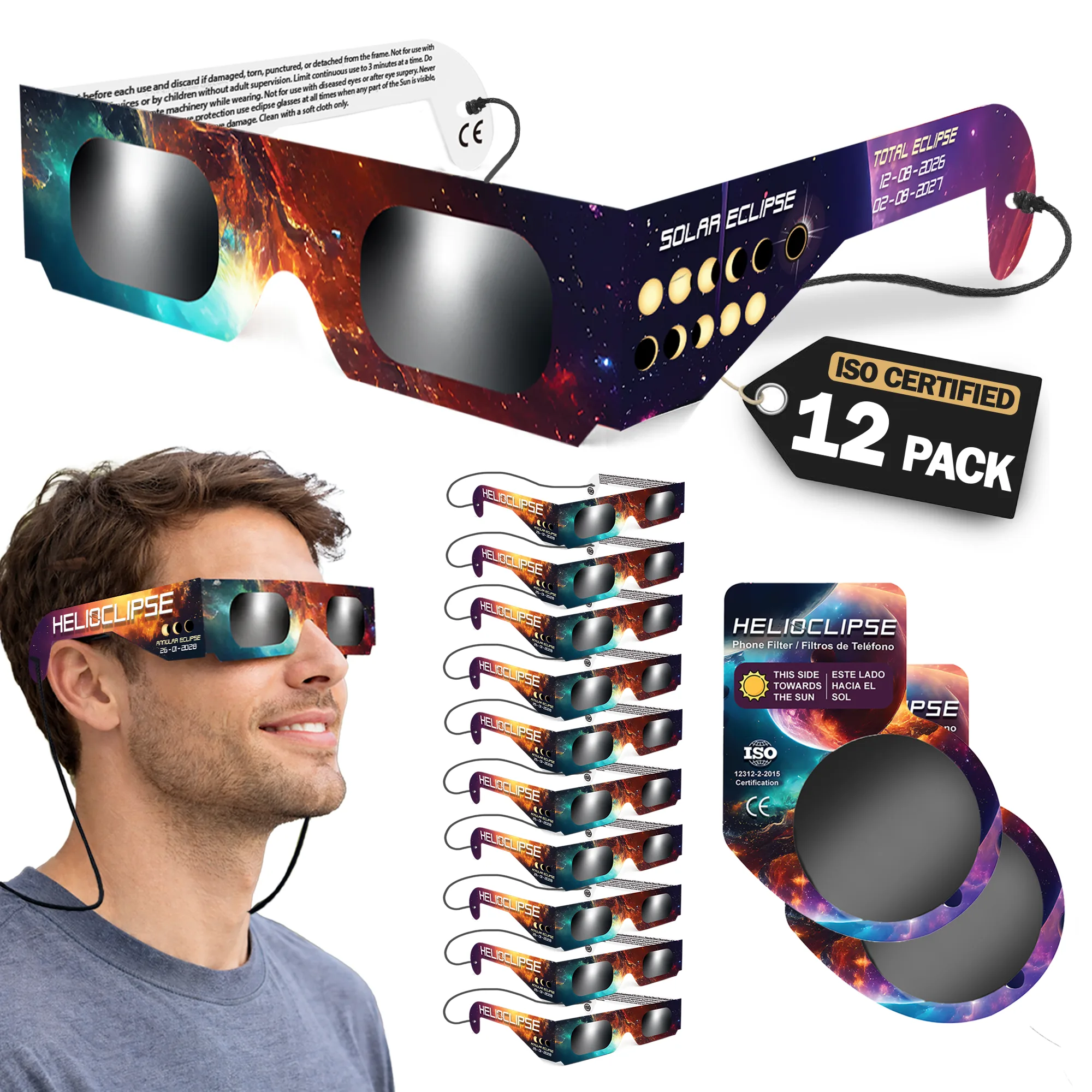
Cloud uncertainty is also a reason to prepare equipment early. Phrases such as eclipse glasses nasa approved or nasa certified solar eclipse glasses are misleading because NASA does not approve or certify viewer brands. When evaluating eclipse viewing glasses, look for trustworthy supplier information, inspect every viewer for damage, and follow the printed instructions. Our solar eclipse glasses are the place to check Helioclipse product details if you need solar eclipse glasses iso 12312-2 certified for your family or group.
For a clear phase-by-phase safety plan, read when to use solar glasses. Tell friends, schools, and family members early: the weather may remain uncertain until late, but safe viewing supplies and group instructions should not.
A calm eclipse-morning workflow
On the morning of the eclipse, avoid opening ten apps and treating every percentage as a vote. Use a compact sequence:
- Confirm that all candidate sites are still inside the correct eclipse zone.
- Read the latest forecast discussion from the national or regional weather service.
- Compare two or three recent model runs, especially low, middle, and high cloud at eclipse time.
- Animate satellite imagery to judge cloud motion and development.
- Check radar and lightning information where showers or thunderstorms are possible.
- Verify road closures, parking rules, fuel or charging range, and the western horizon.
- Make the go-or-stay decision at the agreed time.
Then stop refreshing and get ready to experience the sky. Distribute viewers before the partial phase begins. Give children a simple routine: viewers on before looking up, turn away before taking them off. Set up chairs and cameras without blocking public roads or emergency access.
An eclipse cloud forecast cannot remove uncertainty. What it can do is replace panic with informed choices. You may still meet a cloud at exactly the wrong moment; that is the honest nature of observing from beneath an atmosphere. But a flexible base, layered forecast reading, current satellite imagery, and an early decision give you far better odds than either blind optimism or frantic last-minute driving.
Frequently asked questions
Where can I watch the August 2 solar eclipse?
The excerpt does not identify viewing locations for an August 2 eclipse. It discusses the August 12, 2026 total solar eclipse, whose path of totality crosses parts of Greenland, western Iceland, and Spain.
What time will the February 17 solar eclipse occur?
The excerpt does not provide a time for a February 17 solar eclipse. Eclipse timing and visibility are location-specific, so confirm the local circumstances for your observing site before making plans.
Can an eclipse still be visible through cloud cover?
Cloud cover can block the Sun, so a clear view cannot be promised at a specific place and time. Thin high cloud may affect a sightline differently from thicker cloud, which is why cloud layers matter more than a single cloud-cover percentage.
What should I expect the sky to look like during the eclipse?
The excerpt does not describe the visual appearance of the sky during an eclipse. It notes that the Sun will be about 25 degrees above the western horizon in eastern Greenland and western Iceland, while totality in Spain occurs shortly before sunset, making the western horizon and low cloud especially important.
What is the safest way to choose an eclipse viewing location?
Choose a site with a safe horizon, workable roads, and several observing options rather than relying on a last-minute move. Avoid dangerous driving, blocked horizons, and watching from a road shoulder.
On-site next steps
- Check your exact observing point, totality status, local timing, and solar altitude in the Helioclipse Eclipse Explorer.
- Save two or three legal backup sites with different route and horizon options.
- Arrange ISO 12312-2 eclipse glasses for your group before demand peaks.
- Review the Helioclipse blog and planning guides with the people travelling with you, then agree on one weather decision deadline.
Sources & further reading
Weather and practical forecasting
- Solar eclipse 2024 weather prospects — Q&A with an expert — Space.com
- Eclipse Weather: Decision Time — Sky & Telescope
- Cloudy With a Chance of Eclipse — NASA Earth Observatory
- What happens if it's cloudy for the April 8 solar eclipse? — Space.com
- Eclipse chasers share insider tips, travel advice and skywatching secrets for the 2026 total solar eclipse — Space.com
Eclipse science and viewing safety
- How to View a Solar Eclipse Safely — American Astronomical Society
- Eclipse Basics — American Astronomical Society
- What to Expect: A Solar Eclipse Guide — NASA Science
- Eclipse Viewing Safety — NASA Science
- Eclipses Frequently Asked Questions — NASA Science