2026 totality in Spain: path basics, timing, and what “on the centerline” really means
On August 12, 2026, the Moon’s darkest shadow crossed northern Spain shortly before sunset. Inside that moving shadow, the Sun’s brilliant surface disappeared for roughly one to two minutes. A short distance outside it, even a 99% partial eclipse remained unmistakably bright—and the corona never emerged.
That sharp boundary is the essential fact behind the 2026 totality in Spain. The country was not uniformly “under the eclipse.” A corridor roughly 300 kilometers wide crossed from the northwest toward the east-southeast, while Madrid and Barcelona remained just outside totality. You can examine that geometry, including the difference between the path edge and its center, with our Eclipse Explorer and 3D map.
The global total solar eclipse 2026 path also crossed northern Russia, Greenland, western Iceland and the North Atlantic before reaching Spain and a small corner of Portugal. In Spain, however, the late-evening timing created an unusual planning problem: being inside the path was necessary, but it was not sufficient. You also needed an open west-northwest horizon, workable weather and enough mobility to reach your chosen site.
The path was the Moon’s moving shadow—not a line on a road map
A total solar eclipse occurs when the new Moon passes between Earth and the Sun and its dark inner shadow, the umbra, reaches Earth’s surface. Because the Moon and Earth are both moving, that shadow sweeps across the planet. The strip traced by the umbra is the path of totality.
The lighter outer shadow, or penumbra, covers a much larger area. Inside it, the Moon hides only part of the Sun. That is why much of Europe saw a partial eclipse on August 12 while only a comparatively narrow corridor experienced totality.
The 2026 path of totality in Spain ran east-southeast across the country, broadly echoing the direction of the Ebro basin. It entered northern Spain from the Atlantic side, crossed areas including Asturias, Castilla y León, La Rioja, Aragón and eastern Spain, and continued toward the Balearic Islands. Exact boundary details matter because a location only just outside the umbral corridor did not experience totality at all.
This is also why compressed map labels can be misleading. A graphic called a 2026 total solar eclipse Spain map must distinguish the two path limits from the centerline; a shaded country map without those boundaries cannot tell you whether a particular town was total or partial. The same standard applies to any 2026 eclipse Spain path of totality diagram: the useful information is in the geometry, not merely in the fact that the band touched Spain.
Where the path crossed Spain
Northern and eastern Spain offered many different versions of the same eclipse. NASA’s published local circumstances placed totality in León at approximately 8:28–8:30 p.m. CEST, in Zaragoza at about 8:29–8:30 p.m., and in Valencia at about 8:32–8:33 p.m. These rounded times show the event’s west-to-east progression, but they do not replace coordinate-specific contact times.
Examples from the path illustrate how much circumstances varied:
- Gijón: totality lasted about 1 minute 46 seconds at roughly 8:26 p.m. CEST, with the Sun around 10° above the west-northwest horizon.
- A Coruña: about 1 minute 15 seconds at approximately 8:27 p.m., with the Sun near 12° high.
- Burgos: about 1 minute 44 seconds near 8:28 p.m., with the Sun only around 8° above the horizon.
- Palencia: about 1 minute 42 seconds near 8:29 p.m., with a solar altitude close to 9°.
- Segovia: roughly 54 seconds near 8:31 p.m.—a useful demonstration of how duration can fall away from the middle of the path.
- Sigüenza: about 1 minute 38 seconds near 8:30 p.m., with the Sun around 7° high.
- Mallorca: about 1 minute 36 seconds near 8:31 p.m., but with the Sun only approximately 2.7° above the horizon.
Those figures explain why a list of 2026 total solar eclipse Spain cities needs more than city names. Duration, path position and solar altitude all changed from place to place. A town with 15 extra seconds of totality was not automatically a better site if a ridge, apartment block or bank of distant cloud covered the low Sun.
The 2026 solar eclipse Spain path of totality also passed between Spain’s two largest cities. NASA’s rounded figures gave both Madrid and Barcelona about 99% solar coverage at maximum, but neither city entered totality. For Madrid’s experience specifically, our guide to the serious partial eclipse in Madrid explains why “almost total” was still a fundamentally different event.
Madrid and Barcelona proved that 99% is not totality
The difference between a 99% partial eclipse and a total eclipse is not a matter of one percentage point in spectacle. It is a physical threshold.
As long as any portion of the Sun’s photosphere remains visible, direct sunlight dominates the scene. The sky may dim, shadows may sharpen and the temperature may fall, but the solar corona remains overwhelmed. Certified solar viewers must stay on. Only after the bright solar surface is completely covered does the corona appear around the Moon’s silhouette and the landscape enter the sudden darkness of totality.
Madrid and Barcelona therefore experienced deep partial eclipses, not shortened versions of totality. There is no such thing as “99% totality.” If your location remained outside the path—even by a small distance—you never entered the umbra and there was no glasses-off interval.
This distinction is the most important thing to read from a 2026 total eclipse path Spain graphic. It is also why the two boundary lines on a detailed map matter more than broad regional shading.
What “on the centerline” actually meant
The centerline runs approximately midway between the northern and southern limits of the path. Near it, an observer generally passes through a broader section of the Moon’s umbra and receives close to the longest totality available in that local part of the track. Moving toward either edge shortens totality, gradually at first and then increasingly quickly.
But the centerline was not a magic ribbon of perfect observing conditions. It did not guarantee clear skies, easy roads or an unobstructed Sun. Nor did every point along the global centerline receive the eclipse’s worldwide maximum duration. The maximum for the entire event—about 2 minutes 18 seconds—occurred well before the shadow reached Spain. Most locations in Spain received less than two minutes.
The practical trade-off was simple:
- Near the centerline: more totality and more tolerance for small mapping errors.
- Partway toward an edge: somewhat less totality, but potentially better roads, clearer weather or a cleaner horizon.
- Very near the edge: rapidly shrinking totality and greater sensitivity to the exact boundary calculation.
- Outside the edge: a partial eclipse only, no matter how close the site was.
For most families and first-time observers, being comfortably inside the path was more valuable than standing on a mathematically perfect centerline. A location several kilometers inside the boundary reduced the risk that an imprecise pin, road choice or outdated path overlay would put the group outside totality.
A detailed total solar eclipse 2026 path Spain map should therefore answer three questions at once: Was the coordinate inside totality? How far was it from the nearest path edge? What duration was calculated for that exact point? Our August 12, 2026 planning guide puts those map readings into the wider sequence of eclipse-day decisions.
Timing meant more than one clock reading
A solar eclipse does not begin when totality begins. At a location inside the path, the sequence includes first contact, a long partial phase, second contact and the start of totality, third contact and the end of totality, then the remaining partial phase until fourth contact or sunset.
In León, NASA listed the partial phase as beginning around 7:32 p.m. CEST, totality running approximately from 8:28 to 8:30 p.m., and the partial eclipse ending near 9:22 p.m. In Valencia, the partial phase began around 7:38 p.m., totality occurred approximately from 8:32 to 8:33 p.m., and sunset arrived at about 9:01 p.m. before the partial eclipse had formally finished. Zaragoza followed a similar sunset-interrupted pattern.
That is why a total solar eclipse 2026 map time display needs clearly labeled events rather than a single number. “8:30 p.m.” might mean maximum eclipse, the beginning of totality or a rounded midpoint. For the same reason, total solar eclipse 2026 Spain time information should always identify the city or coordinates and the time zone. Spain’s listed mainland and Balearic times were local CEST, or UTC+2.
A trustworthy 2026 total solar eclipse path Spain time panel should show, at minimum, the partial-phase start, totality start and end, maximum eclipse, sunset and solar altitude. Exact contact times vary by location, so city-level tables should not be applied to a rural site many kilometers away.
The western horizon could overrule the centerline
In northwestern Spain, the totally eclipsed Sun stood roughly 10°–12° above the west-northwest horizon. Farther east, it fell to around 2°–5°. At such low altitudes, apparently minor obstacles become decisive.
To visualize the problem, hold a fist at arm’s length: it spans about 10°. A ridge one fist above the horizon could have hidden totality from parts of northwestern Spain. In Mallorca, where the Sun was less than 3° high, trees, buildings, local terrain or distant haze could block it even when the sky overhead looked clear.
This made an open agricultural plain, reservoir edge or carefully checked west-facing viewpoint potentially more useful than a dramatic mountain overlook. A beautiful site facing east toward the Mediterranean was poorly aligned with an eclipse occurring in the west-northwest. The location needed a view in the correct direction, not simply a view of the sea.
Weather required the same directional thinking. A forecast showing blue sky overhead did not guarantee a clear line of sight through the long atmospheric path near the horizon. Distant cloud hundreds of kilometers away could matter. Historical August cloud patterns favored parts of inland Spain over Iceland and some northern coastal areas, but climatology could never promise the weather on one particular evening.
Our guide to cloud cover and eclipse-day mobility explains how forecasts and horizon checks fit together. The larger lesson from Spain was memorable: centerline duration is measured in seconds, while an obstructed horizon can cost the entire view.
How to read a path map without being fooled
A useful map starts with boundaries. Find the two lines marking the limits of totality, then locate the centerline between them. Zoom to the intended coordinate rather than relying on the nearest city label. After that, inspect the calculated duration, local contact times, solar altitude and azimuth.
Different captions may reverse the order of words—2026 total solar eclipse path Spain map and total solar eclipse 2026 path Spain map refer to the same basic product—but a scientifically useful map should reveal more than the band’s general location. It should let you distinguish total from partial, understand your margin inside the boundary and identify where the Sun appeared in the local sky.
The same caution applies to a 2026 total solar eclipse Spain map that uses percentages outside the path. Eclipse magnitude and obscuration are related but different quantities: magnitude describes the fraction of the Sun’s apparent diameter covered, while obscuration describes the fraction of its area. A label should state which measurement it uses.
A 2026 total solar eclipse path Spain overview was excellent for choosing a region. It was not enough for selecting a field, beach or hotel terrace. For that final step, the map coordinate had to be combined with a ground-level horizon inspection—ideally at the same clock time on the previous evening.
A practical site-selection hierarchy
For Spain’s sunset-adjacent eclipse, the strongest site was not necessarily the one promising the greatest theoretical duration. A practical hierarchy put the non-negotiable conditions first:
- Confirm that the exact coordinate is inside totality. Do not infer this from a province, postcode or nearby city.
- Leave a margin from the path edge. Unless the edge itself is the scientific objective, avoid making your experience depend on a boundary only a few kilometers away.
- Check the west-northwest horizon. Use the eclipse’s local azimuth and altitude, not a general claim that a property has “views.”
- Compare weather options. A shorter clear totality beats a longer one behind cloud.
- Protect your exit route. Crowds can turn a short rural road into a bottleneck, particularly after totality.
- Only then optimize duration. Extra seconds are valuable once the essential conditions are secure.
The planning group also needed a backup location reachable without crossing likely congestion points. Sharing the primary coordinate, alternate site and departure trigger with family or friends ahead of time prevented a last-minute debate in a weak mobile-signal area. Our guide to routes, crowds and backup plans develops that workflow further.
Safe viewing depended on whether totality actually reached you
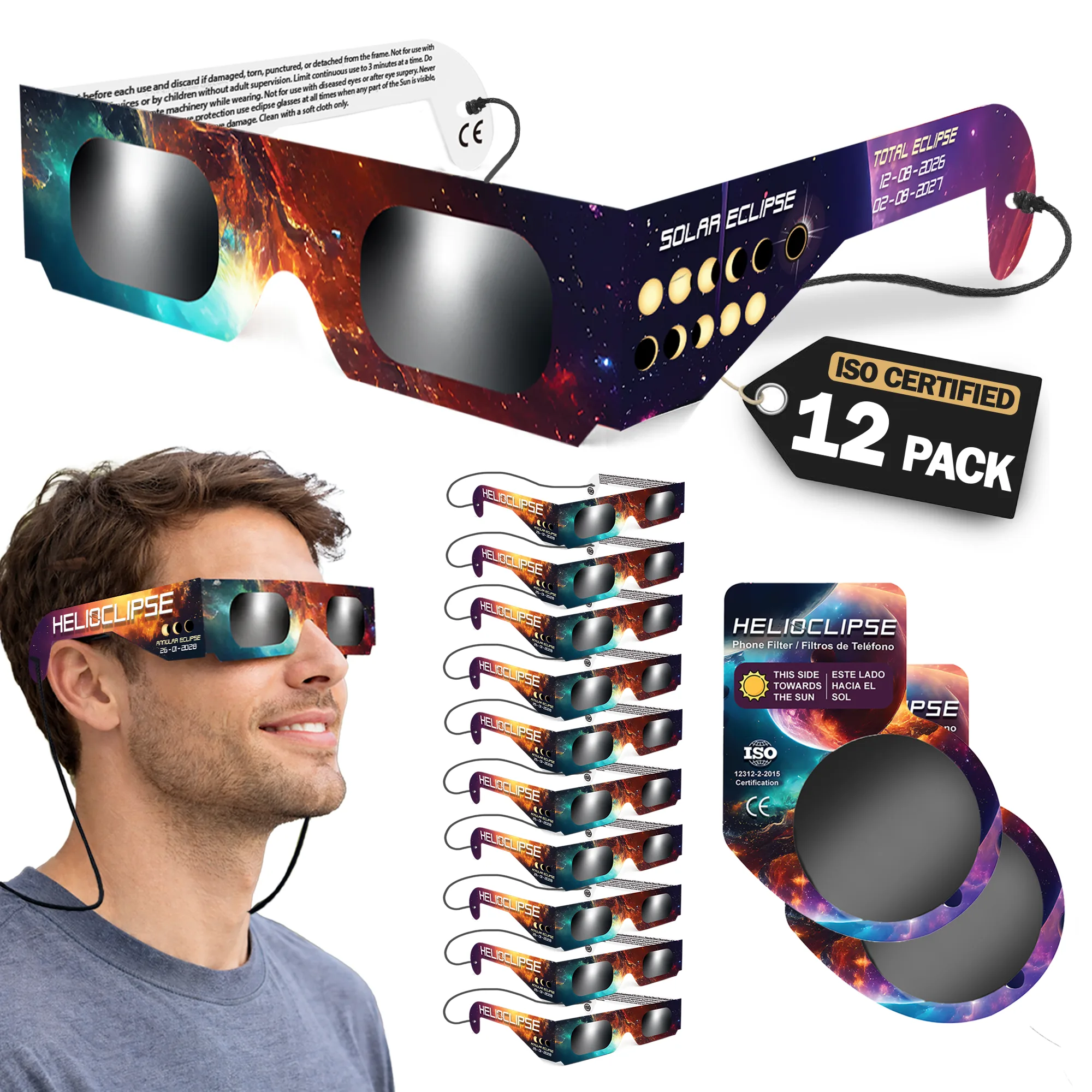
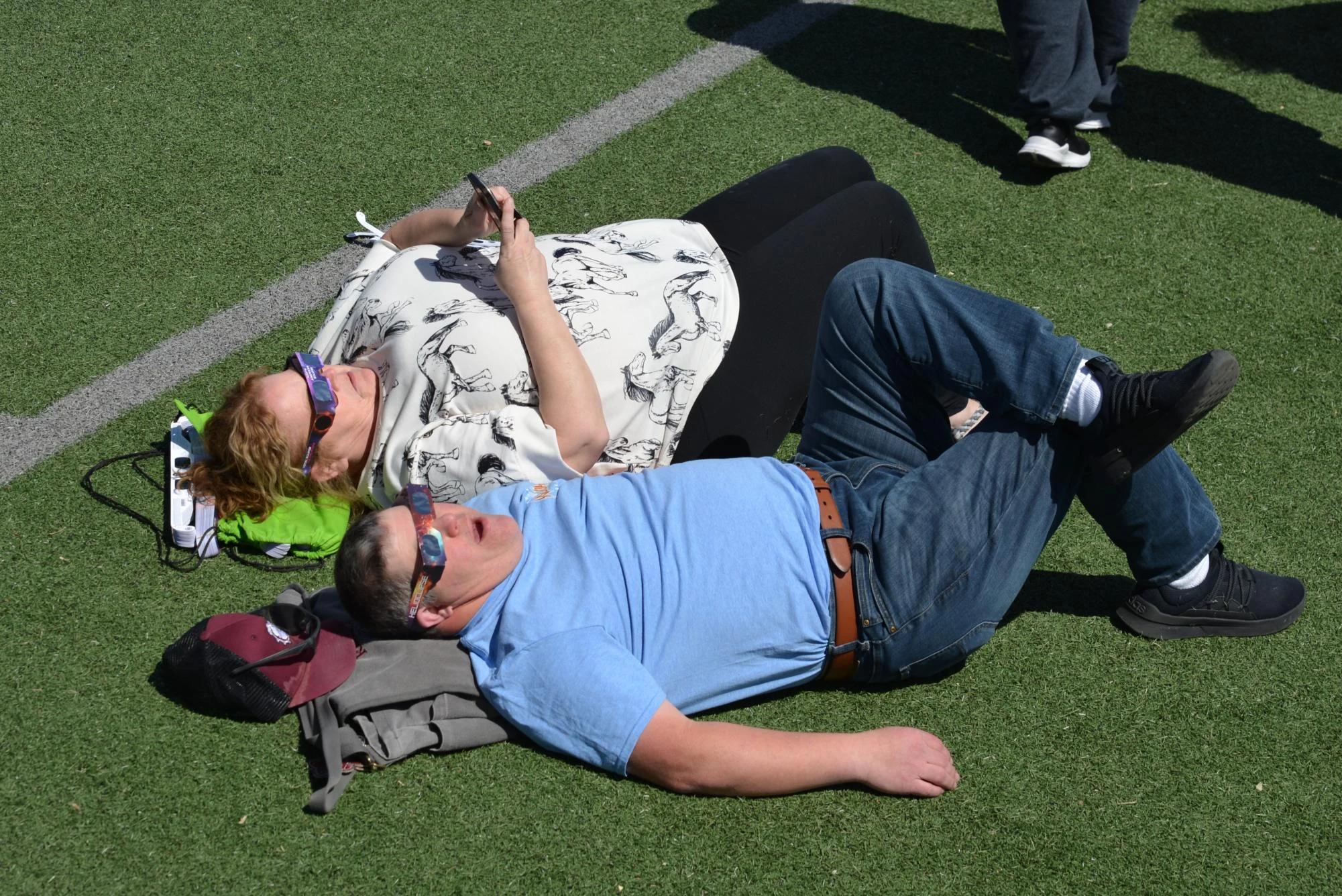
Throughout every partial phase, direct solar viewing required special-purpose viewers conforming to ISO 12312-2. Ordinary sunglasses were not sufficient, regardless of how dark they appeared. Viewers also needed inspection before use: damaged, punctured, scratched or separating filters should not be trusted.
Inside the path, viewers could be removed only after the Moon had completely covered the Sun’s bright face and totality had begun. They had to go back on as soon as direct sunlight reappeared. Outside the path—including Madrid and Barcelona—there was no safe glasses-off interval.
Cameras, binoculars and telescopes required correctly fitted solar filters on the front of the optics during partial phases. Eclipse glasses worn at the eyes do not make it safe to look through unfiltered magnifying equipment, because concentrated sunlight can damage the viewer and the eye.
Product descriptions often use wording such as certified solar eclipse glasses, eclipse glasses ISO 12312-2 or approved solar eclipse glasses. Those phrases should prompt a real check of the product, manufacturer information, instructions and condition—not blind trust in a printed claim. Our ISO 12312-2 guide explains what the standard covers and what families should inspect.
The path’s enduring lesson
The 2026 solar eclipse Spain path of totality showed why total-eclipse planning is a geometry problem before it is a travel problem. The umbra either crossed your coordinate or it did not. Once inside, the centerline offered more time—but the low Sun made terrain, cloud and mobility just as consequential.
Spain also delivered a powerful comparison within a single country. León received roughly two minutes of totality with the Sun still several degrees above the horizon. Segovia received under a minute. Mallorca offered around a minute and a half but placed the Sun less than 3° high. Madrid and Barcelona reached about 99% coverage yet never entered totality.
Those contrasts are what a path map should make visible. The map is not merely a colored stripe: it is a decision tool connecting celestial mechanics to the road, field, skyline and clock at one precise location.
Frequently asked questions
Where should I go in Spain for the best chance of seeing totality in 2026?
Choose a location inside the path of totality with a clear west-northwest horizon. Because the eclipse occurred shortly before sunset, being within the corridor was necessary but also required workable weather and enough mobility to reach a suitable viewing site.
Which Spanish places were inside the 2026 total solar eclipse path?
The path crossed northern and eastern Spain, including areas of Asturias, Castilla y León, La Rioja, Aragón, and eastern Spain, before continuing toward the Balearic Islands. León was within totality, while Madrid and Barcelona were just outside the totality corridor and saw only a partial eclipse.
Was the 2026 total solar eclipse visible from North America?
No, North America is not listed as part of the total-eclipse path in the article. The path crossed northern Russia, Greenland, western Iceland, the North Atlantic, Spain, and a small corner of Portugal.
How should I read a map of the 2026 total solar eclipse path in Spain?
Look for both edges of the totality corridor and the centerline, rather than relying on a broadly shaded map. A town just outside the umbral boundaries experienced only a partial eclipse, even if it was very close to the path.
Which cities should be considered when planning to view the 2026 eclipse in Spain?
León was in the path of totality, with local circumstances placing totality at approximately 8:28–8:30 p.m. CEST. Madrid and Barcelona were outside totality, so city names alone are not enough: confirm whether a specific location lies between the path boundaries.
On-site next steps
- Open the Helioclipse Eclipse Explorer to study the 2026 track in 3D, compare coordinates and see how the path limits, centerline and local horizon relate.
- Review our eclipse planning guides for phase timing, weather decisions and future eclipse opportunities.
- Prepare for future partial phases with Helioclipse solar eclipse glasses designed for direct solar viewing and specified as conforming to ISO 12312-2. Arrange viewers for your family, class or group before demand peaks, and inspect every viewer before use.
Sources & further reading
- Total Solar Eclipse on August 12, 2026 — NASA Science
- Stops Along the Path of Totality — NASA Earth Observatory
- A Sunflower’s View of Totality — NASA Earth Observatory
- Total solar eclipse 2026: Everything you need to know — Space.com
- Spain’s total solar eclipse 2026 comes with a catch — Space.com
- Why Do Eclipses Happen? — NASA Science
- Eclipse Glossary — NASA Science
- Eclipses — NASA Science
- How to View a Solar Eclipse Safely — American Astronomical Society
- About the ISO 12312-2 Standard for Solar Viewers — American Astronomical Society