Ridges, trails, and summits: when elevation helps your horizon—and when it steals the show
A high summit sounds like the natural place to watch a solar eclipse. Sometimes it is. On August 12, 2026, however, the winning site in Spain may be a modest field, reservoir shore or permitted hillside with a clean west-northwest horizon—not the most dramatic peak on the skyline.
That is because totality arrives late in the day. The eclipsed Sun will be roughly 10°–12° above the horizon in parts of northwestern Spain, but only about 2°–5° high in eastern Spain and the Balearic Islands. At those angles, a ridge, forest, building or bank of distant cloud can hide the event even when your coordinates sit comfortably inside the path of totality.
Our hiking ridge spain eclipse viewing horizon safety 2026 guide starts with a simple rule: use elevation only when it solves a verified sightline problem without creating a larger access, weather or descent problem. Begin by checking your coordinates and path position in the Helioclipse Eclipse Explorer, then inspect the actual horizon from the ground.
Why the 2026 horizon is unusually demanding
The path of totality crosses northern Spain from Galicia toward the Mediterranean and the Balearic Islands on August 12, 2026. It is about 305 kilometres wide where it reaches Spain, while Madrid and Barcelona lie outside it and receive deep partial eclipses rather than totality. Our guide to the 2026 totality path in Spain explains why crossing the path boundary changes the experience completely.
Near the central part of the track, the total phase lasts on the order of 1 minute 45 seconds, with published summaries giving approximately 1 minute 44 seconds to 1 minute 49 seconds depending on the location and calculation. Duration falls toward the northern and southern limits. Exact contact times and duration must therefore be checked for your coordinates rather than borrowed from the nearest province or city.
The unusually low Sun is the terrain challenge. In Galicia and parts of the northwest, 10°–12° of altitude leaves some tolerance for low hills. Farther east, an eclipsed Sun only 2°–5° above the west-northwestern horizon can disappear behind terrain that looks insignificant on a conventional road map. Mallorca is an extreme example: around 2.5° of solar altitude means that a nearby slope, hotel, tree line or distant cloud deck can erase the solar view.
This is why hiking ridge spain eclipse viewing horizon safety is not simply a matter of finding the highest contour line. The useful question is whether a site has an unobstructed line of sight toward the Sun’s precise azimuth at the time of totality.
Elevation helps only when it clears the correct obstruction
Elevation can raise your eye line above trees, roofs and a nearby shoulder of land. A broad ridge above a west-facing plateau may also reveal distant weather, giving you time to notice whether cloud is building along the eclipse horizon. Those are real advantages.
But height does not automatically create a clear view. A summit can still have a higher ridge to its west-northwest. A trail climbing the eastern side of a mountain may stay in shadow while the Sun vanishes behind the same mountain you are ascending. In a narrow valley, gaining 200 metres may make no difference if the opposing wall rises by 600 metres.
For a quick sense of scale, 10° is approximately the height of a closed fist held at arm’s length. Two degrees is only a few finger-widths above a level horizon. These hand measurements are useful for understanding the problem, but they are not precise enough for final site selection near a path edge or where totality occurs just above a ridge.
The most reliable field test is to visit the intended site on an earlier evening and observe where the Sun approaches the horizon at the relevant time and bearing. The sunset point shifts from day to day, so combine the visit with a terrain-aware planning tool rather than assuming that the Sun will occupy exactly the same spot. Check for trees, seasonal vegetation, temporary structures and landforms too small to appear in a basic map.
A strong hiking eclipse plan should include at least three recorded coordinates:
- the primary viewing site, with a verified west-northwest sightline;
- a lower, easier backup that remains inside the path;
- an accessible fallback for anyone in the group who cannot safely complete the walk.
That last option matters. A hiking solar eclipse should not split a family or group minutes before totality because one person discovers that the route is steeper, hotter or more exposed than expected.
The summit can steal the show
A summit adds wind exposure, temperature change, loose ground and a more complicated evacuation. It can also concentrate people onto a very small area. During totality, viewers naturally look upward and become less aware of cliff edges, guy lines, tripods and other people moving in the darkening landscape.
Spain-based eclipse guidance specifically advises avoiding cliffs and steep slopes. We would go further: choose a place where everyone can stand still, turn away from the Sun to manage viewers safely, and react to a stumble without falling onto dangerous terrain. A narrow crest that works for two hikers on an ordinary evening may be unsuitable for a crowd carrying cameras and watching the sky.
The descent deserves as much attention as the ascent. In eastern Spain, the eclipse happens so close to sunset that some locations will not see the post-totality partial phase before the Sun drops below the horizon. Twilight follows quickly. Every person should carry a headlamp with charged batteries, even if a phone claims the walk will finish before dark. Phones are poor substitutes when battery levels are low, coverage is overloaded or both hands are needed on rough ground.
Elevation gain hiking figures do not provide a universal difficulty rating. A climb of 200 metres on a maintained trail can be straightforward for a prepared walker and exhausting for a child, an older relative or anyone carrying extra water in August heat. Hiking elevation gain difficulty changes with gradient, surface, exposure, temperature, pack weight and the descent. There is no single answer to what counts as a good elevation gain; the right route is one the slowest member of your group can complete with a generous time reserve.
If the viewpoint requires rushing, scrambling, trespassing or improvising a descent in darkness, it is the wrong eclipse site.
Build the plan around permission, heat and rescue reality
A route shown on a mapping app is not necessarily open to the public. Check the land manager, municipality, protected-area authority or regional government for access rules, fire restrictions, parking controls and temporary eclipse measures. Local restrictions can include closures of forest tracks to motor vehicles, and conditions may change during periods of extreme fire danger.
Stay on permitted trails and never cross crops to shorten the approach. Avoid blocking gates, fire roads and emergency access. If parking is informal or limited, choose another site rather than creating a roadside hazard. Tell someone outside your group where you are going, your planned return time and the coordinates of both your primary and backup sites.
Carry water, sun protection, food, necessary medication, a first-aid kit, warm layers for the evening and an offline map. Save local emergency information before leaving coverage. Mountain and search-and-rescue teams should not have to retrieve someone who climbed unfamiliar terrain solely because a summit photograph looked impressive.
Make the decision together before eclipse day. Families and friends should agree on a turnaround time, the conditions that trigger a retreat, and who has authority to cancel the climb. Nobody should feel pressured to continue because the eclipse is rare. Totality is memorable from a safe open site; it is not improved by exhaustion or an avoidable rescue.
Weather at eye level matters more than blue sky overhead
An ordinary forecast icon compresses the whole sky into one symbol. For this eclipse, you care specifically about the lowest few degrees of the west-northwestern horizon during the late afternoon and early evening. A site may be sunny overhead while a distant cloud bank blocks a Sun only 3° high.
From Mallorca or southeastern Spain, the line of sight passes through much more atmosphere than it would if the Sun were high. Haze, wildfire smoke, humidity and remote cloud can therefore matter even when the immediate site remains dry. Summit wind can also be much stronger than conditions in the nearest town.
Review several forecasts during the final days, but keep the plan flexible until roughly 24 hours before the event. Our guide to cloud cover and eclipse-day mobility explains how to distinguish climate expectations from a usable short-range forecast. Do not begin a technical or exposed climb merely because a model shows a small break in the clouds.
A lunar eclipse weather forecast may help determine whether clouds will hide the Moon, but lunar-eclipse safety and solar-eclipse safety are fundamentally different: looking at the eclipsed Moon is harmless, while looking at any exposed part of the Sun requires proper protection. Make sure everyone in your group understands which event you are planning.
Totality is binary, and the path comes before the viewpoint
Can the moon completely block the sun? Yes, but only where the Moon’s dark central shadow reaches Earth and only for the brief total phase. The Sun and Moon appear close to the same angular size because the Sun is about 400 times wider than the Moon and also roughly 400 times farther away. That coincidence lets the Moon hide the bright solar surface and reveal the faint corona.
A 99% partial eclipse is not a shorter version of totality. The remaining sliver of photosphere is still intensely bright, the corona is not revealed in the same way, and there is no safe glasses-off interval. Madrid and Barcelona are outside the 2026 totality path, even though both will experience striking partial eclipses. A mountain near either city does not move you into the Moon’s central shadow.
For the same reason, the most beautiful ridge inside the path is useless if terrain hides the Sun, while a plain-looking site with a clean horizon can deliver the complete experience. First establish whether the coordinates are inside totality. Next check the duration and solar altitude. Only then compare trails, roads and viewpoints.
Do not mix this event with later eclipse routes. A spain eclipse 2026 trip concerns August 12, 2026; the tangier eclipse 2027, algeria eclipse 2027 and morocco 2027 eclipse planning discussions concern the separate total solar eclipse of August 2, 2027. The path of the 2027 total solar eclipse also continues eastward toward the Arabian Peninsula, so a jeddah solar eclipse 2027 plan needs its own map, times, climate research and local-access checks. None of those later-event results should be used to select a 2026 ridge in Spain.
Eye protection does not become optional near sunset
Why shouldn't you look at the sun during an eclipse? Because the exposed solar surface is still the Sun. A low position, orange colour or thin crescent can make it feel less threatening, but it does not make direct viewing safe. During every partial phase, use solar viewers that conform to ISO 12312-2.
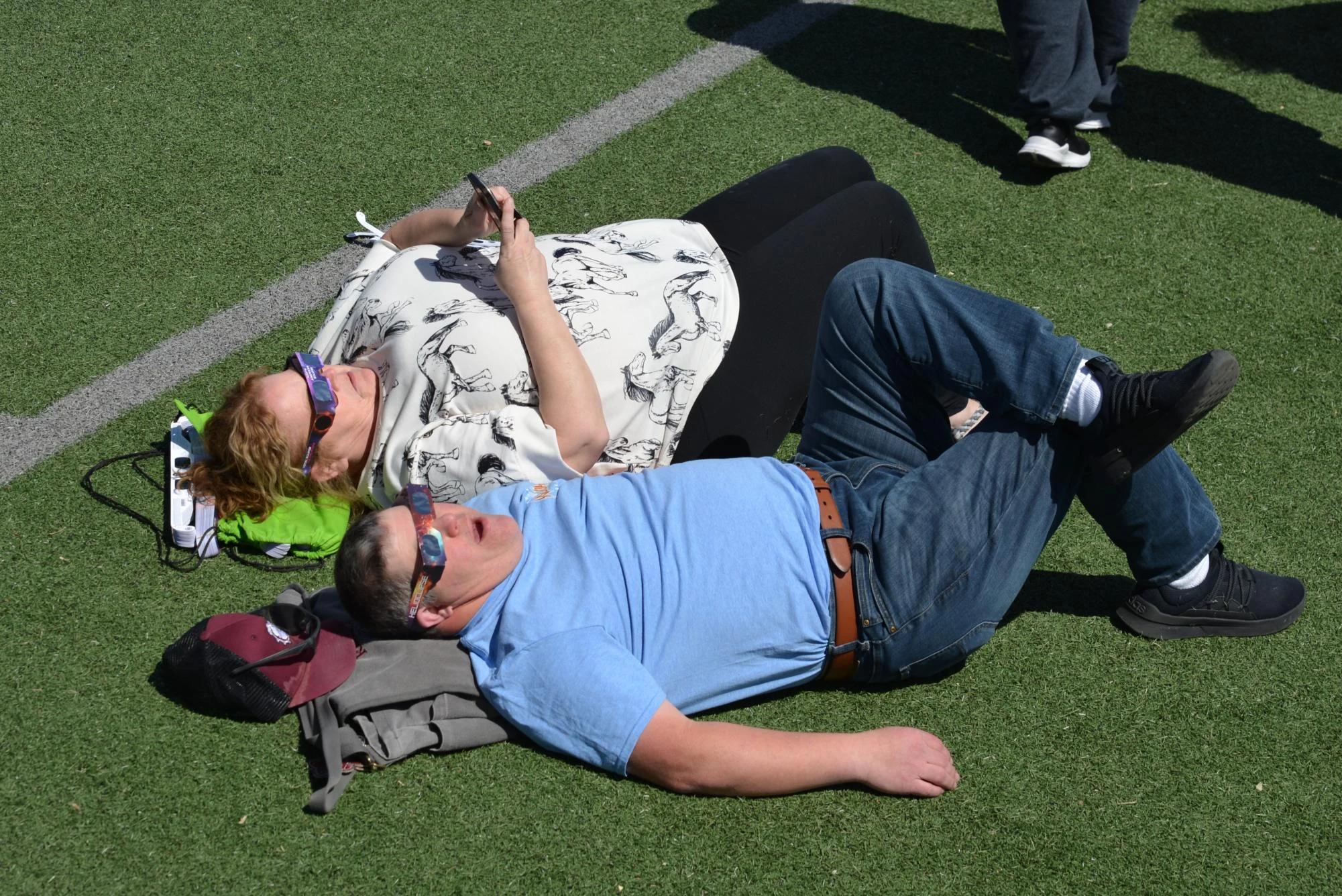
Put the viewers on before looking up. After each look, turn away from the Sun before removing them. Inspect every viewer for scratches, punctures, tears or filters coming loose from the frame, and supervise children closely. Ordinary sunglasses are not eclipse viewers, regardless of how dark they appear.
Only observers inside the path of totality may remove their viewers, and only after the bright solar surface has been completely covered. Put them back on as soon as even the smallest bright point reappears. If your location receives a partial eclipse—or if a ridge hides the exact beginning or end of totality—there is no safe moment to guess. Follow coordinate-specific contact times and the glasses-on, glasses-off phase sequence prepared before the event.
Do not look through binoculars, a telescope or a camera lens while wearing eclipse glasses. Concentrated sunlight can damage the viewer and your eyes. Magnifying optics require a purpose-built solar filter secured over the front aperture; anyone without the correct equipment and experience should leave those instruments packed away.
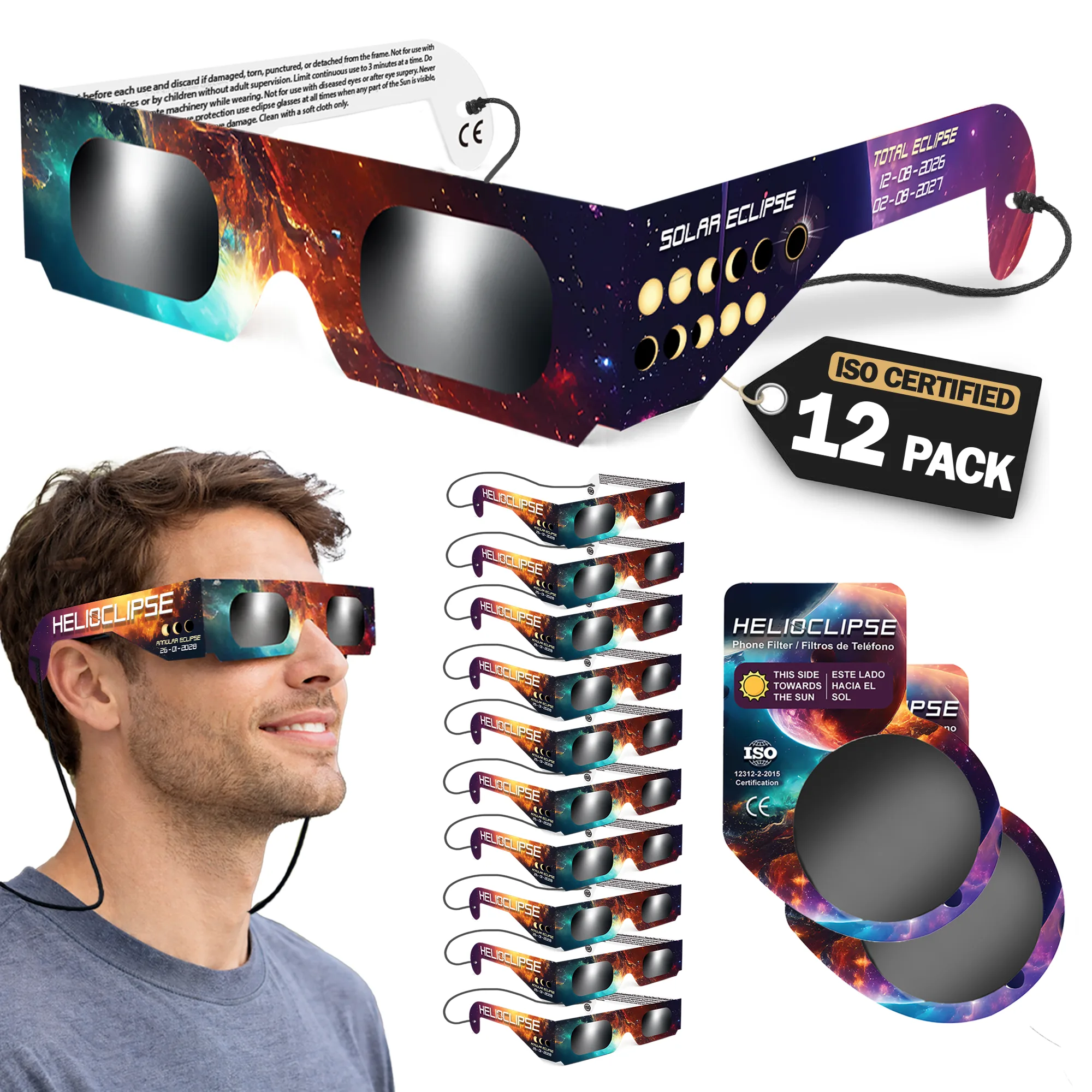
When product descriptions use phrases such as approved solar eclipse glasses or eclipse glasses nasa approved, read carefully: NASA does not approve individual viewer brands. The meaningful product information is traceable conformity with ISO 12312-2 and an undamaged filter from a responsible supplier. Shoppers looking for solar eclipse glasses iso 12312-2 certified should verify the stated standard and instructions rather than trusting a marketplace title alone. Helioclipse offers ISO 12312-2 eclipse viewers for families and groups planning ahead.
A practical go-or-no-go checklist
A safe spain eclipse 2026 travel plan should survive this checklist without optimistic assumptions:
- Path: Are the exact viewing coordinates inside totality, rather than merely inside a province crossed by the path?
- Duration: Have you recorded the local start and end of totality and allowed for shorter duration near the path edge?
- Horizon: Is the west-northwest sightline clear at the Sun’s predicted altitude and azimuth?
- Access: Is the trail open, permitted and realistic for every member of the group?
- Ground: Is there enough level space to stand safely away from cliffs, roads and unstable slopes?
- Weather: Have you checked low-horizon cloud, haze, smoke, heat, thunderstorms and summit wind?
- Exit: Can the group descend safely after sunset, with headlamps and a route known in advance?
- Traffic: Can you arrive early and stay nearby instead of joining a mass departure immediately after totality?
- Eye safety: Does everyone have an inspected ISO 12312-2 viewer and understand the phase sequence?
- Backup: Is there a lower-risk site already chosen, rather than an improvised alternative found under time pressure?
Share the plan with your group well in advance. A spain eclipse 2026 trip will be easier when transport, accessibility, water and viewers are group decisions—not surprises revealed at the trailhead.
Frequently asked questions
Does this guide explain why it is unsafe to look directly at the Sun during an eclipse?
No. The excerpt focuses on choosing a location with a clear horizon and does not provide eye-safety instructions for viewing the Sun.
How should hikers choose a ridge or summit for viewing the 2026 eclipse in Spain?
Choose elevation only if it clears a verified obstruction in the Sun’s west-northwest direction without creating bigger access, weather, or descent problems. Inspect the actual horizon from the ground, because a high peak is not automatically better than a permitted hillside, field, or reservoir shore.
What should I plan for when arranging an eclipse trip to Spain in 2026?
Confirm that your exact location is inside the path of totality, since locations outside it will see only a deep partial eclipse. Check local contact times, duration, and the Sun’s position for your coordinates rather than relying on information for a nearby city or province.
Is a dramatic mountain viewpoint the best choice for eclipse travel in Spain?
Not necessarily. Totality arrives late in the day, and low terrain, trees, buildings, or clouds can block the low west-northwest Sun even from a location within the totality path.
Can a lunar-eclipse weather forecast help me select a site for this event?
The excerpt does not discuss lunar eclipses or provide weather forecasts. It does note that distant cloud can hide the low Sun, so a clear, unobstructed horizon remains important for this solar eclipse.
On-site next steps
- Open the Helioclipse Eclipse Explorer and check whether each candidate coordinate is inside the path, how long totality lasts there, and where the Sun will sit above the horizon.
- Compare a scenic ridge with at least one lower, more accessible backup. Verify the actual west-northwest sightline on location and confirm current trail or land-access rules with the relevant local authority.
- Order enough Helioclipse solar eclipse glasses for your family or group before local demand rises. Inspect them before packing and keep them dry and protected from scratches.
Sources & further reading
- Spain's total solar eclipse 2026 comes with a catch — here's how to avoid ruining your view — Space.com
- Solar and Lunar Eclipses in 2026 — Sky & Telescope
- Europe's Brush with Totality — Astronomy Magazine, Sky Guide 2026
- Eclipse chasers share insider tips, travel advice and skywatching secrets for the 2026 total solar eclipse — Space.com
- Tips for watching the solar eclipse — Science Media Centre Spain
- Eclipse Viewing Safety — NASA Science
- How to View a Solar Eclipse Safely — American Astronomical Society
- Solar Filters for Optics: Telescopes, Binoculars & Cameras — American Astronomical Society
- How & Why Solar Eclipses Happen — American Astronomical Society
- Eclipses — NASA Science