Madrid in August 2026: a serious partial eclipse—without pretending you are in totality
On the evening of August 12, Madrid will see the Sun reduced to an exceptionally thin, brilliant crescent. NASA gives the city about 99% solar coverage at maximum, while calculations cited for central Madrid put the figure even closer to 100%. Yet the city center does not cross the decisive geometric boundary: this remains a partial solar eclipse 2026 experience, not totality.
That distinction is not pedantic. From central Madrid there will be no safe naked-eye interval, no view of the solar corona and no moment when you should remove your eclipse viewers. The remaining sliver of the Sun’s photosphere will still be intensely bright.
The event happens late in the day, with maximum eclipse at about 8:32 p.m. CEST and the Sun setting while the eclipse is still in progress. That makes the western horizon almost as important as the forecast. Before choosing a park, rooftop or open piece of ground, check your precise location in our Eclipse Explorer and 3D map. A building or ridge in the wrong direction could end your view before the Moon reaches maximum coverage.
This is our practical guide to the partial solar eclipse Madrid August 2026: what will happen over the city, how it differs from totality only a short journey north, and how to decide whether to stay in Madrid or travel into the path.
The essential Madrid circumstances
The partial solar eclipse Madrid August 2026 date is Wednesday, August 12, 2026. Madrid will be on Central European Summer Time, or CEST, which is UTC+2.
NASA’s published city table gives this approximate partial solar eclipse Madrid August 2026 time sequence:
- Partial eclipse begins: 7:36 p.m. CEST, or 17:36 UTC
- Maximum eclipse: 8:32 p.m. CEST, or 18:32 UTC
- Maximum solar coverage: about 99% in NASA’s rounded table
- Sunset: approximately 9:16 p.m. CEST, or 19:16 UTC, before the geometric partial eclipse has finished
These are city-level planning times, not a promise of second-by-second circumstances at every address. Your exact coordinates alter the contact times, maximum coverage and height of the Sun. Use the Helioclipse map for your actual observing point and recheck it as the date approaches.
The phrase 2026 Madrid eclipse can also conceal an important geographic ambiguity. Madrid may mean the historic center, the municipality, the wider metropolitan area or the entire autonomous community. Puerta del Sol is outside totality. Some northern municipalities in metropolitan Madrid lie at or across the path boundary, so two observers separated by a relatively modest distance can have categorically different experiences.
What 99% coverage does—and does not—mean
Solar coverage, also called obscuration, is the percentage of the Sun’s apparent area hidden by the Moon. It is not the same quantity as eclipse magnitude, which describes how much of the Sun’s diameter is covered along a line. A good partial solar eclipse Madrid August 2026 map should identify which measurement it displays rather than putting an unexplained percentage beside the city.
NASA rounds Madrid’s maximum coverage to 99%. A more location-specific figure cited for Puerta del Sol is approximately 99.96% obscuration. Those values should not be treated as contradictory without first checking coordinates, calculation models and rounding. Both communicate the same practical fact: central Madrid sees an extraordinarily deep partial eclipse, but a thin piece of the bright photosphere remains exposed.
At maximum, certified viewers should reveal a hairline solar crescent. Ambient light may become strange and muted. Shadows can sharpen, the temperature may change, and people around you may notice that the evening feels unlike an ordinary sunset. Through gaps between leaves, hundreds of tiny crescent Suns may appear on walls or pavements.
But the last fraction is not visually equivalent to zero. During totality, the Moon blocks the photosphere and exposes the much fainter corona. That sudden removal of direct sunlight creates the darkened sky, visible corona and brief naked-eye phase associated with a total eclipse. A 99.96% partial eclipse still leaves direct photospheric light in view, so it does not unlock those phenomena.
There is no scientifically meaningful “99% totality.” There is a deep partial eclipse on one side of the umbral boundary and totality on the other.
Why the path boundary runs through the Madrid story
The global total solar eclipse 2026 path crosses Greenland, Iceland, the Atlantic, northern Spain and a very small part of Portugal. Across Spain, the path of totality runs from the northwest toward the east, crossing areas that include parts of Galicia, Asturias, Castilla y León, La Rioja, Aragón and the Mediterranean side of the country.
Madrid’s city center sits just outside that corridor. Published reporting places the totality boundary through the northern side of the metropolitan region, with San Sebastián de los Reyes, roughly 20 kilometres north of central Madrid, among the places reported to receive a very short total phase. One estimate gives it approximately 24 seconds of totality near 8:31 p.m. CEST.
That short duration tells you how close the area is to the edge. Near an eclipse boundary, small changes in position matter enormously. Do not assume that an address in northern Madrid, a station with “Madrid” in its name or a site a few kilometres from someone else’s plan shares the same circumstances. Put the exact observing coordinates into the map and verify whether the location marker is inside or outside the umbra.
The solar eclipse August 2026 path is therefore not merely a broad stripe across a country map. At metropolitan scale it is a hard boundary between two physical states: some photosphere remains visible, or none does. Any partial solar eclipse Madrid August 2026 2026 guide map must draw that boundary clearly and allow readers to inspect individual locations.
You may also encounter several similar labels for the same event. The August 12, 2026 solar eclipse path refers to the full geometry, including the broad partial-eclipse region. The August 2026 eclipse path of totality means only the narrow corridor swept by the Moon’s umbra. Our broader Spain path guide explains how the centerline, edge and partial zone differ.
Staying in Madrid versus travelling into totality
Staying in central Madrid is a defensible choice. You avoid a complex evening journey, can observe with friends and family near home, and still see one of the deepest partial eclipses possible. The partial phase develops over almost an hour before maximum, so there will be time to watch the crescent narrow through safe viewers rather than treating the event as one instantaneous photograph.
The trade-off is absolute: you will not see totality. If your goal is the corona, a darkened sky and the brief removal of solar viewers, you must be at a verified location inside the path. Crossing the boundary is the minimum requirement; moving farther into the path generally provides a longer total phase and more protection against small location errors.
The contrast is measurable. Published estimates give San Sebastián de los Reyes around 24 seconds, while Valladolid receives about 1 minute 29 seconds, Palencia about 1 minute 42 seconds, León about 1 minute 44 seconds, and Zaragoza about 1 minute 23 seconds. These cities are not interchangeable: their totality duration, horizon altitude, terrain, cloud climatology and transport pressures differ.
The full August 12 planning guide can help if you are still deciding. If you travel, plan for congestion before and especially after the eclipse. Madrid and Barcelona both sit frustratingly close to the totality corridor, which could put heavy pressure on roads and public transport. A short drive on an ordinary Wednesday cannot be assumed to remain short on eclipse evening.
Tell your group early what the decision means. “We are watching a spectacular partial eclipse from Madrid” is an honest and worthwhile plan. “We are going north to experience totality” is a different plan involving exact coordinates, transport, a western sightline and a backup location. Confusing the two is how groups end up expecting a corona that never appears.
The low Sun changes where you should stand
The Madrid solar eclipse 2026 unfolds toward the west-northwest, late in the evening. Even if the overhead sky is perfectly clear, the Sun can disappear behind an apartment block, tree line, stadium, ridge or bank of distant cloud before maximum eclipse.
A useful viewing site therefore needs more than open space directly above you. It needs a long, low sightline in the direction of the setting Sun. Visit your proposed location on an earlier evening at approximately the same clock time. Stand on the exact patch of ground you intend to use and check whether the horizon is genuinely open. Remember that the Sun’s position shifts from day to day, so confirm the eclipse azimuth with an appropriate map rather than treating a casual sunset check as a complete simulation.
Central squares surrounded by buildings may offer less sky than their size suggests. Likewise, a park can have an obstructed western edge because of mature trees. An elevated site may help, but elevation is useful only when it clears the relevant horizon safely and legally. We are not announcing or implying an organised event at Puerta del Sol or any other city landmark; consult local authorities for access rules and any verified public programme.
Sunset also truncates the visible sequence. NASA’s asterisk beside Madrid’s 9:16 p.m. endpoint means that time represents sunset, not the moment when the Moon has completely moved away from the Sun. From Madrid, the eclipsed Sun reaches the horizon while the partial phase is still underway.
Weather: watch the horizon, not just the forecast icon
August climatology generally favours inland Spain more than some cloudier northern coastal areas, but a seasonal average cannot predict one evening. Heat haze, wildfire smoke, dust, thunderstorms or a narrow strip of cloud near the horizon can all matter. Because the Sun will be low, distant atmospheric conditions in the viewing direction may block it even when the sky overhead looks blue.
Start with broad forecasts several days out, then compare short-range cloud guidance as the event approaches. Pay special attention to low and middle cloud toward the west-northwest, visibility, smoke and developing storms. Do not make a long last-minute drive based on one weather-app symbol.
If you remain in Madrid, choose one primary observing site and at least one realistic backup with a similarly open horizon. If you plan to enter totality, preserve mobility—but set a firm deadline for moving. Chasing a small patch of blue sky through eclipse traffic can leave you watching from a road with no safe place to stop.
Our guide to cloud cover and eclipse-day mobility explains how to separate long-term climate from the forecast that actually controls eclipse day.
Madrid’s safety rule is exceptionally simple
From central Madrid, keep proper solar viewers on whenever you look directly at the Sun. Every visible moment is partial. There is no glasses-off cue and no safe naked-eye interval, even at maximum coverage or as the Sun approaches the horizon.
Use viewers that conform to ISO 12312-2 and inspect them before the event. Discard any viewer with torn material, punctures, scratches, loose filters or other damage. Ordinary sunglasses are not substitutes, regardless of how dark they appear. Children should be supervised: have them place the viewers securely over their eyes before turning toward the Sun, then turn away before removing them.
A printed standard number should be part of your checks, not the whole chain of trust. Product wording such as eclipse glasses ISO 12312-2 or iso certified solar eclipse glasses needs to be backed by a traceable manufacturer, appropriate instructions and credible conformity information. NASA does not approve individual brands, so claims such as “NASA approved” should not be treated as a certification category.
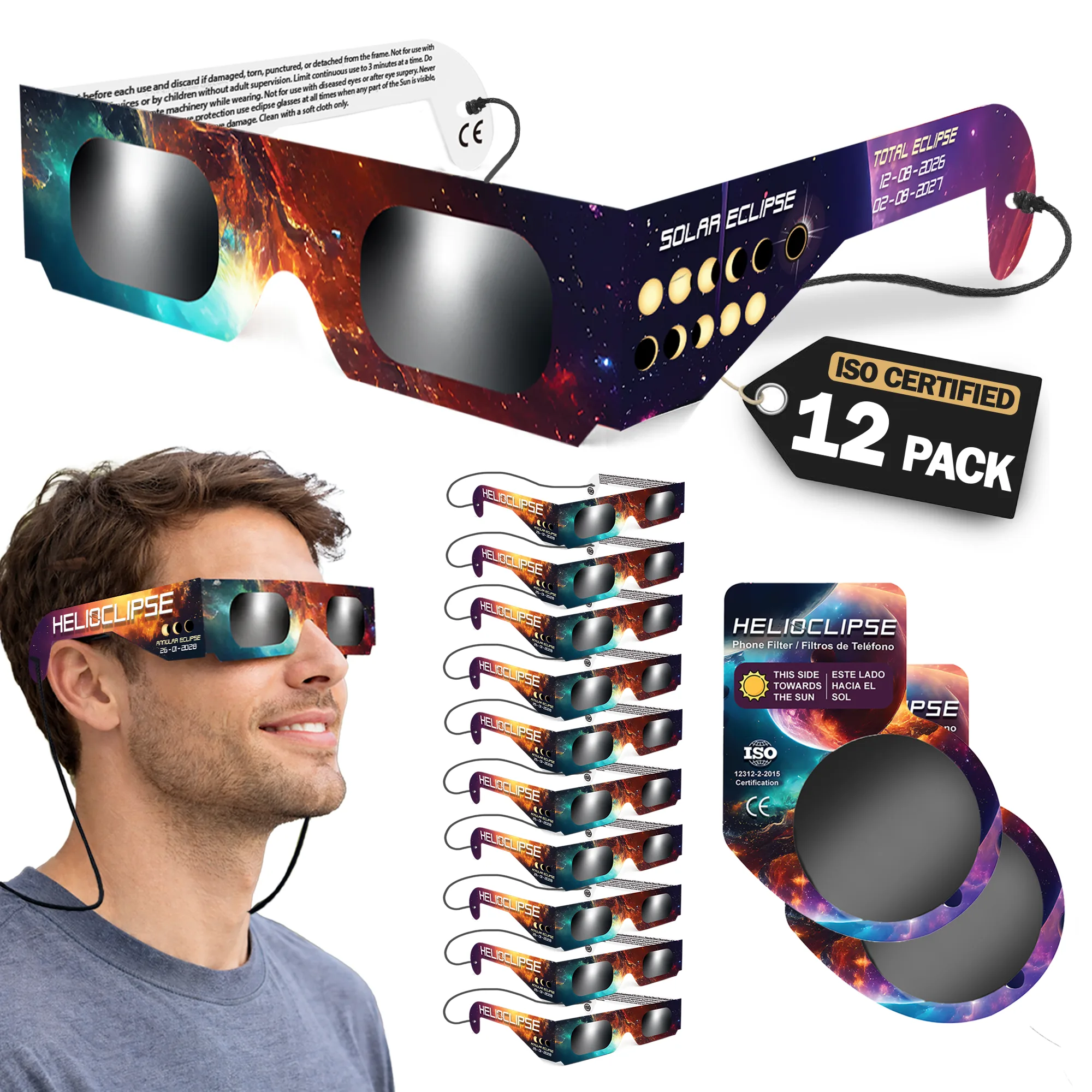
For a family, classroom or group, order certified solar eclipse glasses early enough to inspect them and practise using them. Our Helioclipse solar eclipse glasses are intended for direct, unmagnified solar viewing. Eclipse viewing glasses must never be placed between your eyes and binoculars, a telescope or a camera lens.
Magnifying optics collect and concentrate sunlight. A telescope, binocular or camera requires an appropriate solar filter securely mounted at the front aperture, before sunlight enters the instrument. Do not look through unfiltered optics while wearing eclipse glasses; the concentrated light can damage the filter and your eyes. Seek specialist guidance before attempting solar photography.
If you do not have a safe direct viewer, use projection. A pinhole projector, perforated kitchen utensil or gaps between crossed fingers can cast images of the crescent Sun onto a surface. Keep your back to the Sun and look at the projection—not through the hole.
The rule changes only for observers who have verified that they are inside the path of totality. There, viewers may come off only after the bright photosphere has disappeared completely, and they must go back on as soon as it begins to return. Our guide to eclipse phases and when to use solar glasses walks through that sequence. It does not create a glasses-off phase for central Madrid.
A practical plan for families and groups
The partial solar eclipse Madrid August 2026 2026 guide can be reduced to a clear group plan without reducing the event itself to a checklist.
First, decide whether your shared goal is a deep partial eclipse in Madrid or totality farther north. Make that decision explicit before people book transport or assume that “almost 100%” means the same thing as total. If the group includes young children, older relatives or anyone who needs accessible transport, staying close to home may be the better experience—even though it is not totality.
Second, save exact coordinates and verify them on the map. Record the beginning, maximum and sunset times in both CEST and UTC if members of the group are travelling internationally. Arrive early enough to check the horizon and settle children before the eclipse starts at about 7:36 p.m.
Third, distribute and inspect viewers before eclipse day. Write names on individual packets if that makes school or family organisation easier. Practise the movement: viewers on, look up briefly, look away, viewers off. You do not need to stare continuously. Checking the Sun every few minutes makes the Moon’s motion easier to appreciate.
Finally, build the experience around more than one moment. Watch the solar crescent change shape, look for projected crescents under trees, notice changes in shadows and compare observations. A phone photograph of your group reacting safely may be more memorable than an unsuccessful attempt to enlarge the Sun with unsuitable equipment.
Questions Madrid observers are likely to ask
Will the 2026 solar eclipse be visible in Madrid?
Yes. Central Madrid will see a very deep partial eclipse on August 12, with NASA listing approximately 99% coverage at 8:32 p.m. CEST. The Sun sets at roughly 9:16 p.m. while it is still partially eclipsed.
Is central Madrid inside the path of totality?
No. Puerta del Sol and central Madrid remain outside the path, despite the extremely high obscuration. Some northern parts of the wider metropolitan region are reported to cross into totality, making exact coordinates essential.
Where is the best place in Spain to see the eclipse?
There is no single answer independent of your priorities. For totality, you must first be inside the path. Valladolid, Palencia, León and Zaragoza offer published totality durations of roughly 1 minute 20 seconds to 1 minute 45 seconds, but horizon, weather and transport also matter. From Madrid, a nearby edge location may offer only seconds and could be much less forgiving of a mapping or navigation mistake.
Why can’t I remove my viewers when only a tiny sliver remains?
Because that sliver is still the Sun’s exposed photosphere. It remains intense enough to injure the retina. Only complete coverage of the photosphere during true totality creates a brief naked-eye interval, and that interval does not occur in central Madrid.
Is there a downloadable guide or one fixed citywide time?
A static partial solar eclipse Madrid August 2026 2026 guide map can show the broad geometry, but exact circumstances vary by coordinates. For planning, use an interactive map and note partial beginning, maximum, obscuration, solar altitude, azimuth and sunset for your chosen location. Recheck institutional tables before the event rather than relying on an old screenshot or an unlabeled PDF.
Frequently asked questions
Where should I go in Spain for the best chance of seeing totality in August 2026?
Madrid’s city center will not experience totality; the article notes that totality is available a short journey north. Check the precise path boundary and your intended viewing location, because some northern municipalities in the metropolitan area lie at or across it.
Will the August 12, 2026 solar eclipse be visible from Madrid?
Yes. From central Madrid, the eclipse begins at about 7:36 p.m. CEST and reaches maximum at about 8:32 p.m. CEST, with roughly 99% solar coverage in the published city table. The Sun sets at approximately 9:16 p.m. CEST while the partial eclipse is still underway.
What makes a near-total partial solar eclipse different from totality?
Even with about 99% of the Sun covered, central Madrid remains outside the totality boundary. There will be no safe naked-eye viewing interval, no visible solar corona, and eclipse viewers should not be removed because the remaining photospheric sliver is still intensely bright.
What should I plan for when watching the partial eclipse from Madrid?
Choose a location with a clear western horizon, since the eclipse occurs late in the day and the Sun will set before the partial phase ends. Exact times, maximum coverage, and the Sun’s height vary by observing point, so check circumstances for your specific location.
What are the key details for a Madrid eclipse viewing plan in August 2026?
The eclipse occurs on Wednesday, August 12, 2026, with maximum in Madrid at about 8:32 p.m. CEST. Central Madrid is expected to see about 99% solar coverage, but it is still a partial eclipse rather than totality, so safe eclipse viewers remain necessary throughout.
On-site next steps
- Open the Helioclipse Eclipse Explorer, place the marker on your actual Madrid viewing site and confirm whether it is inside or outside totality. Check the local maximum, horizon direction and sunset relationship.
- If you are staying in central Madrid, choose a west-northwest-facing site and a practical backup. If you are travelling north, compare the extra totality duration with traffic, weather and boundary risk.
- Get ISO 12312-2 certified Helioclipse viewers for your family or group in time to inspect them before August 12.
- Share the plan now: meeting point, arrival time, exact coordinates, safety rule and who is bringing the viewers.
Sources & further reading
- Total Solar Eclipse on August 12, 2026 — NASA Science
- 10 best Spanish cities to see the total solar eclipse 2026 — Space.com
- Spain’s total solar eclipse 2026 comes with a catch — Space.com
- Solar and Lunar Eclipses in 2026 — Sky & Telescope
- How to see the August 12 total solar eclipse — Astronomy Magazine
- How to View a Solar Eclipse Safely — American Astronomical Society
- About the ISO 12312-2 Standard for Solar Viewers — American Astronomical Society
- Eclipses Frequently Asked Questions — NASA Science
- Eclipses — NASA Science
- Solar Eclipse Eye Safety technical report — AAS and Ralph Chou