Barcelona in August 2026: partial phases, city canyons, and the Mediterranean haze variable
At about 8:29 p.m. CEST on Wednesday, August 12, 2026, Barcelona is expected to see roughly 99.8% of the Sun covered by the Moon. That number sounds almost indistinguishable from totality. In the sky, it is not.
Barcelona remains outside the path of totality. There will be no safe glasses-off interval, no view of the solar corona and no moment when the Sun’s bright face is completely hidden. Instead, the city gets an exceptionally deep partial eclipse with the Sun hanging very low toward the west-northwest—precisely where apartment blocks, trees, hills, thin cloud and atmospheric haze can decide whether you see the narrow solar crescent at all.
That combination makes the Barcelona eclipse 2026 less a question of finding a famous landmark than of checking geometry from one exact patch of ground. Start by placing your intended viewing location on the Helioclipse Eclipse Explorer, then inspect the real horizon in person at the same time of evening before eclipse day.
This is our Barcelona-only briefing for the partial solar eclipse Barcelona August 2026: what 99.8% coverage means, why a beach is not automatically better than the Eixample, how to treat haze honestly and why certified solar viewers stay on for every direct look.
The essential Barcelona circumstances
The partial solar eclipse Barcelona August 2026 date is Wednesday, August 12, 2026. The best-supported published figure in our source set places maximum eclipse in Barcelona at approximately 8:29 p.m. CEST, equivalent to 18:29 UTC, with about 99.8% obscuration.
“Obscuration” or “coverage” describes the proportion of the Sun’s apparent area hidden by the Moon. It is not necessarily the same as eclipse magnitude, which measures how much of the Sun’s diameter is covered along a line. Because those quantities are different, we are not relabeling the sourced 99.8% coverage figure as magnitude. Use your precise coordinates in an interactive map to verify both the local timing and the terminology attached to the result.
For clarity, our partial solar eclipse Barcelona August 2026 2026 guide uses coverage for that 99.8% figure. A useful partial solar eclipse Barcelona August 2026 2026 guide map must also be centered on your actual observing point—not merely on “Barcelona”—because the more immediate difference within the municipality will be the local horizon. A responsible partial solar eclipse Barcelona August 2026 2026 guide time must state the time zone too: August clocks in Barcelona use CEST, which is UTC+2.
The phrases 2026 Barcelona eclipse, Barcelona solar eclipse 2026 and August 2026 eclipse Barcelona all refer here to the same solar event. The wider partial solar eclipse 2026 is visible across a large area of Europe, northwestern Africa and parts of North America, while totality is confined to a narrow corridor crossing Greenland, Iceland and northern Spain.
Why 99.8% partial is still not totality
A tiny uncovered portion of the solar photosphere remains intensely bright. Human vision also adjusts to changing light, so a landscape that has become strangely dim does not make an unfiltered glance safe. In Barcelona, the rule is simple: certified solar viewers remain in place for every direct look at the Sun, from the first visible partial phase until the Sun is out of sight.
The experiential difference is equally important. Inside totality, the last bright part of the photosphere disappears, the corona becomes visible and observers may remove solar viewers briefly when—and only when—the Sun is completely covered. Barcelona never reaches that state. Even at maximum, a brilliant sliver remains.
You may still notice remarkable changes. Daylight can acquire a muted, metallic quality; contrast may weaken; shadows can become unusual; and projected images beneath leaves or through small holes become slender crescents. But the city should not be promised the darkness, exposed corona or unmistakable 360-degree twilight associated with totality. Our guide to eclipse phases and when to use solar glasses explains the boundary in detail.
The difference between 99.8% partial and 100% total is not a matter of rounding. Totality has a hard geographic edge. Being very close to that edge does not produce an abbreviated version of the corona; you are either within the Moon’s central shadow or outside it.
The low Sun turns Barcelona into a horizon problem
Maximum eclipse comes late in the evening, with the Sun only a few degrees above the west-northwestern horizon along Spain’s eastern side. At that altitude, a modest obstruction can hide it. A 20-metre building 200 metres away spans an angle of roughly 5.7 degrees from ground level—enough to block a Sun that is already close to setting.
That is why a broad plaza can still fail. The space above you may look enormous while a single western façade occupies the crucial strip of sky near the horizon. Street trees, rooftop plant rooms, cranes and temporary event structures matter too. A viewpoint does not need a perfect 360-degree panorama; it needs an open corridor in the correct direction.
Scout with these questions:
- Can you see the west-northwestern horizon, not merely a patch of western sky?
- Is the view open all the way down, or does a building begin a few degrees above the horizon?
- Would the same spot still work if hundreds of people arrived?
- Is there a nearby second location with a cleaner horizon?
- Can children stand securely without drifting into a road, cycle lane or crowded edge?
Visit at roughly the same evening hour on a clear day in the weeks before August 12. The Sun’s position will not be identical on another date, but the rehearsal will reveal the obstruction pattern and how quickly nearby structures swallow a low object. On eclipse day, use the map for the Sun’s direction and the real site for everything a digital model may miss.
Beach versus Eixample: the intuitive answer can be wrong
Barcelona’s beaches feel like the obvious choice because they offer open space and a huge horizon. But the sea lies mainly to the east and southeast of the city, while the eclipsed Sun will be toward the west-northwest. From Barceloneta, Sant Miquel, Bogatell or Mar Bella, you are not necessarily looking out over an empty Mediterranean horizon toward the eclipse. Depending on your exact position, you may be looking back across urban structures, trees or rising ground.
The beach can still work if a chosen section has a clean line in the required direction. Its advantages include room for groups, fewer close façades and the possibility of moving tens or hundreds of metres when a local obstruction appears. Its weaknesses include crowding, beach furniture, waterfront structures and the false confidence created by an unobstructed sea view in the wrong direction.
The Eixample presents the opposite trade-off. Long streets can create useful sightline corridors, but the grid is not aligned simply east-west, and a corridor that looks promising on a map may end at a façade, canopy or tree crown. At such a low solar altitude, viewing from the middle of an ordinary street is also an obvious traffic and safety problem. A rooftop may improve the horizon, but only with permission, safe access and an edge-management plan suitable for children and crowds.
Elevated parks and miradors are not automatic winners either. Barcelona rises toward Collserola, so gaining height can reveal more sky while also placing western terrain directly behind the Sun. Montjuïc, for example, contains many different slopes, terraces, walls and tree lines; the name of the hill alone cannot tell you whether a particular platform sees the necessary azimuth. Test the coordinates, then test the ground.
The practical conclusion is wonderfully unglamorous: the best Barcelona location is the one with the lowest verified obstruction toward the eclipse, enough safe standing room and a backup nearby. A famous view in the wrong direction is worse than an ordinary open patch in the right one.
Haze, humidity and cloud: three different problems
Mediterranean haze is a variable, not a forecast. We cannot responsibly promise that Barcelona will be hazy on August 12, nor can we attach a city-specific probability without verified local climatological data. What we can say is that a low line of sight passes through much more atmosphere than a view high overhead, magnifying the effects of aerosols, moisture and thin cloud.
Haze reduces contrast and may turn the low Sun orange or red. Humidity can contribute to poor transparency, but high humidity by itself does not tell you exactly what the horizon will look like. A narrow bank of cloud can block the eclipse completely even when most of the sky is blue. Conversely, a generally hazy day may still leave the solar crescent visible through certified viewers.
None of these effects makes direct viewing safe. A dim-looking Sun behind haze or cloud can brighten unexpectedly as the atmospheric layer shifts, and harmful radiation is not something you can judge by visual comfort. Keep the viewers on.
Forecast strategy should become more specific as the date approaches:
- Several days out, compare broad cloud patterns rather than trusting one app icon.
- On the morning of August 12, look at cloud layers, visibility and wind direction.
- During the afternoon, use satellite imagery and observations from locations upwind.
- Preserve a local backup with a different horizon exposure.
- Do not make a rushed cross-country move based on one forecast update.
Our guide to cloud cover and eclipse-day mobility provides a fuller forecast workflow. In Barcelona, mobility may mean changing beaches, parks or open spaces within the city—not necessarily chasing the shadow for hundreds of kilometres.
Barcelona or totality: make the decision deliberately
The broad question where can you see the solar eclipse in August 2026? has two answers. Partial phases extend across much of Europe and beyond, including Barcelona. Totality is visible only inside the narrow path crossing Greenland, Iceland and northern Spain before reaching the western Mediterranean.
Likewise, where will the solar eclipse be visible in 2026? is too broad to determine the experience. The event is visible partially from many countries, but the corona and glasses-off total phase belong only to locations inside the totality path. Our Spain totality path guide explains that geometry.
Barcelona residents who stay in the city get approximately 99.8% coverage at maximum. Zaragoza, by contrast, lies inside the totality path in the published circumstances used for our research, with about 1 minute 23 seconds of totality near 8:29 p.m. CEST and the Sun only around 6 degrees above the west-northwest horizon. S’Arenal on Mallorca is cited at roughly 1 minute 36 seconds near 8:31 p.m. CEST, although its eclipse is even lower in the sky.
Those comparisons show why “almost total” is not a substitute for crossing the path boundary. They do not constitute a transport plan. Rail can make a city such as Zaragoza look accessible from Barcelona on an ordinary day, but eclipse-day capacity, engineering work, reservation rules, late returns and station crowd controls must all be checked with the relevant operator when official schedules are available. Do not invent a same-day itinerary from current journey times, and do not assume you can arrive shortly before maximum and find an open horizon.
If you remain in Barcelona, embrace the event you actually have: a profound partial eclipse shared with family and friends, without the logistical burden of reaching totality. If seeing the corona is your goal, plan to be securely inside the path and arrive early enough to inspect the western horizon.
Timing questions require coordinates, not one citywide answer
For Barcelona, what time is the partial eclipse in 2026? resolves most usefully to a sourced maximum of approximately 8:29 p.m. CEST on August 12, but maximum is not the whole observing schedule. You also need first contact, the Sun’s altitude and azimuth at each stage, maximum coverage and whether the Sun sets before the local partial phase has fully concluded.
The phrase partial solar eclipse Barcelona August 2026 time should therefore never be treated as a single universal timestamp for every rooftop, beach and suburb. Astronomical contact times vary slightly with coordinates, while the time at which you lose the Sun behind a building can vary dramatically over a few metres.
Before leaving home, save a location-specific schedule from the Helioclipse map and confirm that it displays the correct time zone. If a timetable shows UTC, add two hours for CEST on this date. Avoid copying second-level contact times from an unrelated Barcelona-area location; that precision becomes misleading when your coordinates and visible horizon are different.
The most useful answer is a short sequence rather than one number: arrive well before the partial phase, watch the Moon progressively reshape the Sun through certified viewers, be settled for the 8:29 p.m. maximum, and remain aware that buildings or the natural horizon may end your view before the mathematical eclipse ends.
Eye safety for Barcelona’s entire eclipse
Barcelona has no total phase, so there is no moment when direct naked-eye viewing becomes safe. Use special-purpose solar viewers conforming to ISO 12312-2 whenever you look directly at the Sun. Ordinary sunglasses—even several pairs stacked together—are not solar filters.
Inspect each viewer before eclipse day. Discard it if the filter is scratched, punctured, torn or separating from its frame. Children should practise the sequence in advance: look down, put the viewer securely over the eyes, look up briefly, then turn away before removing it. That simple routine prevents the viewer from slipping during the transition.
Product wording deserves care. The phrase approved solar eclipse glasses is incomplete unless you know who performed the testing and whether the product can be traced to a trustworthy supplier. NASA does not approve particular viewer brands. Likewise, wording such as solar eclipse glasses ISO 12312-2 certified should be supported by credible conformity information rather than treated as safe merely because the standard number is printed on the frame.
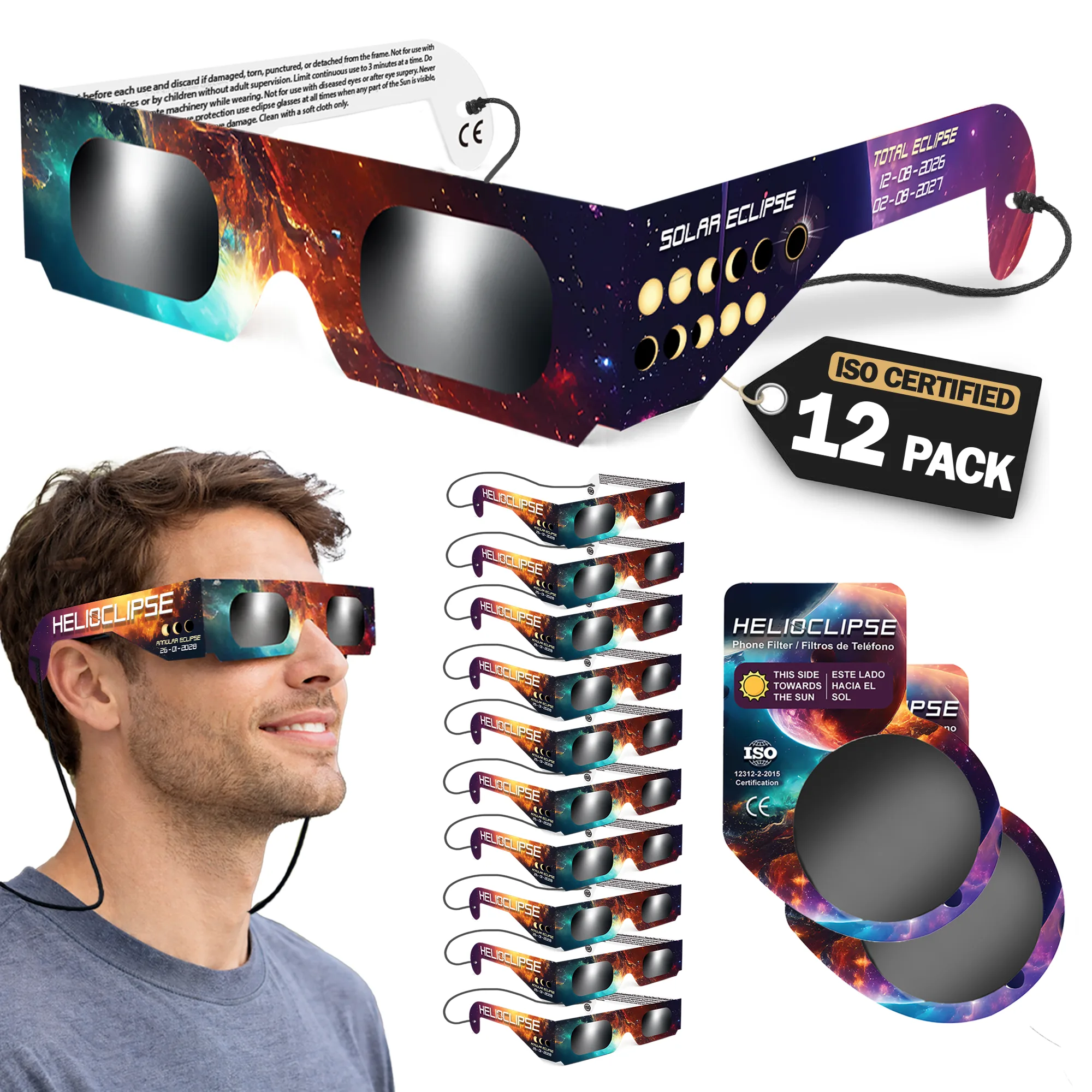
For a family or school group, bring enough certified solar eclipse glasses and a few spares so nobody is tempted to use a damaged pair. Helioclipse offers ISO 12312-2 certified eclipse viewing glasses for direct, unmagnified solar viewing. Order early enough to inspect them and teach everyone how to use them before August 12.
Cameras, binoculars and telescopes need a different solution: a suitable solar filter secured over the front aperture of the instrument. Never look through unfiltered magnifying optics while wearing eclipse glasses. Concentrated sunlight can damage the viewer and your eyes almost immediately. If you are not already experienced with solar equipment, enjoy the eclipse without magnification or ask a qualified astronomy group to supervise.
Indirect projection is an excellent companion activity. With your back to the Sun, a pinhole projector, colander or gaps between crossed fingers can cast images of the narrowing solar crescent onto a pale surface. Do not look through the holes. In a city full of balconies, railings and leafy trees, the projected crescents may become one of the day’s most memorable sights.
A practical plan for families and groups
Tell your group now that Barcelona is getting a deep partial eclipse, not totality. That single distinction prevents the dangerous assumption that glasses should come off when the light becomes dim. Share the date, agree on a primary location and choose a nearby backup before the city’s obvious viewpoints become crowded.
Pack lightly but deliberately:
- ISO 12312-2 solar viewers plus spares
- water, hats and sunscreen for the waiting period
- a phone with the location and local circumstances saved offline
- a small pinhole-projection activity for children
- a watch or phone showing CEST clearly
- any essential medication and a simple way to contact separated group members
Arrive early enough to evaluate both the horizon and the crowd. If tripods, walls or packed promenades compromise the site, move before the deepest phase. The spectacle develops gradually, so there is no need to stare continuously; brief protected looks every few minutes will show the Moon’s progress clearly.
Most importantly, leave some attention for the city itself. Watch how the light changes on pale façades, how projected crescents collect beneath trees and how people react when the remaining solar sliver looks impossibly thin through their viewers. Barcelona will not enter totality, but 99.8% coverage at low altitude can still produce an eerie, communal evening—provided the horizon cooperates.
Frequently asked questions
Where in Spain should I go for the best view of the August 2026 solar eclipse?
The excerpt does not identify a single best location in Spain. For Barcelona, the key issue is an unobstructed west-northwest horizon at your exact viewing spot, because the Sun will be very low and local buildings, trees, hills, cloud, and haze may block the crescent.
What time is the 2026 eclipse visible from Spain?
For Barcelona, maximum of the solar eclipse is expected at about 8:29 p.m. CEST on Wednesday, August 12, 2026 (18:29 UTC). The excerpt addresses a solar eclipse, not a lunar eclipse, and local timing should be checked for precise coordinates.
What will the partial solar eclipse look like in Barcelona in August 2026?
Barcelona is expected to have about 99.8% of the Sun's apparent area covered at maximum, but it will remain outside the path of totality. There will be no glasses-off interval, no visible solar corona, and no point at which the Sun's bright face is completely hidden.
How should I use a Barcelona eclipse viewing guide for August 2026?
Use a guide or interactive map centered on your exact observing location rather than on Barcelona generally, and confirm whether it reports coverage or magnitude. Visit the site at the same evening time before eclipse day to inspect the real west-northwest horizon for obstructions and haze.
What are the main viewing concerns for the 2026 solar eclipse in Barcelona?
The main concerns are the very low Sun toward the west-northwest and the possibility that buildings, trees, hills, thin cloud, or Mediterranean haze will hide the narrow solar crescent. Certified solar viewers must be used for every direct look because Barcelona will experience a partial eclipse, not totality.
On-site next steps
- Place your exact beach, plaza, rooftop or park coordinates in the Helioclipse Eclipse Explorer and record maximum time, Sun direction and local coverage.
- Inspect the west-northwestern horizon from the real site, then choose a nearby backup with different obstructions.
- Read the August 12, 2026 planning guide if you are deciding between Barcelona’s partial eclipse and travel into totality.
- Prepare certified Helioclipse solar viewers for everyone who will look directly at the Sun. In Barcelona, they stay on throughout every visible phase.
Sources & further reading
- Where and when to see the Aug. 12 solar eclipse—exact times for North America and Europe — Live Science
- 10 best Spanish cities to see the total solar eclipse 2026 — Space.com
- Into Totality: Our Guide to the August 12th Total Solar Eclipse — Universe Today
- The biggest skywatching day of 2026 is coming — Space.com
- The Sky Today on Wednesday, August 12: A total solar eclipse, plus the Perseids peak — Astronomy
- Eclipse Viewing Safety — NASA Science
- Eclipses — NASA Science
- How to View a Solar Eclipse Safely — American Astronomical Society
- About the ISO 12312-2 Standard for Solar Viewers — American Astronomical Society
- Eclipse Basics — American Astronomical Society