Bilbao in 2026: one city, one eclipse—Basque Country totality for walkers, transit riders, and skyline readers
Bilbao will enter the Moon’s central shadow on August 12, 2026—but this is not a city where you can casually step outside at the last second and assume the skyline will cooperate. Totality arrives at approximately 8:27 p.m. CEST, lasts about 26 seconds at a representative central-city location, and places the Sun only around 8.2 degrees above the west-northwest horizon. A building, wooded ridge, bridge structure, or badly positioned street can erase the main event without moving you outside the eclipse path.
That combination makes the Bilbao eclipse 2026 a wonderfully urban planning problem. You need to confirm that your exact location is inside totality, find a genuinely open horizon, and reach it before a stadium-scale crowd starts competing for the same narrow pavements and viewpoints. Begin with our Eclipse Explorer and 3D map, checking coordinates rather than relying on the word “Bilbao” alone.
The reward is real. During those brief seconds, the last direct sunlight can vanish, the solar corona can appear around the black silhouette of the Moon, and the evening city can drop into an abrupt, unfamiliar twilight. Bilbao total eclipse 2026 plans therefore deserve more precision than a pin dropped somewhere near the estuary.
Bilbao is inside the path—but close enough to the edge for precision to matter
NASA’s global event map places northern Spain inside the total solar eclipse 2026 path on August 12. Bilbao lies near the northern side of that corridor, not near the region of longest totality. That is why its estimated total phase is measured in tens of seconds rather than the roughly one-and-a-half-minute durations available at some locations farther toward the path’s interior.
The practical distinction is absolute. Inside the umbra, the Moon completely covers the Sun and reveals the corona. Immediately outside it, even an extremely deep partial eclipse leaves a sliver of photosphere shining. That sliver is still dazzlingly bright, so there is no corona and no safe naked-eye interval. Our broader guide to the 2026 totality path across Spain explains why the boundary between partial and total is a physical line, not a gradual zone of “almost totality.”
Bilbao’s short duration also means that small changes in position can matter. Do not assume every address carrying a Bilbao postal label has identical circumstances, and do not infer the result for a hillside barrio from a city-centre estimate. Check the coordinates of your hotel, park, bridge approach, or viewing area. If your chosen point sits uncomfortably near an edge line, move deeper into the mapped totality corridor while remaining within the city and recheck the new point.
A credible solar eclipse Spain 2026 map should show the totality boundaries, your selected coordinates, local contact times, and the direction and altitude of the Sun. A simple shaded map of northern Spain is not enough for street-level planning.
The headline numbers for August 12
For a representative Bilbao location, the best currently published city-level estimate is:
- Date: Wednesday, August 12, 2026
- Approximate start of totality: 8:27 p.m. CEST, or about 18:27 UTC
- Approximate duration: 26 seconds
- Direction: west-northwest
- Solar altitude during totality: about 8.2 degrees
Treat those figures as planning estimates, not a substitute for calculating your exact coordinates. The phrase total solar eclipse 2026 Bilbao Spain time needs a location attached to it: contact times and totality duration vary across the city and change more quickly near the edge of the path. Recheck them close to eclipse day against an authoritative calculation.
The partial phase begins well before totality, giving you time to watch the Moon gradually cover the Sun through certified viewers. The most dramatic environmental changes are concentrated near the end. In the final minutes, the remaining solar crescent becomes extremely thin, daylight takes on an unusual quality, shadows sharpen, and the western sky darkens rapidly. Then Bilbao’s total phase arrives—and roughly half a minute later, the photosphere begins to return.
That brevity is the emotional core of a total solar eclipse 2026 Bilbao Spain plan. Twenty-six seconds is long enough to see the corona and feel the city change, but short enough that fumbling with a phone, arguing over where to stand, or waiting for one person to arrive can consume much of it.
Read Bilbao’s skyline from the Sun backward
An 8.2-degree altitude is low. Hold a clenched fist at arm’s length: its apparent width is roughly 10 degrees. The eclipsed Sun will therefore sit less than one fist above a perfectly level horizon. Bilbao does not have a perfectly level horizon.
The city occupies the Nervión estuary valley, enclosed by hills and crossed by bridges, rail structures, roads, towers, trees, and tightly built streets. Open water can provide a longer view, but the estuary bends; standing beside it does not automatically mean you face west-northwest. A riverside promenade with a beautiful northward view may still hide the Sun behind a building upstream. Likewise, a high terrace can offer an impressive city panorama while a more distant ridge blocks the final few degrees above the horizon.
Use the Sun’s direction as your starting point. From a proposed site, identify west-northwest and ask four separate questions:
- Is the coordinate definitely inside totality?
- Is the geometric horizon open at an altitude of roughly 8 degrees?
- Could trees, temporary stages, cranes, parapets, or buildings block that line?
- Can your group reach and leave the site safely without relying on one overloaded connection?
Do a rehearsal at approximately the same clock time on August 11 if you can. The Sun will be in almost the same part of the sky, making the previous evening far more informative than a daytime photograph or a generic “panoramic viewpoint” description. If you cannot visit in advance, inspect 3D terrain and street-level imagery, then keep a second walkable location with a different horizon profile.
A solar eclipse 2026 Spain interactive map is most useful when it answers this sight-line question, not merely whether a city falls beneath a colored band. Our map can help you compare exact points, but temporary obstructions and vegetation still require an on-the-ground check.
Artxanda: panoramic, accessible, and likely to be intensely busy
Artxanda is the obvious name in many Bilbao solar eclipse 2026 plans. The hillside viewpoint is close to the centre, offers a broad urban panorama, and is connected by a funicular whose normal journey takes only a few minutes. Those advantages also concentrate demand.
Do not translate “short ride” into “quick escape.” A funicular carries people in batches, while an eclipse crowd can arrive continuously for hours. Queues may build well before the partial phase, platform access could be managed, and routine service information may not describe eclipse-day operations. Check official transport announcements near the date and have a walking route that your group can realistically manage.
Artxanda also needs a precise horizon test. Elevation helps you see over nearby buildings, but it does not make distant terrain disappear. Stand where you actually intend to observe and identify the west-northwest line rather than assuming every part of the ridge faces the same way. A lookout crowded with raised phones, tripods, and people arriving after you may further narrow the usable view.
If Artxanda is your choice, treat it like an event venue: arrive early, carry water, agree on a meeting point, and expect mobile data to slow under heavy demand. Families should decide in advance whether the atmosphere of a packed lookout is worth the transport and queueing pressure. A less famous open space with a verified sight line may produce a calmer 26 seconds.
Walking the estuary and testing central-city alternatives
Bilbao’s compact centre allows a useful kind of eclipse planning: scouting more than one candidate on foot. Abando, Uribarri, Deusto, the Casco Viejo approaches, and the riverside around central bridges offer different combinations of elevation, street orientation, open water, and built obstruction. They must be checked point by point; a barrio name cannot certify totality or reveal the horizon.
Building canyons are the central risk. From a narrow street, the Sun may remain invisible even while the overhead sky is clear. Open plazas can improve the angular view, but a western façade may still intercept an 8-degree-high Sun. Bridges can offer broader sight lines, yet their pavements are movement corridors, not automatically safe observation platforms. Never stop where you obstruct cyclists, emergency access, transit entrances, or pedestrian flow.
The estuary is useful because you can read long sight lines directly. Walk to the exact point, face west-northwest, and see what occupies the first fist-width above the skyline. If the view contains only a thin gap between buildings, reject it. If the line runs through foliage, remember that August trees will be fully leafed. If it crosses a ridge close to the predicted solar altitude, choose another location rather than hoping the Sun clears it.
For anyone assembling a Bilbao Spain eclipse 2026 itinerary, the strongest plan is often a pair of sites within a manageable walk: one primary location and one backup with a meaningfully different western exposure. They should not depend on crossing the entire city during the final hour.
Transit can remove traffic risk, but not capacity limits
Bilbao’s metro, tram, buses, commuter rail, and funicular make a car-free eclipse day plausible. They do not make it frictionless. August schedules, planned works, event controls, and capacity restrictions can change, so consult the relevant operators rather than copying an ordinary weekday journey planner months in advance.
Build the day around an early arrival. The partial phase is part of the experience, and reaching your site before it begins gives you time to check the horizon, inspect viewers, find toilets and water, and position children away from traffic. Waiting until shortly before 8:27 p.m. creates a brittle plan: one full vehicle, delayed interchange, or closed entrance could cost the entire total phase.
After totality, resist the reflex to leave in the same minute as everyone else. The Sun’s bright face returns immediately, so put your viewers back on before looking toward it. Then let the first surge clear if your location remains safe and open. Transit platforms and bridge approaches can experience crowding even when roads are not gridlocked.
A solar eclipse 2026 Spain Bilbao plan should therefore include walking times, not just vehicle times. Know how long it takes your slowest group member to reach the backup site, and avoid routes that rely on lifts or escalators whose availability you have not verified. For children or anyone with limited mobility, shade, seating, gradients, and toilet access matter as much as the map pin.
Plan for crowds on the scale of a major match
Nobody can reliably state how many people will occupy each Bilbao viewpoint this far in advance. The useful comparison is operational rather than predictive: imagine a stadium crowd dispersing into a network of promenades, stations, bridges, and hillside paths. Even if the city absorbs the total number, one famous lookout or narrow access route can become uncomfortable.
Tell your friends and family early, but keep the group practical. Share a written rendezvous point, the coordinates of both viewing sites, and the latest time at which you will switch to the backup. Do not make successful observation depend on live messages getting through in the final minutes.
Avoid standing in roads or climbing walls for a better angle. Do not block a bridge lane, funicular entrance, or emergency route. If officials establish managed viewing areas, respect capacity controls and check whether entry is ticketed. A polished total solar eclipse 2026 Bilbao Spain 2026 guide cannot predict those temporary arrangements; municipal and transport notices published closer to August 12 will be the controlling sources.
The awkwardly broad label total solar eclipse 2026 Bilbao Spain 2026 guide map is only useful when reduced to local decisions: which coordinate, which horizon, which walking route, and which fallback? Save those details offline and give every adult in the group a copy.
Bilbao’s cloud problem is really a horizon problem
One published climatological estimate puts Bilbao’s historical August cloud chance near 57 percent. That is a planning signal, not a forecast for August 12, 2026. A seasonal average cannot tell you whether a cloud bank will occupy the west-northwest horizon during a particular 26-second interval.
For this eclipse, an overhead patch of blue is not enough. Because the Sun is only about 8 degrees high, you will look through a long slanting path in the atmosphere. Low coastal cloud, haze, or a distant bank over the Bay of Biscay can hide the Sun while much of the sky above Bilbao appears clear.
Start monitoring forecasts several days out, but reserve decisions about movement for the period when high-resolution forecasts and satellite imagery become meaningful. Compare cloud layers and direction of travel, not just a single percentage icon. Our guide to cloud cover and eclipse-day mobility explains how to distinguish climate expectations from an actionable short-range forecast.
Within one city, mobility has limits. A kilometre or two can escape an isolated shower or improve a sight line, but it may not outrun a regional marine cloud deck. Your backup should therefore solve local problems—one blocked horizon, one crowded approach, one patch of low cloud—without pretending that crossing Bilbao guarantees different weather.
Eye safety for a total phase lasting only seconds
Use solar viewers that conform to ISO 12312-2 throughout every partial phase. Ordinary sunglasses are not suitable, regardless of darkness. Inspect each viewer for tears, punctures, scratches, loose filter material, or water damage, and supervise children directly.
In Bilbao, remove viewers only after the Sun’s bright face is completely covered and nothing remains visible through the filter. Because totality is expected to last only about 26 seconds at a representative location, assign one informed adult to call the transitions. The moment any bright photosphere returns, put viewers back on before looking at the Sun. Our guide to eclipse phases and when to use solar glasses walks first-time observers through that sequence.
Never look through an unfiltered camera, binoculars, or telescope, with or without eclipse glasses over your eyes. Magnifying optics require a purpose-made solar filter securely mounted over the front aperture. A handheld viewer is not an instrument filter.
Product wording can also cause confusion. Phrases such as approved solar eclipse glasses and eclipse glasses nasa approved imply an approval program that NASA does not operate for individual brands. What matters is traceable conformity with ISO 12312-2, clear instructions, an undamaged filter, and a trustworthy seller. When choosing eclipse viewing glasses, look beyond marketplace wording such as solar eclipse glasses iso 12312-2 certified and verify what the supplier actually states about testing and conformity.
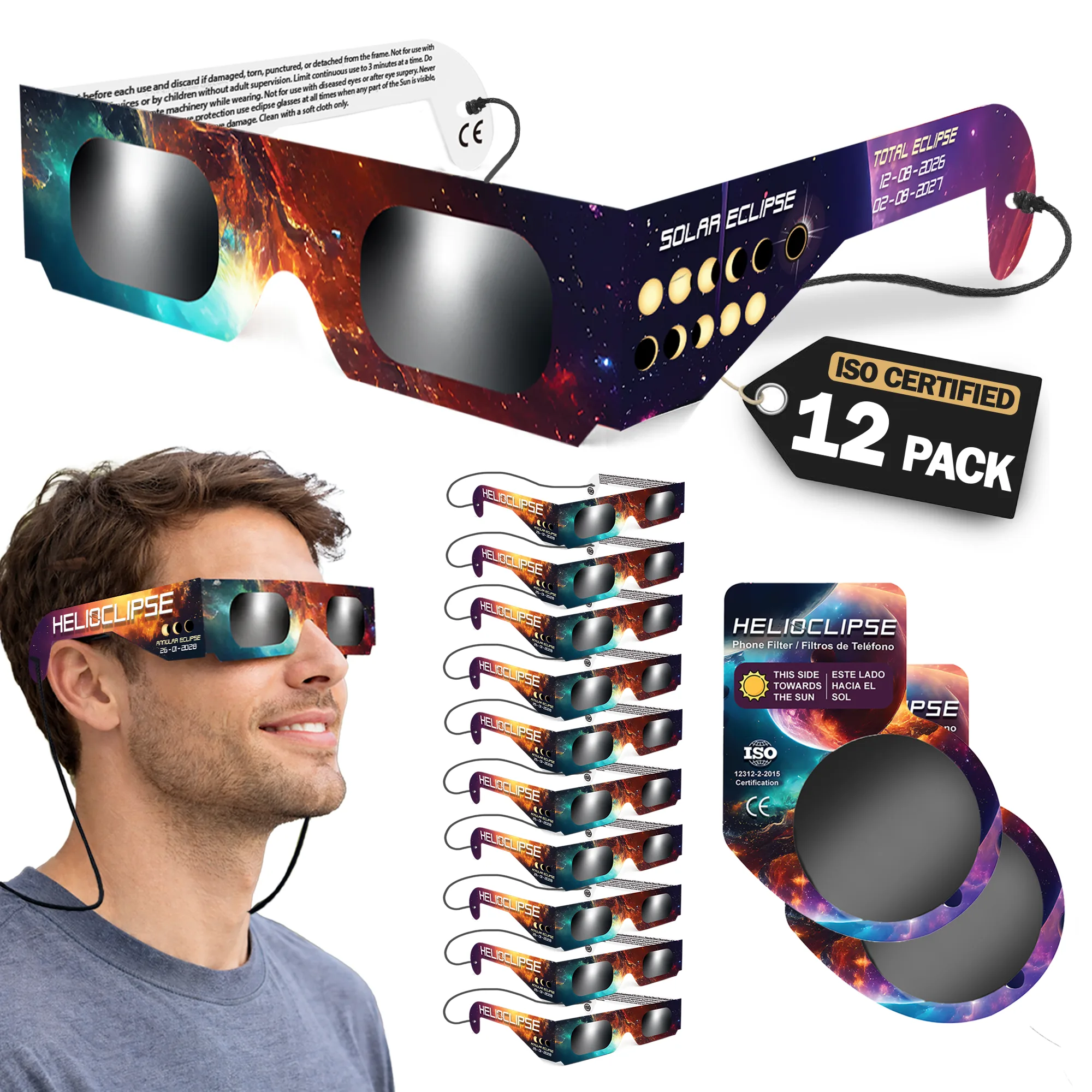
Order enough viewers before late demand develops, then store them flat and dry. Bring a few spares for damage or for the friend who joins at the last minute. You can explore Helioclipse solar eclipse glasses when equipping your group.
What the 26 seconds may feel like
During most of the partial phase, the city will still look surprisingly normal. The uncovered part of the Sun remains intensely bright. You will notice the advancing Moon through your viewer long before the surroundings become dark.
The final minutes are different. The evening light can fade quickly, temperatures may dip, and the western sky can acquire an uncanny, compressed twilight. Streetlights may switch on. People who have spent an hour talking may suddenly become quiet—or shout—as the last solar bead disappears.
Only then does the corona become visible around the Moon. Bilbao’s totality is short enough that we recommend watching rather than attempting a complicated photography sequence. Take in the black lunar disk, the pearly corona, and the color around the horizon. If you want a phone recording, start it beforehand on a fixed wide view and leave it alone.
The returning solar edge ends naked-eye viewing immediately. Twenty-six seconds will feel both astonishingly full and impossibly brief. That is why the best Bilbao solar eclipse 2026 preparation is not more equipment; it is removing avoidable decisions from the moment itself.
A compact Bilbao checklist
Several planning labels circulate for this event—total solar eclipse 2026 Bilbao Spain map, solar eclipse Spain 2026 map, and solar eclipse 2026 Spain interactive map—but every useful version should lead to the same checks:
- Confirm the exact observing coordinates are inside totality.
- Record local partial-phase and totality times for those coordinates.
- Verify the Sun’s west-northwest direction and low altitude.
- Inspect the real horizon at the same time on the previous evening if possible.
- Choose a walkable backup with a different sight line.
- Check official transit and municipal notices close to the event.
- Carry ISO 12312-2 viewers, water, sun protection, and any needed medication.
- Download maps, times, and meeting instructions for offline use.
- Arrive before the partial phase rather than racing the final countdown.
A file titled total solar eclipse 2026 Bilbao Spain 2026 guide map should contain those operational details, not just a national path graphic. Likewise, the wording solar eclipse 2026 Spain Bilbao must resolve to a specific point: citywide labels cannot tell you whether a ridge or tower occupies your eight-degree sight line.
Frequently asked questions
Which locations in Spain offer the longest view of the 2026 total solar eclipse?
Locations farther toward the interior of the totality corridor can have roughly one-and-a-half minutes of totality, compared with about 26 seconds at a representative central Bilbao location. The excerpt does not identify one single best location, and a usable viewing site also needs an open west-northwest horizon.
What time will the solar eclipse occur on February 17?
The excerpt does not provide timing for a solar eclipse on February 17. It addresses the total solar eclipse on August 12, 2026, with totality in Bilbao occurring at approximately 8:27 p.m. CEST.
Will Bilbao be in the path of totality in 2026?
Yes. Bilbao is inside the Moon’s central shadow on August 12, 2026, although it lies near the northern side of the totality corridor. Exact coordinates should be checked because locations near the path boundary may have different totality circumstances.
What are the main planning concerns for watching the 2026 eclipse from Bilbao?
Totality is brief—about 26 seconds at a representative central-city location—and the Sun will be only around 8.2 degrees above the west-northwest horizon. Choose a site with a genuinely open horizon and arrive early, since buildings, ridges, bridge structures, and crowds can obstruct the view.
What should I know before choosing a viewing location for the 2026 total solar eclipse in Bilbao, Spain?
Confirm that the exact coordinates of your hotel, park, bridge approach, or viewing area are inside totality rather than relying on the city name alone. Outside the umbra, even a very deep partial eclipse does not provide a safe naked-eye interval or reveal the corona; if your point is near an edge line, move deeper into the mapped corridor and check again.
On-site next steps
- Open the Helioclipse Eclipse Explorer and test your accommodation, primary viewing point, and backup point separately. Record whether each is inside totality, the local duration, and the Sun’s direction.
- Walk the west-northwest sight line in person, ideally around 8:27 p.m. on August 11. Reject any location where terrain, buildings, or trees approach the predicted solar altitude.
- Equip your group early with ISO 12312-2 solar eclipse glasses, inspect them before use, and rehearse the glasses-on, glasses-off, glasses-on sequence together.
Sources & further reading
- 10 best Spanish cities to see the total solar eclipse 2026 — Space.com
- Spain's total solar eclipse 2026 comes with a catch — Space.com
- Total Solar Eclipse on August 12, 2026 — NASA Science
- Stops Along the Path of Totality — NASA Earth Observatory
- How to see the August 12 total solar eclipse — Astronomy Magazine
- How to View a Solar Eclipse Safely — American Astronomical Society
- Eclipse Basics — American Astronomical Society
- Eclipse Viewing Safety — NASA Science
- What to Expect: A Solar Eclipse Guide — NASA Science
- Solar Eclipse Eye Safety Technical Report — American Astronomical Society