Palma (Mallorca) in 2026: one city, one eclipse—island light, sea haze, and horizon truth
On August 12, 2026, Palma will spend roughly a minute and a half inside the Moon’s shadow. Totality is expected at about 8:31 p.m. CEST—18:31 UTC—with the eclipsed Sun only around 2.4° above the west-northwestern horizon. That last number is the one that should shape almost every decision you make.
A Sun that low can disappear behind a hotel, a line of trees, port infrastructure, Bellver’s wooded slopes, a rooftop parapet, or a thin bank of marine cloud. Palma is inside the path, but being in the right city is not the same as having the right view. Use our Eclipse Explorer and 3D map from the exact place where you expect to stand—not merely from a Palma city marker.
The total solar eclipse 2026 Palma Mallorca Spain experience should last approximately 1 minute 36 seconds at suitable locations around Palma, although exact contact times and duration vary with coordinates. It will be brief, late, and visually extraordinary if the horizon cooperates: a black lunar disk and pale corona suspended just above the end-of-day landscape.
Palma is in totality—but the horizon decides whether you see it
The August 12 event is a total solar eclipse across a narrow path running through Greenland, Iceland, the Atlantic, Spain, and a small corner of Portugal. The phrase total solar eclipse 2026 Spain therefore describes two very different experiences: true totality within the Moon’s umbra and a deep partial eclipse immediately outside it. Even 99% coverage does not reveal the corona or create the full darkness of totality.
Palma falls inside the total solar eclipse 2026 path Mallorca, close enough to its southern portion for published city estimates to give about 96 seconds of totality. The decisive geometry, however, is vertical as well as horizontal. At approximately 2.4° altitude, the Sun’s center is only about five apparent solar diameters above a perfectly flat astronomical horizon. A modest obstruction can erase that margin.
That is why a total solar eclipse 2026 Palma Mallorca Spain map needs more than a colored path band. It must help you assess the bearing and elevation of the Sun from your coordinates. The west-northwest direction matters: an open view south across Palma Bay may be beautiful while still pointing away from the eclipse.
Published figures put totality near 20:31 CEST, or 18:31 UTC, but do not treat a rounded city time as your personal countdown. A total solar eclipse 2026 Palma Mallorca Spain time lookup should return contact times for your exact pin, along with solar altitude and azimuth. Buildings, ship movement, restricted areas, and local topography are not captured by a city-wide timing label.
Promenade, beach, or historic core: what changes inside one city
Palma’s seafront sounds like the obvious answer, but “seafront” is not a direction. Much of the bay opens broadly southward. The eclipsed Sun will be toward the west-northwest, potentially across parts of the built city, port, hills, or nearby structures depending on where you stand. Walk the site with a compass view rather than assuming water automatically supplies the horizon.
Along the waterfront and around Can Pastilla, long, open sections may offer better possibilities than enclosed streets, but every candidate point needs its own test. A palm tree at ordinary sunset is picturesque; a palm crown directly in front of a Sun only 2.4° high is an eclipse blocker. Railings, kiosks, lighting columns, temporary stages, moored vessels, and dense crowds can matter too.
The historic core presents the opposite character. Its stone streets, courtyards, cathedral walls, and narrow sightlines make a powerful Palma setting, but they are poorly matched to an object nearly touching the horizon. From many street-level positions, the Sun will vanish behind the urban fabric well before totality. A rooftop may improve the geometry, yet access, capacity, safety barriers, and the direction of neighboring buildings must all be confirmed in advance.
Higher ground is not automatically superior. Around Bellver, elevation can extend a distant view, but trees and local terrain may cut into the critical bearing. Public access, closing times, fire restrictions, crowd controls, and transport arrangements may also change. We would choose a verified, modestly elevated opening over an impressive viewpoint whose west-northwest sightline has never been checked.
The palma solar eclipse 2026 is therefore a city-scale line-of-sight problem. The palma 2026 eclipse plan that works best will identify a primary position and at least one reachable backup within the municipality, each tested at approximately the same clock time on a preceding evening.
The sunset rehearsal is your most useful site inspection
Visit your intended location before August 12—ideally more than once—and remain there until sunset. The Sun’s exact setting position shifts from day to day, so an ordinary rehearsal is not a perfect celestial overlay, but it reveals the obstruction profile that a map alone cannot: rooflines, trees, cranes, terrain, access gates, and places where a crowd could block a seated child’s view.
Use the solar eclipse 2026 Mallorca map for the eclipse geometry, then compare its west-northwest azimuth with the real skyline. Hold your phone’s compass level, allowing for its limited precision and possible interference from metal structures. Better still, identify distant landmarks on the map and use them to establish the correct sector.
The solar eclipse Spain 2026 map view should answer four separate questions:
- Is the exact pin inside the path of totality?
- At what local time do second and third contact occur there?
- What are the Sun’s altitude and azimuth at totality?
- Does terrain rise into that direction before the geometric horizon?
A planning label such as palma Spain 2026 eclipse may identify the city but cannot answer those questions. Likewise, palma Spain eclipse 2026 and palma Spain solar eclipse 2026 are useful compact event descriptions, not substitutes for coordinate-level circumstances.
Arrive early on eclipse day. The partial phase develops gradually, while suitable public space may fill quickly. Agree on a meeting point with your group because mobile networks can become congested. Give children their viewers before the event starts, practise putting them on while looking down, and make sure every adult understands the moment when protection may—and may not—come off.
Ferry and cruise passengers must plan from the berth, not the island name
A ferry ticket to Palma does not guarantee a clear eclipse. Port terminals, breakwaters, warehouses, cranes, ships, security zones, and nearby terrain can all occupy the west-northwestern skyline. A passenger looking over open water toward the south may still have the eclipsed Sun behind land or infrastructure.
For the solar eclipse 2026 Palma de Mallorca, place the map pin on the expected berth or accessible passenger area. Check whether you are permitted to remain there around 20:31 CEST and whether embarkation, departure, or a mandatory return-to-ship time overlaps totality. A vessel scheduled to be alongside can change berth; one expected at sea can change course or timetable. Confirm arrangements with the operator close to the date.
Do not count on watching through a cabin window. Coatings, reflections, narrow fields of view, dirty glass, and the ship’s orientation can defeat the view, and ordinary glazing does not replace safe solar protection. If a vessel is moving, the relevant viewpoint and horizon change continuously. The total solar eclipse Mallorca 2026 geometry must be recalculated for the ship’s actual position rather than borrowed from Palma’s city-center estimate.
Cruise and ferry passengers should also resist generic “Mallorca eclipse” advice that recommends another coast without accounting for transfer time. Palma traffic, port controls, road capacity, and the post-eclipse return can turn a seemingly short move into a missed sailing. A verified berth-side view may be wiser than an ambitious excursion with no operational margin.
Sea haze is not cloud, but it can still erase a low corona
Mallorca’s August reputation for sunshine is not a forecast for one evening in 2026. Historical cloud statistics quoted for the area are useful for comparing climates, but they cannot promise a clear two-minute window. One published compilation gives a cloud figure of about 32% for Playa de Palma since 2000; the meaning depends on the dataset and measurement method, and it says nothing certain about August 12, 2026.
Low solar altitude adds another atmospheric problem. Light from a Sun near the horizon crosses far more air than light from a Sun overhead. Water droplets, dust, salt aerosol, humidity, smoke, and urban pollution scatter and absorb some of that light. A sky that looks blue overhead can become milky or opaque in the final few degrees above the sea or land horizon.
That haze can soften the partial crescent and suppress the corona during totality. Thin cloud may remain almost invisible earlier in the afternoon and then become obvious as the Sun descends behind it. Conversely, a hazy day can improve near sunset if the lower atmosphere clears. Neither a seasonal average nor a morning forecast can settle the question by itself.
Check official forecasts, satellite imagery, smoke and dust information, and the visible horizon on eclipse day. Our broader guide to cloud cover and eclipse-day mobility explains how to compare evidence without treating any model as certainty. Within Palma, preserve a realistic walking or transit backup rather than planning a last-minute island crossing.
Most importantly, haze does not make the Sun safe to view. If the bright photosphere remains visible, use proper solar protection even when the Sun appears dim, red, or filtered by cloud.
What the final minutes should feel like
During the partial phase, the Moon will progressively cover the Sun while everyday brightness remains surprisingly persistent. In the final 10 to 15 minutes, the quality of the light should change more rapidly. Shadows can sharpen, colors may appear muted, and the western sky can darken as the umbra approaches.
Palma’s low-Sun geometry could compress several visual effects into one striking horizon scene. The remaining solar crescent will be close to the landscape; distant clouds may darken; automatic lights may switch on; and the temperature or breeze may shift. At second contact, the last direct photospheric light disappears and the corona becomes visible around the Moon.
Published estimates give roughly 1 minute 36 seconds of totality—short enough that complicated photography can consume the whole experience. Decide in advance on two or three priorities: look at the corona, notice the horizon and the people around you, and be ready for the return of sunlight. The first brilliant point after totality ends is your signal to put viewers back on immediately.
The total solar eclipse 2026 Palma Mallorca Spain date is fixed; the exact human experience is not. Cloud could conceal the Sun while the city still darkens. A clear horizon could reveal the corona almost touching the landscape. Either way, knowing the sequence lets you experience the event rather than spending those 96 seconds adjusting equipment.
Eye safety: protection stays on through every partial phase
Use special-purpose viewers conforming to ISO 12312-2 whenever any part of the Sun’s bright face is visible. Ordinary sunglasses are not adequate, regardless of tint. Inspect every viewer before use and discard it if the filter is scratched, punctured, torn, loose, or otherwise damaged. Children need active supervision.
Only people who are at a location experiencing actual totality may remove their viewers, and only after the bright solar surface has completely disappeared. In Palma, that unfiltered interval is expected to last about 96 seconds, depending on the precise location. Put the viewers back on as soon as the first bright point of photosphere returns. If cloud prevents you from identifying the contacts confidently, follow a reliable audible countdown tied to your exact coordinates and err on the side of keeping protection on.
Our guide to eclipse phases and when to use solar glasses is worth sharing with everyone in your group before the day. If your verified point turns out to be outside the path, there is no glasses-off interval at all.
Eclipse viewers are for direct, unmagnified observation. Never look through binoculars, a telescope, or a camera lens while wearing them; concentrated sunlight can damage the filter and your eyes. Optical equipment requires a purpose-made solar filter secured over the front aperture, with expert guidance if you are unfamiliar with solar observing.
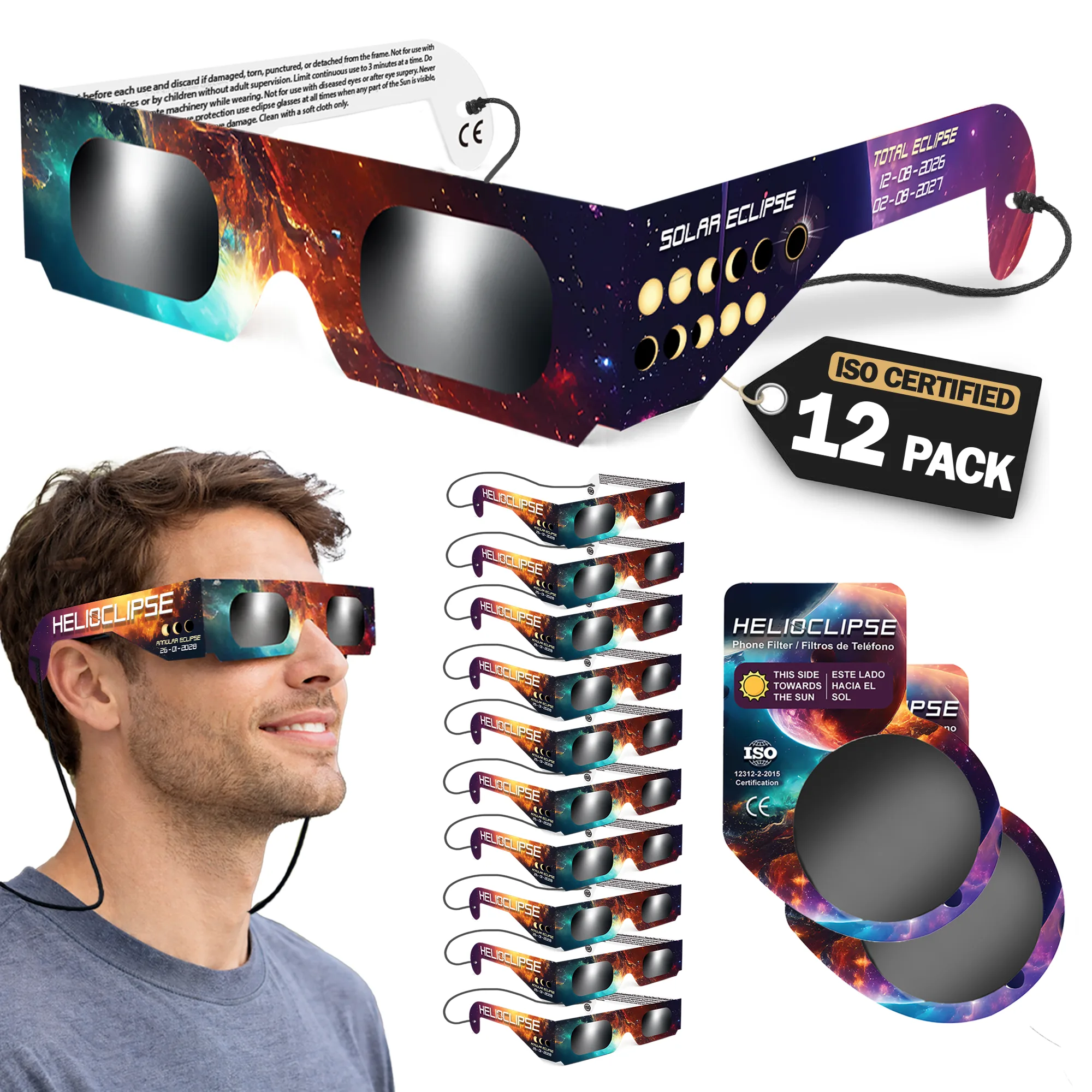
Product language can be confusing. Eclipse glasses ISO 12312-2 refers to the relevant international standard for direct, unmagnified solar viewers, while phrases such as certified solar eclipse glasses should be supported by trustworthy manufacturing and test information—not merely printed as advertising. NASA does not approve consumer viewer brands, so a claim of “NASA approved” is not a meaningful certification category. Choose undamaged eclipse viewing glasses from a dependable source and order enough for your group before demand peaks.
A practical Palma plan
Build the day around the low horizon rather than around a famous landmark.
- Pin your exact location. Use the total solar eclipse 2026 Palma Mallorca Spain map at street or berth level, not an island-wide marker.
- Record local circumstances. Save second contact, third contact, solar altitude, and west-northwest azimuth. Keep 20:31 CEST as an approximate city reference, not a second-perfect promise.
- Inspect the skyline. Rehearse near sunset and identify anything rising more than a couple of degrees into the critical direction.
- Choose one realistic backup. Keep it inside Palma and reachable without depending on uncongested roads.
- Prepare the group. Share the meeting point, safety rules, water, sun protection, and the plan for children or anyone with limited mobility.
- Recheck access and weather. Verify public-space rules, port restrictions, transport, cloud, dust, smoke, and the actual horizon on August 12.
- Stop moving in time. A theoretically better location is useless if you are still in transit when the shadow arrives.
The phrase total solar eclipse 2026 Palma Mallorca Spain guide can sound as though one universal itinerary exists. It does not. Palma contains enclosed medieval streets, elevated wooded ground, open promenades, beaches, working port areas, and private rooftops. The best choice is the accessible site where path geometry, west-northwest sightline, weather evidence, and crowd management all work together.
Frequently asked questions
Where should I watch the 2026 total solar eclipse from in Palma?
Choose a location with a clear, unobstructed view toward the west-northwest horizon. At totality, the Sun will be only about 2.4° high, so hotels, trees, port structures, slopes, parapets, or low marine cloud can block it; check the bearing and elevation from the exact place you plan to stand.
Which parts of Spain will experience totality during the 2026 eclipse?
The narrow path of totality will cross Spain, while locations immediately outside it will see a deep partial eclipse instead. The excerpt identifies Palma as being inside the path, but it does not provide a complete list of Spanish cities affected.
Are there any organized eclipse-viewing events in Spain for 2026?
The excerpt does not mention any public parties or organized viewing events. If you attend any gathering, confirm that its viewing site has a clear west-northwestern horizon rather than assuming a waterfront or city location has the right sightline.
Will the 2026 total solar eclipse be visible from Mallorca?
Yes. Palma, Mallorca is inside the path of totality on August 12, 2026, with published estimates of about 96 seconds of totality at suitable locations. Visibility depends on an open west-northwestern horizon because the eclipsed Sun will be very low.
What are the key planning facts for viewing the 2026 eclipse in Palma?
Totality in Palma is expected at about 8:31 p.m. CEST (18:31 UTC) and may last roughly 1 minute 36 seconds, although timing and duration vary by exact coordinates. Use location-specific contact times, solar altitude, and azimuth rather than a city-wide estimate, and remember that a south-facing view across the bay may point away from the eclipse.
On-site next steps
- Open the Helioclipse Eclipse Explorer, place the pin on your intended promenade position, rooftop, hotel, berth, or public space, and check whether terrain or structures threaten the low west-northwestern view.
- Read our 2026 totality-in-Spain path guide to understand centerline, edge, and partial-eclipse differences.
- Once your group plan is taking shape, order Helioclipse solar eclipse glasses early enough to inspect them and practise safe use before August 12.
Sources & further reading
- Where to view the Solar Eclipse in Palma on 12 August 2026 — Visit Palma
- 10 easy places to see the total solar eclipse 2026 from Spain's major vacation destinations — Space.com
- What time is the total solar eclipse on Aug. 12, 2026? — Space.com
- Solar and Lunar Eclipses in 2026 — Sky & Telescope
- Total Solar Eclipse on August 12, 2026 — NASA Science
- How to View a Solar Eclipse Safely — American Astronomical Society
- About the ISO 12312-2 Standard for Solar Viewers — American Astronomical Society
- Eclipse Viewing Safety — NASA Science
- What to Expect: A Solar Eclipse Guide — NASA Science
- Phenomena You'll Experience at a Total or Annular Eclipse — American Astronomical Society