Spain 2026: low Sun, long shadows, and why “on the path” still needs a clear horizon plan
Spain’s total solar eclipse on August 12, 2026 comes with an unusual planning challenge: from mainland Spain, totality happens late in the evening, with the Sun already low in the west-northwest. A pin can sit comfortably inside the Moon’s shadow on a map while a ridge, apartment block, line of trees, or bank of distant cloud hides the real Sun.
That makes the Spain 2026 solar eclipse a two-part problem. First, you must be inside the path of totality. Second, you need an open sightline in the direction and at the altitude where the eclipsed Sun will actually appear. Use our Eclipse Explorer and 3D map early: check a precise pin rather than relying on a province, town name, or broad path graphic.
This is not a contest to name one “best” Spanish city. The useful questions are more local: Is your pin inside totality? How long does totality last there? How high is the Sun? What blocks the west-northwestern horizon? Can your group move if cloud or traffic threatens the plan?
The path is the first boundary, not the final answer
The global total solar eclipse 2026 path crosses northern Russia, Greenland, Iceland, the Atlantic, Spain, and a small corner of northwestern Portugal. Across Spain, the band of totality is roughly 300 kilometres wide, although quoted widths vary slightly with the eclipse model and the definition used for the solar edge.
The shadow reaches northwestern Spain and runs east-southeast across the country, broadly following the national-scale direction of the Ebro corridor before continuing toward the Mediterranean and the Balearic Islands. Galicia, Asturias, parts of Castilla y León, the Ebro region, Aragón, the Valencian area, and the Balearics all enter the national planning picture—but whether a particular address is total or partial must be checked by coordinates.
This is why a 2026 solar eclipse Spain path graphic cannot settle a local plan by itself. The boundary is sharp. Inside it, the Moon completely covers the Sun for a brief interval. Outside it, some photospheric sunlight remains visible, even if only a thin and intensely bright sliver.
Madrid and Barcelona illustrate the difference. NASA’s selected-city table gives both cities about 99% solar coverage at maximum, but both remain outside totality. That is a deep partial eclipse, not “99% totality.” There is no interval when the corona replaces the bright solar surface, and viewers in those cities must keep proper solar protection on throughout.
For more detail on centerline, edge, and path geometry, read our guide to Spain’s 2026 path of totality. The key national lesson is simple: the Spain 2026 solar eclipse path tells you where totality is geometrically possible. It does not tell you whether a wall, mountain, haze layer, or cloud deck will let you see it.
Totality moves across Spain shortly before sunset
NASA’s published local times give a useful sense of the evening schedule. In León, the partial phase begins at about 7:32 p.m., with totality running approximately from 8:28 to 8:30 p.m. In Zaragoza, the partial phase starts near 7:34 p.m. and totality falls around 8:29–8:30 p.m. Valencia’s partial phase begins near 7:38 p.m., followed by totality around 8:32–8:33 p.m.; sunset then arrives at about 9:01 p.m. All of those entries are local clock times in NASA’s table, and the rounded minutes should not replace pin-specific contact times.
Most observers along the global path receive less than two minutes of totality. The exact duration in Spain changes with position: a site close to the path edge may get only a short interval, while a pin deeper inside the shadow generally gains more time. Even one or two kilometres can matter near a boundary, so never infer your status from the nearest city alone.
The wording 2026 solar eclipse Spain totality should therefore trigger three separate checks: whether the pin is inside the umbra, how long complete coverage lasts, and the Sun’s altitude and azimuth at that moment. Duration alone is not enough. A longer predicted totality behind a ridge is worth zero visible seconds.
A 2026 solar eclipse Spain low sun western horizon time is not one national clock reading. It varies by longitude and exact position within the path. Save the pin-specific times from the map, label the timezone, and share them with everyone in your group. Build the plan around first contact, totality, sunset, and the time you need to be parked and settled—not merely around the rounded minute of maximum eclipse.
Low means genuinely low—and the east gets lower
The phrase 2026 solar eclipse Spain low sun western horizon describes real geometry, not just sunset atmosphere. In northwestern Spain, the totally eclipsed Sun is expected to stand roughly 10°–12° above the horizon. Farther east, including parts of eastern mainland Spain and the Balearic Islands, it may be only about 2°–5° high.
That contrast changes what counts as an obstruction. Hold a closed fist at arm’s length and its apparent width is roughly 10°. Three fingers together span about 5°, while one finger is close to 1°–2° for many people. These are only field estimates, but they reveal how little sky separates a 3°-high Sun from the landscape.
Long shadows make the same geometry tangible. On level ground, a one-metre object casts a shadow about 5.7 metres long when the Sun is 10° high. At 3°, that shadow stretches to roughly 19 metres. A person, tripod, tree, or building can project a shadow many times its own height because the sunlight is arriving almost sideways.
The Spain 2026: low Sun, long shadows, and why “on the path” lesson matters most toward the eastern end of the Spanish track. A site that appears broad and open can still fail if its western horizon rises by only a few degrees. Mediterranean accommodation that faces east toward the sea may offer a beautiful sunrise but put the eclipse behind inland hills or buildings to the west-northwest.
Do not equate “coastal” with “clear horizon.” The relevant direction is where the Sun will be during totality, not where the nearest water lies. On Mallorca or another Balearic island, a west-facing shoreline may help; an east-facing beach may not. The map pin and horizon profile have to agree.
Turn a map pin into a horizon test
A 2026 solar eclipse Spain low sun western horizon map needs more than a coloured path band. For each candidate pin, record four quantities:
- Path status: inside totality, outside totality, or uncomfortably close to the calculated edge.
- Totality duration: the interval between second and third contact at that pin.
- Solar position: altitude above the horizon and azimuth, measured clockwise from north.
- Horizon altitude: the angle of hills, trees, buildings, or other obstacles in the same direction.
The obstruction calculation is unforgiving. A ridge that rises 100 metres above you at a horizontal distance of one kilometre subtends an angle of about 5.7°. At two kilometres, the same height difference is still about 2.9°. That ridge would completely hide a 2.5°-high eclipsed Sun and could interfere with one at 5° once trees and uneven terrain are included.
A 2026 solar eclipse Spain low sun western horizon location is therefore an exact observing point, not merely “Zaragoza,” “Burgos,” or “Mallorca.” Moving from one side of a valley to another can change the horizon while barely changing the eclipse duration. Moving onto a scenic hilltop can also make matters worse if the summit approach, vegetation, safety barriers, or crowds force you onto the wrong side.
Start with the Helioclipse map, then inspect terrain and recent imagery. Visit the candidate site in person if possible, ideally on more than one evening. Check the west-northwestern view from the exact place where your group can legally and safely stand—not from a nearby road, drone photograph, or viewpoint that may be inaccessible on eclipse day.
The phrase 2026 solar eclipse Spain low sun western horizon map is most useful when it means this combined workflow: eclipse geometry plus terrain plus a real ground check. None of those layers can substitute for the others.
A national path contains several different observing problems
Discussion of the 2026 solar eclipse northern Spain can make the entire track sound uniform, but the geometry evolves markedly from west to east. In Galicia, Asturias, and the northwestern interior, the eclipsed Sun is higher—roughly 10°–12° in the cited regional estimates—but mountainous terrain, valleys, Atlantic cloud, and low western haze still demand care.
Across Castilla y León and toward Burgos and León, open agricultural landscapes may provide long sightlines where the terrain permits. NASA’s León example places almost two rounded minutes of totality around 8:28–8:30 p.m. local time. The practical advantage is not a guarantee of clear sky; it is the possibility of finding multiple accessible pins with a sufficiently low west-northwestern horizon.
Farther east through the Ebro region and Aragón, totality comes with the Sun lower. Zaragoza’s rounded timing is about 8:29–8:30 p.m., followed by a partial phase that reaches sunset before the eclipse is geometrically over. Here, distant relief can matter even when the immediate site feels flat.
In the Valencia region and the Balearic Islands, totality happens only a few degrees above the western horizon at many locations. NASA gives Valencia roughly one rounded minute, around 8:32–8:33 p.m., with sunset around 9:01 p.m. A transparent atmosphere and a genuinely open western sightline become decisive because the observer is looking through a much longer atmospheric path.
Lists of 2026 solar eclipse Spain cities can help establish approximate timing, but they should never become a league table of destinations. A modest, legal field with several exit routes and a clean horizon may outperform a famous landmark where buildings, terrain, restricted access, and traffic remove every backup option.
The atmosphere near the horizon is part of the view
When the Sun is high, a cloud near your location is the obvious threat. When the Sun is 2°–5° above the horizon, your line of sight passes through far more atmosphere, so haze and distant cloud become disproportionately important. A forecast icon showing “sunny” overhead does not promise a transparent west-northwestern horizon.
Low cloud, sea haze, wildfire smoke, dust, and thin cloud layers can all attenuate or erase a sunset Sun. Refraction also lifts the apparent solar image slightly relative to a simple geometric horizon, especially close to sunset, but that is not a planning margin you should rely on. Atmospheric refraction varies with conditions, and it cannot see through a mountain or building.
Long-range climate statistics help compare broad regions; they cannot choose your field on August 12. In the final days, inspect several forecast models, satellite imagery, visibility guidance, cloud layers, and conditions upstream along the line of sight. Give special weight to cloud near the western horizon rather than concentrating only on what is overhead.
For the 2026 solar eclipse Spain low sun western horizon 2026 guide workflow, prepare at least two or three pins before the short-range forecast becomes reliable. Put them in different terrain or weather zones where possible. Decide in advance what forecast change would make you move, and set a deadline after which traffic risk outweighs a small meteorological advantage.
Our eclipse-day weather and mobility guide explains how to treat climate as a starting point and the live forecast as a decision tool. Tell friends, relatives, or a school group about the backup plan early. A convoy trying to improvise on crowded roads is much less mobile than a group that already has shared pins, fuel, water, and a departure time.
Scout the human landscape as carefully as the natural one
A technically perfect coordinate may be unusable if it is private land, has no safe parking, closes before sunset, or requires stopping on a narrow road. Confirm access rules and opening hours. Never block farm entrances, emergency routes, or traffic lanes, and do not assume a roadside shoulder can accommodate a crowd.
Stand at the site and look west-northwest at the relevant time of evening. Check for trees, utility poles, temporary structures, stadium lighting, walls, and buildings. A phone panorama can help you compare candidate sites, but mark the actual standing area and do not confuse a wide-angle photograph with angular clearance.
Plan for people arriving well before the partial phase begins. NASA’s examples put first contact around 7:32–7:38 p.m. in León, Zaragoza, and Valencia. That means parking and crowd management will overlap with ordinary evening travel. After totality, many observers may leave at once even though the partial phase continues toward sunset.
The shorthand 2026 solar eclipse Spain 2026 can obscure the fact that this is an evening public-space problem as well as an astronomical event. Families need toilets, shade before the Sun gets low, drinking water, and a clear method for supervising children. Drivers need a safe route out after dusk. Everyone needs to know that cloud is disappointing, but unsafe parking or a last-minute roadside stop is not an acceptable response.
Eye protection does not become optional because the Sun looks dim
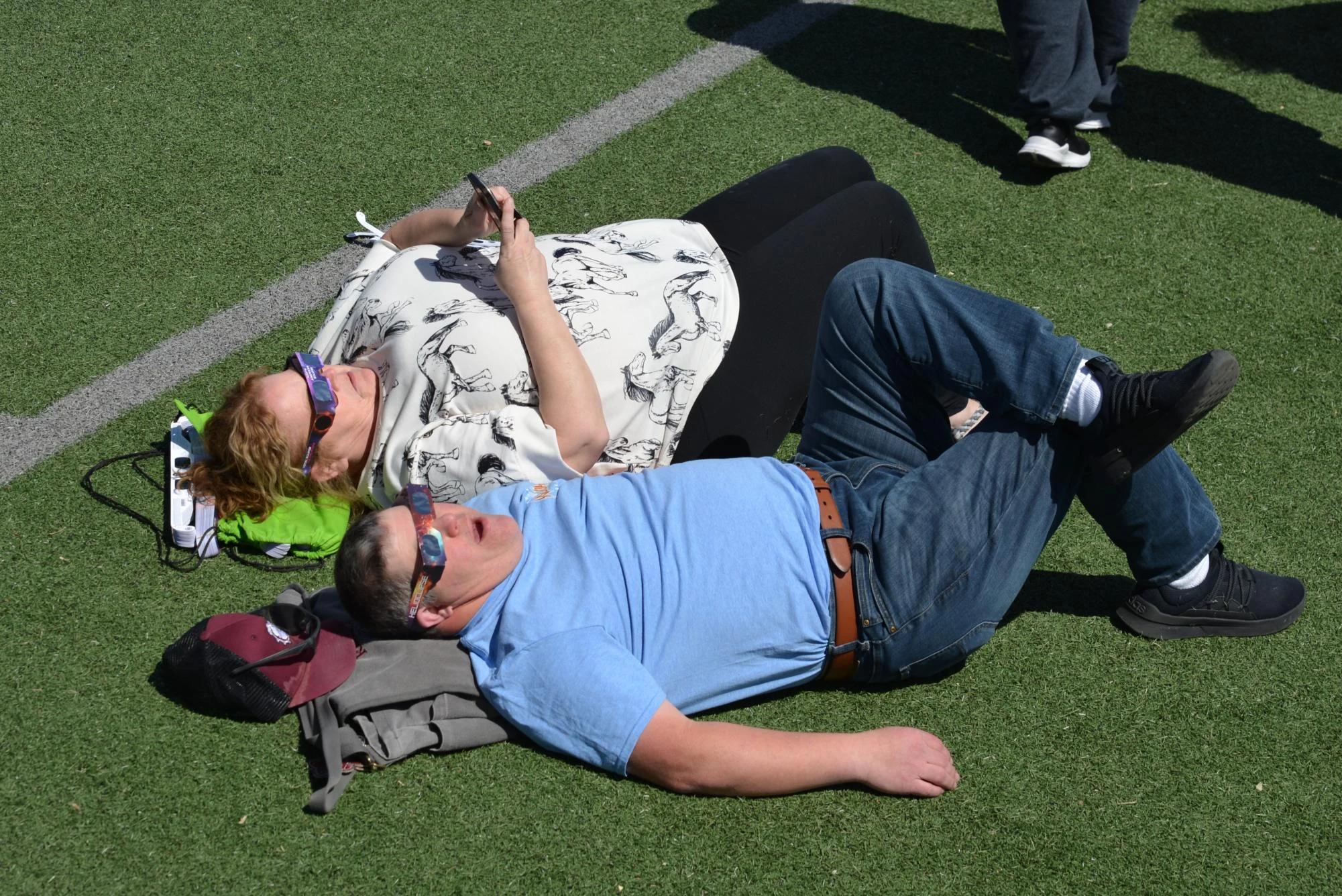
A low, orange, hazy, or deeply eclipsed Sun can still injure your eyes. During every partial phase, look directly at it only through a solar viewer that conforms to ISO 12312-2, or use an indirect method such as pinhole projection. Ordinary sunglasses are not suitable, no matter how dark they appear.
Only observers who are inside the path may remove their viewers during the brief interval when the Moon completely covers the Sun’s bright face. Put them back on immediately when even the first bright point of photosphere returns. Outside the path—including Madrid and Barcelona—there is no glasses-off interval at all. Our phase-by-phase guide is worth sharing with every first-time observer in your group.
Cameras, binoculars, and telescopes require purpose-built solar filters secured over the front aperture. Do not look through unfiltered optics while wearing eclipse glasses: concentrated sunlight can damage the viewer and your eyes. Ask an experienced solar observer for help if magnified observing or photography is part of the plan.
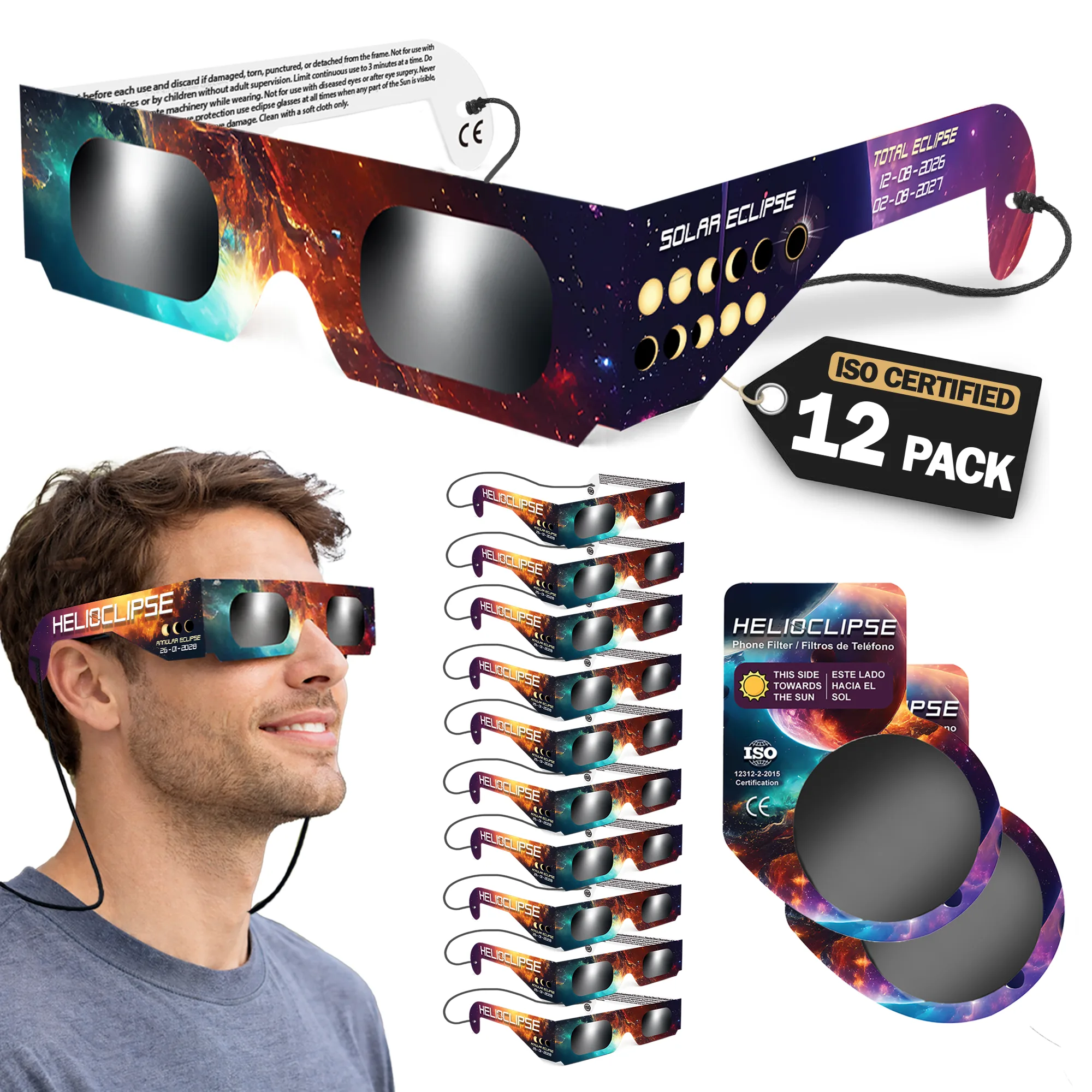
Product wording also deserves precision. NASA does not approve commercial viewer brands, so phrases such as approved solar eclipse glasses or eclipse glasses nasa approved should not be treated as official endorsements. What matters is a trustworthy product, clear usage instructions, an undamaged filter, and documented conformity with the applicable standard. Our ISO 12312-2 certified solar eclipse glasses are the appropriate direct-viewing tool for the partial phases; inspect every pair before use and supervise children.
Listings that say solar eclipse glasses iso 12312-2 certified or simply eclipse viewing glasses still need to be evaluated on evidence and source credibility, not wording alone. Buy early enough to inspect the viewers, practise putting them on before looking up, and give every family or group member the safety instructions before eclipse day becomes hectic.
What your final plan should contain
A strong plan fits on one shared page or message. It should contain the date—August 12, 2026—plus the primary coordinate, two backup coordinates, local contact times from a current map, totality duration, solar altitude and azimuth, horizon notes, access rules, parking arrangements, and a weather decision deadline.
Treat the 2026 solar eclipse Spain low sun western horizon time and site as linked information. A time copied from León cannot safely cue observers near Valencia, and a horizon photograph from the town centre cannot validate a field several kilometres away. Use one consistent pin for every number.
Include a safety callout: viewers on throughout the partial phases; viewers off only after complete coverage is confirmed from inside the path; viewers back on at the first return of direct sunlight. Assign one informed adult to call the transitions for a family or school group, while reminding everyone to respond to what the Sun is actually doing rather than trusting a timer blindly.
Finally, write down the reason for each backup. One may offer a lower horizon; another may sit on the opposite side of a forecast cloud boundary; a third may avoid a motorway bottleneck. That turns a collection of saved locations into a real decision system.
Frequently asked questions
How does the eclipse path determine whether I can see totality?
Totality is possible only inside the narrow path where the Moon completely covers the Sun. In Spain, a location must also have an unobstructed view toward the low west-northwestern Sun, because terrain, buildings, trees, haze, or clouds can block the eclipsed Sun even when the pin is inside the path.
What does the 2026 eclipse path look like across Spain?
The path is a broad band of totality, roughly 300 kilometres wide across Spain, running from the northwest toward the east-southeast. Its boundary is sharp, so a broad map graphic cannot confirm whether a specific address will experience totality; coordinates should be checked.
Can observers in North America see the August 12, 2026 total solar eclipse?
The excerpt does not provide visibility details for North America. It states that the total-eclipse path crosses northern Russia, Greenland, Iceland, the Atlantic, Spain, and a small corner of northwestern Portugal.
What time will the February 17 solar eclipse occur?
The excerpt provides information about the total solar eclipse on August 12, 2026, not an eclipse on February 17. For Spain on August 12, totality occurs late in the evening, when the Sun is already low in the west-northwest.
Where should I go in Spain for the best view of the 2026 total eclipse?
There is no single best city identified in the excerpt. Choose a precise location inside the path of totality with a clear west-northwestern horizon, then consider totality duration, Sun altitude, possible obstructions, cloud risk, traffic, and whether your group can move if needed.
On-site next steps
- Open the Helioclipse Eclipse Explorer and place pins on your exact candidate sites. Check path status, local duration, direction, and timing rather than relying on the nearest city.
- Compare each pin with terrain and an in-person west-northwestern horizon check. Save at least two legal, accessible alternatives before the final forecast period.
- Review the wider August 12, 2026 planning guide with everyone travelling in your group.
- Order Helioclipse solar eclipse glasses early, inspect them for damage, and practise the glasses-on and glasses-off sequence before eclipse day.
Sources & further reading
- NASA Science: Total Solar Eclipse on August 12, 2026
- Space.com: Spain's total solar eclipse 2026 comes with a catch—here's how to avoid ruining your view
- Space.com: Millions could see a rare sunset during the total solar eclipse on Aug. 12, 2026
- NASA Earth Observatory: Stops Along the Path of Totality
- NASA: What’s Up—August 2026 Skywatching Tips
- NASA: Eclipse Viewing Safety
- American Astronomical Society: How to View a Solar Eclipse Safely
- American Astronomical Society: About the ISO 12312-2 Standard for Solar Viewers
- American Astronomical Society: Eclipse Basics
- NASA: Types of Solar Eclipses